REVIEW · BERLIN
Berlin Highlights in 2 Hours: Express Walking Tour
Book on Viator →Operated by Original Berlin Walks · Bookable on Viator
Two hours can change how you see Berlin. This express walk strings together major turning points in Germany’s 20th-century story, from the Cold War border sites to the Holocaust memorials, with a guide keeping you on a steady track. I love the small-group size (max 25) and that each stop is free to enter, so your money stays focused on the storytelling. The one drawback is simple: 10-minute stop times mean you won’t have long stretches for quiet reflection, especially at the memorials.
I also like that the route starts at Pariser Platz 1 and ends near Checkpoint Charlie, so you can keep moving afterward without doubling back. Guides such as Ryan, Gregor, Dylan, and Giles are singled out for being clear, engaging, and responsive to questions, which matters when the topic is heavy. It’s offered in English with a mobile ticket, and it’s built for most travelers since the pace is kept appropriate for mixed-age groups.
In This Review
- Key Highlights You Will Feel Immediately
- Two Hours of Big Meaning, Done the Practical Way
- Where You Start and Finish (And Why It Matters)
- Pariser Platz and Brandenburg Gate: Unity, Architecture, and a Loaded Square
- The Reichstag Building: Government, Upheaval, and Visual Clues
- Two Memorial Stops That Demand Respect: Sinti and Roma + the Holocaust Memorial
- Fuhrerbunker: The Last Days, Explained Clearly
- The Reich Air Ministry to the Federal Ministry: How Buildings Change Hands
- The Berlin Wall at Niederkirchnerstraße: Escape Attempts and Daily Life
- Topography of Terror and Checkpoint Charlie: From SS Headquarters to Cold War Crossings
- Price, Pace, and Group Size: Is $21.77 Worth It?
- Who Should Book This Tour (And Who Might Skip It)
- Should You Book This Berlin Highlights Express Walk?
- FAQ
- How long is the Berlin Highlights in 2 Hours walking tour?
- How much does the tour cost?
- Is the tour offered in English?
- What’s included for entry tickets at the stops?
- Where does the tour start and where does it end?
- Do I get a mobile ticket?
- How big is the group?
- What is the cancellation window?
Key Highlights You Will Feel Immediately
- Small-group focus (up to 25): easier questions, less waiting around, and a more personal rhythm.
- Every stop is entry-free: you pay for the walk and the explanations, not add-on ticket costs.
- You cover both Cold War and Holocaust landmarks: major sites in one tight loop.
- A guide turns stone into context: from Hitler’s bunker to SS and Gestapo headquarters.
- Free time after the walk: the express format helps you build the rest of your Berlin day.
Two Hours of Big Meaning, Done the Practical Way
Berlin can feel endless on foot, especially when you want the big sights without committing to half a day. This tour is designed for exactly that: you get a guided route through central Berlin’s most important 20th-century sites in about two hours, then you’re free to wander on your own.
If you like learning with a purpose, you will appreciate the way the stops connect. The story moves from symbols of unity and power, to memorials of mass murder, to the mechanics of dictatorship, and finally to the Cold War line that split the city. It’s not just photo stops; it’s a sequence meant to help your brain organize what you see.
There’s also value in paying for a group walk instead of trying to self-plan everything between scattered sites. For $21.77, you’re not just buying access to locations. You’re buying time with a guide who can explain what you are looking at, why it mattered, and how Germany talks about it now.
You can also read our reviews of more walking tours in Berlin



Where You Start and Finish (And Why It Matters)

You begin at Pariser Platz 1 and end at Checkpoint Charlie (Friedrichstraße 43–45). That matters more than it sounds. Starting at Pariser Platz puts you right in the Brandenburg Gate area, and ending at Checkpoint Charlie drops you at one of Berlin’s most central, tourist-friendly nodes for continuing your day.
The tour also runs near public transportation, which is a lifesaver in a city where you can otherwise lose time getting from one “must-see” to the next. With a mobile ticket, you also avoid the little hassle of printing or figuring out paperwork on the spot.
And because the tour is only about two hours, you can pair it with museums, viewpoints, or dinner plans without the anxiety of getting stuck on a long schedule. That shorter commitment is one reason this walk works so well for first-timers and for anyone who wants structure without a full-day tour.
Pariser Platz and Brandenburg Gate: Unity, Architecture, and a Loaded Square
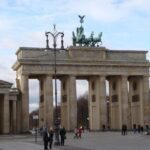
Your first stop is Brandenburg Gate, then you walk along Pariser Platz. This is the part where Berlin looks confident and composed, framed by neoclassical buildings and an open square that draws people in immediately.
It helps to see Brandenburg Gate early, because you’ll soon realize how often symbols get used and reused in German politics. A guide’s job here is to point out what you are seeing on the surface—then hint at the darker chapters that came later. It’s a quick start, but it sets your expectation: this tour is going to keep connecting place to meaning.
A practical note: since the stop time is short, come prepared with comfy walking shoes and a willingness to move. If you want long photo sessions right at the gate, you may need to do that on your own after the tour.
The Reichstag Building: Government, Upheaval, and Visual Clues
Next you approach the Reichstag Building, Germany’s parliamentary landmark. Even if you mostly notice its exterior from the street, there’s a lot to absorb once someone explains the layers behind it.
You’ll hear how the Reichstag connects to the Weimar Republic and to Germany’s political life up to today. The value of having a guide here is that you can read the building like a timeline rather than just a big impressive facade.
The potential drawback is the same express-tour tradeoff: you’re not lingering long enough to go deep into architecture at a slow museum pace. Still, if your goal is to get orientated fast and understand the key chapters, this stop does a good job pointing you toward what to notice later.
Two Memorial Stops That Demand Respect: Sinti and Roma + the Holocaust Memorial
Then the tour shifts tone, and it stays serious. You visit the Memorial to the Sinti and Roma Victims of National Socialism, and then you reach the Memorial to the Murdered Jews of Europe.
At the Sinti and Roma memorial, the guide’s focus is remembering the thousands of Sinti and Roma people who were persecuted and killed. This matters because these stories are often less familiar to many visitors than other Nazi victim narratives. Even in a short time, you can leave with a clearer sense of who was targeted and why remembrance is part of how Germany faces its past.
The Holocaust memorial is a different experience. The concrete slabs form a maze-like space that invites you to slow your thoughts, even if your schedule doesn’t allow long pauses. The guide will explain the idea behind walking through it and why the design feels unsettling.
Here’s the key consideration for your planning: this is emotional ground. If you tend to find memorials hard to handle, build in extra time afterward for a breather. If you’re visiting with family or friends, agree beforehand that you may not want to chat much during the memorial stops.
A few more Berlin tours and experiences worth a look

Fuhrerbunker: The Last Days, Explained Clearly
You stand near Fuhrerbunker, where your guide describes Hitler’s final days of World War II, including his suicide on April 30, 1945. This stop is heavy, but it’s also useful because it turns an abstract event into a place-based story.
Berlin has many sites tied to the Nazi era, but not all of them communicate the end of the regime the same way. A good guide connects the location to the timeline: the collapse, the frantic final moments, and how Germany today confronts and reflects on what happened.
Because it’s an express tour, you are moving on quickly. But the value is that you get oriented fast and you know what questions to ask later, whether that’s about the bunker area itself or about how postwar Germany built a culture of memory and responsibility.
The Reich Air Ministry to the Federal Ministry: How Buildings Change Hands
One of the most interesting stops is the Aviation Ministry of Berlin, which your guide links to the former Reich Air Ministry and Luftwaffe headquarters. You then learn how the same complex was later used by East Germany’s government and now houses the Federal Ministry of Finance.
This is where the tour makes a very practical point: buildings outlast regimes. The stones don’t forget. Politics changes the people inside, but architecture keeps witness, and the city keeps reusing space.
You will likely see how Nazi-era construction, East German use, and today’s federal government all sit in the same urban footprint. It helps you understand Berlin as a living archive: layers stacked in one place, not sealed behind museum walls.
If you love history you can touch, this stop earns its place. If you only want cheerful sights, this one might feel like a reminder that nothing in Berlin is purely decorative.
The Berlin Wall at Niederkirchnerstraße: Escape Attempts and Daily Life
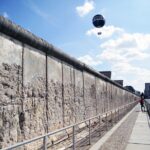
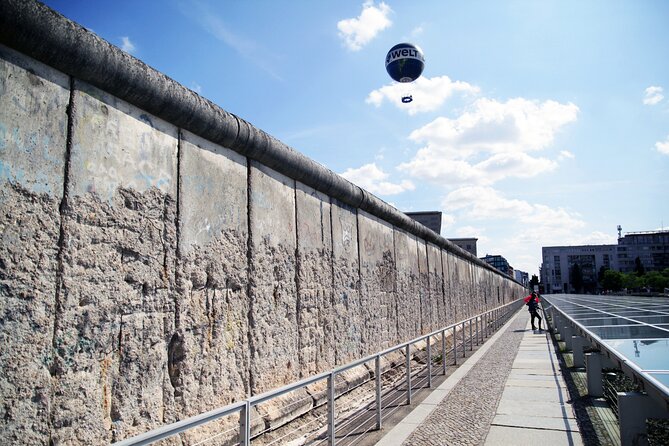
Then you head to Niederkirchnerstraße, where you see a preserved section of the Berlin Wall. The guide tells gripping stories about daring escape attempts—both the successes and the tragic failures—and what divided daily life meant for people on East and West sides.
This stop is powerful because the Wall is not just a concept anymore. Even in a short time, you can visually register the barrier and then let the guide’s examples put a human scale onto the concrete.
The express format means you won’t hear every story in full detail, but you’ll still walk away with a clearer sense of what the city’s division actually looked like on the ground. And once you understand the mechanics of separation, you start noticing them everywhere you go in Berlin.
Tip for your own comfort: if you prefer less intense storytelling, you might want to keep your expectations realistic. The Wall section and the escape stories are designed to hit hard, and that’s part of why the tour is worth doing.
Topography of Terror and Checkpoint Charlie: From SS Headquarters to Cold War Crossings
After the Wall, you visit Topography of Terror, the historic site connected to SS, Gestapo, and SD headquarters in Nazi Germany. Today, it’s home to the Topography of Terror exhibition, offering a direct way to understand atrocities committed during World War II.
Even without spending long hours in an exhibition setting, the guided framing helps you make sense of what happened here. The value is not only that you learn facts, but that the guide helps you understand how systems were built, how fear worked, and why remembering is part of preventing repetition.
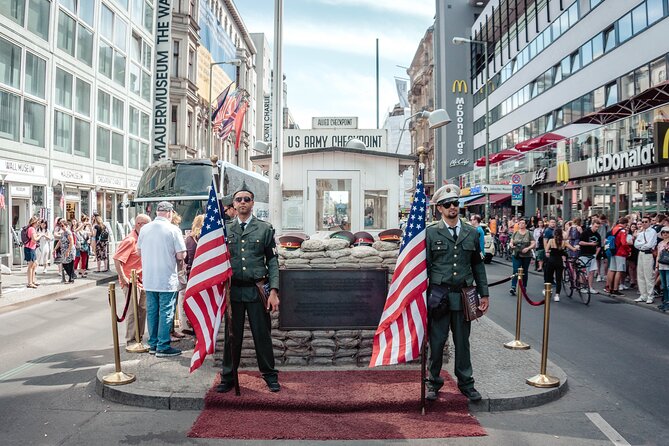
Finally, you end at Checkpoint Charlie, one of the most famous border crossing points during the Cold War. The guide ties it together with tales of espionage and escape attempts, which creates a strong closing loop: Berlin as a place where control was enforced, and where people tried to break free.
Ending at Checkpoint Charlie is also practical. You get a clear endpoint that is easy to continue from, whether you’re heading to a museum, grabbing food, or setting your next walk.
Price, Pace, and Group Size: Is $21.77 Worth It?
At $21.77 per person for about two hours, you’re paying for guided interpretation plus coverage of major central sites, with admission ticket free for the stops included. That combination matters in a city where solo sightseeing can turn into lots of small costs and lots of wasted time.
The biggest value is the guide-led connections. It’s one thing to see a memorial or a famous building. It’s another to understand how each place fits into the broader story—especially for topics like the Holocaust, Nazi power structures, and the Cold War split.
Pace is the tradeoff. This is an express tour, and each stop is around 10 minutes. If you enjoy rapid orientation and then want to explore more deeply afterward, this format is a win. If you want slow, quiet, lingering time at each memorial, you may find the schedule too tight.
Group size is limited to 25, which keeps things moving but still lets you ask questions. Some experiences even end up feeling smaller in practice, which can make the conversation more personal. Either way, you should expect clear, organized pacing rather than wandering.
Who Should Book This Tour (And Who Might Skip It)
You should book this if you:
- want a fast route through Berlin’s most important 20th-century landmarks
- like structured learning with a guide instead of trying to self-assemble the story
- want to get back out on your own after two hours, not after half a day
You might skip it if you:
- need long reflection time at memorials
- prefer light, low-emotion sightseeing only
- plan to cover the topic in extreme depth with multiple museum hours (this walk is built for orientation)
It’s also a good choice if you’re traveling in English and want everything set up with a mobile ticket. Service animals are allowed, and it’s described as suitable for most travelers, which usually means the walking is manageable.
If you’re deciding when to book, note that it’s often booked around 12 days in advance on average. If your schedule is tight, booking sooner reduces the odds of missing the slot you want.
Should You Book This Berlin Highlights Express Walk?
Yes, if your goal is orientation with meaning. This is one of those tours where you leave with a mental map, not just photos. The best part is how the guide turns major sites—Brandenburg Gate, the Reichstag, two Holocaust-related memorial spaces, Fuhrerbunker, Nazi-era administrative power, the Wall, Topography of Terror, and Checkpoint Charlie—into a connected storyline.
If you want a relaxing, casual stroll, you might find the subject matter intense and the timing a bit rushed. But if you’re willing to move quickly, listen carefully, and then take your own time afterward, you’ll likely feel you got a lot of value for your money.
FAQ
How long is the Berlin Highlights in 2 Hours walking tour?
It runs for approximately 2 hours.
How much does the tour cost?
The price is $21.77 per person.
Is the tour offered in English?
Yes, it is offered in English.
What’s included for entry tickets at the stops?
The stops listed all show admission ticket free.
Where does the tour start and where does it end?
It starts at Pariser Platz 1, 10117 Berlin, Germany and ends at Checkpoint Charlie, Friedrichstraße 43–45, 10117 Berlin, Germany.
Do I get a mobile ticket?
Yes, the tour uses a mobile ticket.
How big is the group?
The maximum group size is 25 travelers.
What is the cancellation window?
You can cancel up to 24 hours in advance for a full refund.