REVIEW · AMSTERDAM
Absolutely Amsterdam – the Essential Introductory Walking Tour
Book on Viator →Operated by FreeDam Tours · Bookable on Viator
Amsterdam makes sense on foot. This small-group walk strings together Amsterdam’s key sights and big themes, from money and water to tolerance and trade, all inside the UNESCO-listed canal core.
What I like most is the easy, steady pace that keeps it friendly for first-timers, plus the storytelling style that turns each landmark into something you can remember. And I also appreciate that the tour is built as an intro you can keep using later in your trip, not a one-and-done checklist.
One thing to consider: a couple of major photo/learning stops are outside the paid admission zones, so you may want to budget separately (or just enjoy the exterior views) if you’re curious about what’s inside.
In This Review
- Key highlights at a glance
- A Small-Group Walk That Makes Amsterdam Click
- Price and value: why $5.93 can still feel meaningful
- Starting at Beursplein: the story of water and finance
- Damrak and the roots behind the Red Light District
- Ons’ Lieve Heer op Solder: tolerance without the door being opened
- Chinatown and Dutch drug policy: the coffeeshop effect
- The Waag and Rembrandt’s first major leap in portrait art
- Oostindisch Huis: the Golden Age trade empire (and the shadow)
- Waterlooplein Market and the Jewish Quarter after WWII
- The Amstel and canal-house clues you can spot right away
- Oudemanhuispoort and bike culture that actually makes sense
- Royal Palace Amsterdam on Dam Square: republic to monarchy
- What it’s like on the ground: pace, group size, and guide style
- Who should book this tour?
- Should You Book Absolutely Amsterdam – the Essential Introductory Walking Tour?
- FAQ
- What is the duration of the Absolutely Amsterdam walking tour?
- Where does the tour start?
- Is the tour offered in English?
- How many people are in a group?
- Are admission tickets included for the stops?
- Do you enter the hidden church at Ons’ Lieve Heer op Solder?
- How much walking is involved?
- Is there an admission fee for Damrak or Chinatown?
- What is the cancellation policy?
Key highlights at a glance
- Small group (max 15): easier questions, less bumping around on tight streets
- UNESCO core on foot: you see the city’s “why” as you walk its “what”
- Tolerance in real places: religion, law, and everyday life tied to specific stops
- Canal-house details: why buildings lean, why they’re skinny, and why you see curtains
- Golden Age trade stories (with a serious side): money-making and its consequences
- First-timer friendly flow: about 2.5 hours with short, manageable segments
A Small-Group Walk That Makes Amsterdam Click
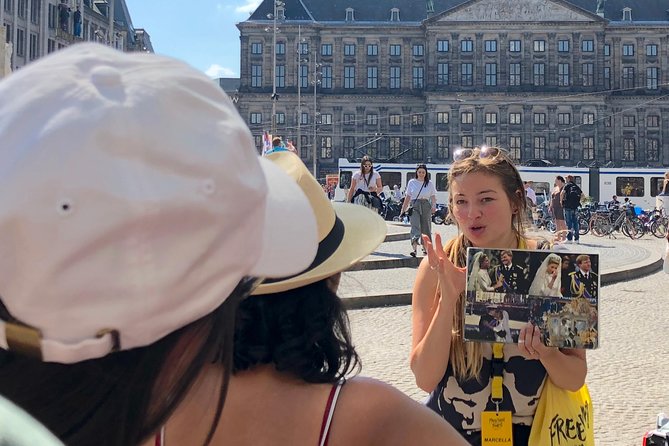
Amsterdam can feel like a puzzle at first: canals, bikes, narrow streets, big landmarks that seem disconnected. This tour does the opposite. It gives you a thread. You start at Beursplein and work your way through the city’s center so you understand how water, trade, religion, and politics shaped what you see today.
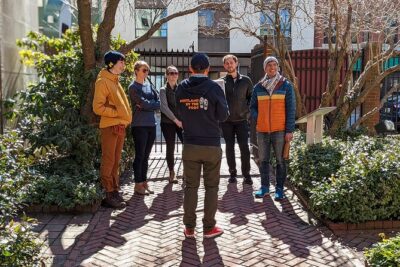
The group stays small enough that the guide can keep moving without rushing you off every corner. You’re not just standing for photos—you’re listening to short explanations that help you read the buildings, the layout, and the changing neighborhoods. If you like getting your bearings fast, this is one of the smartest ways to do it.
You can also read our reviews of more walking tours in Amsterdam

Price and value: why $5.93 can still feel meaningful
At around $5.93 per person, this feels almost too low for a full walking tour. The value is in the structure: about 2 hours 30 minutes, roughly ten stops, and clear time at each point. You also get a “pay-what-you-want” vibe with tipping, which can matter if you want to show appreciation for good guiding.
What you’re not buying is an included museum ticket at every stop. A few entries aren’t included, so the price works best if you’re happy to view some places from the outside or with photos, then decide later if you want to return with an admission ticket.
Starting at Beursplein: the story of water and finance
The tour begins at Freedam Tours, Beursplein 5, near Beurs van Berlage, and your first stop anchors the whole day. This area sits in a location tied to Amsterdam’s relationship with water, including where the old Amtel river used to flow.
From here, you get the “why” behind the city’s growth. Amsterdam didn’t rise on luck. It rose because of trade and the systems that managed it—especially finance. This first explanation sets the tone: every next stop will connect back to how people made money, organized society, and justified power.
Practical tip: this is a good moment to ask your guide how long you should plan for each theme later, like canals vs. Jewish history vs. art. Starting with a map-in-your-head usually makes the rest of your trip easier.
Damrak and the roots behind the Red Light District
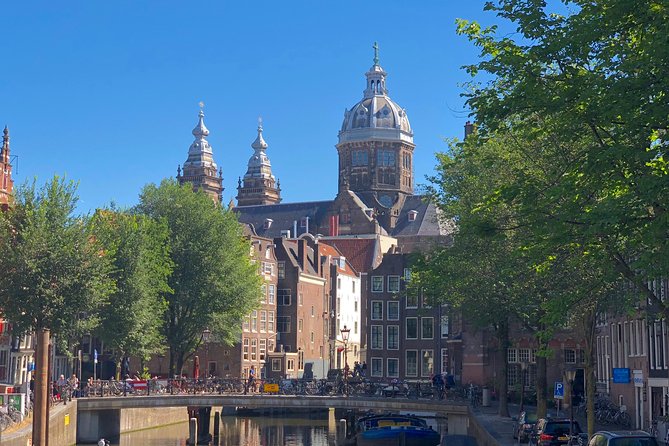
Next comes Damrak, the old harbor area where you start hearing the layered origins behind the Red Light District. The guide connects it to two big forces you’ll keep seeing throughout Amsterdam: the role of the Church and the way “holy” and “profane” economies have overlapped over time.
You also get a focused look at prostitution’s legal status in the 20th and 21st centuries, including how and why it became formalized as a profession, and what changed in the neighborhood as decades passed. That’s not light gossip. It’s a quick way to understand why Amsterdam has a famously permissive reputation—and how that reputation is tied to policy, not just nightlife.
Consideration: Damrak can be busy. If your schedule allows, plan for crowded sidewalks and keep your pace calm. The guide’s job is to move the group through without getting stuck.
Ons’ Lieve Heer op Solder: tolerance without the door being opened
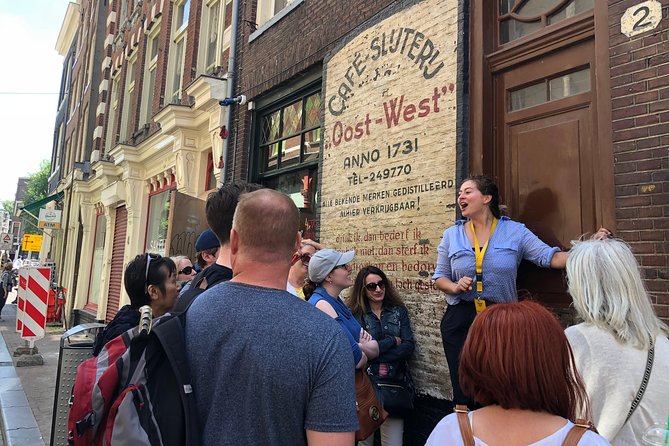
At Our Lord in the Attic Museum, you get a story of religious tolerance that isn’t only “nice intentions.” It’s about how tolerance worked under pressure once Catholicism became illegal in the 17th century.
Here’s a key detail: you don’t actually enter the hidden church. Instead, you see it from the outside and get photos of the interior. That still works for most visitors because it shows the architectural trick—how secrecy and compliance coexisted. You also connect it to the idea of tolerance today, in the 21st century.
This stop is short, around 15 minutes, so it works best as a primer. If you feel curious enough to want the full museum experience, you’ll likely want a separate visit with admission.





Chinatown and Dutch drug policy: the coffeeshop effect
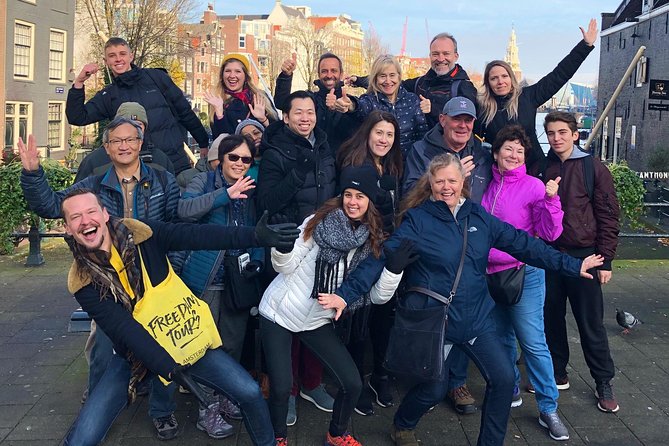
You then head into Chinatown, but the point isn’t food shopping. It’s policy and cause-and-effect. The guide explains Dutch drug policies and how this area became a near no-go zone in the 1970s. From there, you hear how the coffeeshop system—focused on selling marijuana—emerged.
This is one of those stops that changes how you interpret what you see on Amsterdam streets. Instead of judging from stereotypes, you learn the behind-the-scenes logic that shaped enforcement and public order. It also helps you understand why Amsterdam has a reputation for compromise: not because rules are vague, but because the city often tries to manage reality rather than ignore it.
If you’re the type who likes how cities work politically, this is a highlight.
The Waag and Rembrandt’s first major leap in portrait art
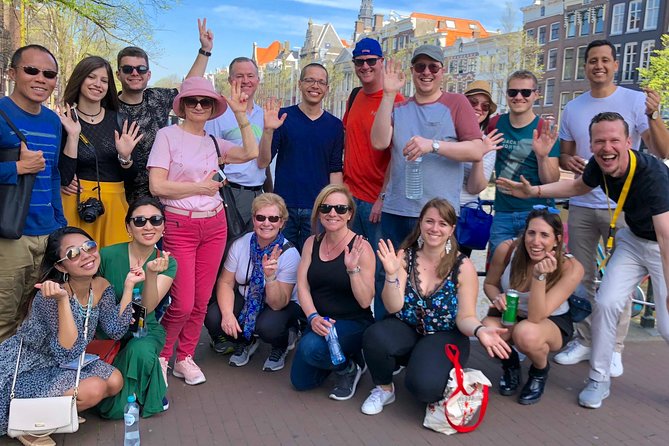
At The Waag, you get an art stop with a twist: the guide talks about where Rembrandt painted his first major work and how that changed portrait-making. There’s a visual element too: a copy of the painting is shown so you can spot details rather than just hearing a lecture.
This is great for visitors who don’t want “art school” but still want real context. Ten minutes is tight, so the guide focuses on the most important idea: what was different about the portraits and why it mattered.
Note: admission isn’t included here, so if you want to go inside and see more, plan it as a separate add-on based on your interest level.
Oostindisch Huis: the Golden Age trade empire (and the shadow)
The tour then moves into Oostindisch Huis, a famous 17th-century setting with a courtyard that’s hard to access on your own. You get to learn how Amsterdam became the hub of a global trading empire, and how that Golden Age made the city extraordinarily wealthy.
But the guide doesn’t pretend the story is clean. You’ll hear the good parts and also the darker legacy of the period. That’s the right balance for an intro tour. Wealth didn’t appear by magic, and the same systems that built power also produced harm.
You’ll spend about 15 minutes here. It’s also the kind of stop where a good guide can do real work—connecting what you’re looking at (courtyard, architecture, location) with the economics that created it.
If you’ve got limited time in Amsterdam, this stop is a smart use of it.
Waterlooplein Market and the Jewish Quarter after WWII
Next: Waterlooplein Market, located in the former Jewish Quarter. The guide explains how the area was nearly destroyed at the end of the Second World War—not for the reason most people guess.
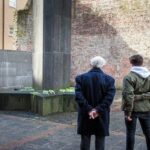
You then get a clear look at the consequences of Nazi occupation, the decimation of Jewish populations across Europe, and what surviving life meant during the last Hunger Winter of the war. This stop takes about 15 minutes, and it lands because it connects place to people, not just buildings to dates.
If you want a respectful, fact-forward way to start understanding Amsterdam’s WWII story, this part does it without getting overly heavy.
The Amstel and canal-house clues you can spot right away
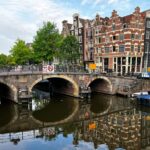
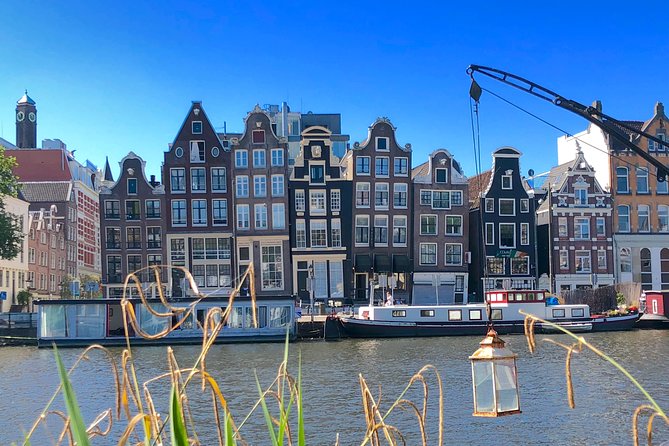
Now you shift into sightseeing mechanics. At the Amstel (or sometimes another canal depending on weather and the guide’s route), you learn why Amsterdam has canals and how to read canal houses like a local.
You’ll get explanations for:
- why many canal houses look skinny,
- why they lean in odd ways (some of it is intentional),
- why buildings have a hook,
- and why Dutch people keep curtains open so often.
This stop is more than fun trivia. It teaches you how to look. After this, you’ll start seeing clues everywhere. Even if you’ve visited Amsterdam before, this kind of “how to read the street” guide refreshes your eye.
Oudemanhuispoort and bike culture that actually makes sense
At Oudemanhuispoort, you visit a former monastery turned hospital and now part of the University of Amsterdam. Then the guide pivots to something you’ve already noticed: bike culture.
You learn why there are so many bikes compared to people and why the bikes often look so… practical. The point isn’t judging style. It’s understanding how infrastructure, daily habits, and civic pride create a city where cycling feels normal.
This stop lasts about 10 minutes and works well because it keeps you moving while still giving you a concrete explanation for the phenomenon you’ll see constantly.
Practical note: bike traffic can be intense. Keep your head up at crossings, and follow the guide’s timing when moving through busy intersections.
Royal Palace Amsterdam on Dam Square: republic to monarchy
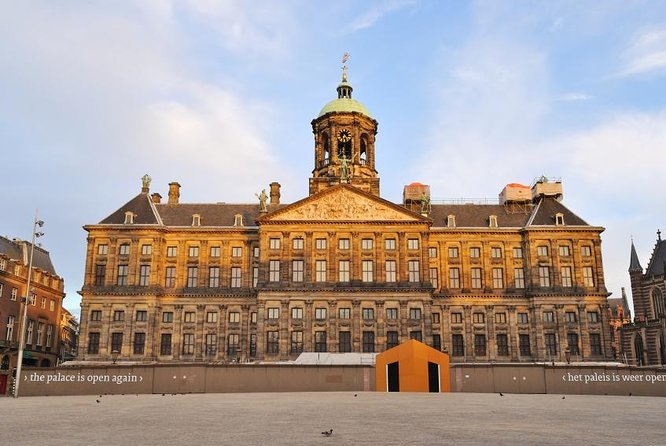
The final stretch heads to Royal Palace Amsterdam at Dam Square. This is where you get the political arc: a quick overview of why and how the Netherlands shifted from a republic to a monarchy, and an introduction to the current Royal Family with pictures.
Yes, there’s room for lighter “juicy” context, but the core goal is orientation: you finish knowing what Dam Square represents, not just that it’s where you take photos.
This stop is about 15 minutes. Admission isn’t included, so if you want interior rooms, you’ll need to plan separately.
What it’s like on the ground: pace, group size, and guide style
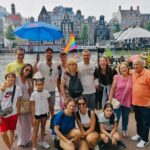
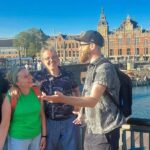
You’ll walk a lot, but the stops are timed so you’re not stuck for long stretches without breaks. The tour is designed for most people, and the maximum group size is 15, which helps keep the route manageable.
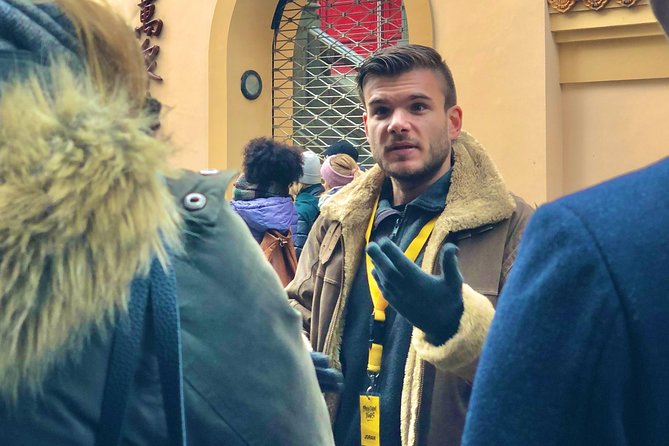
The quality theme in the guide feedback is consistent: humor, storytelling, and visuals. Guides named in feedback include Gianni, Jaap, Esi, Sergio, David, Raymond, Samuel, Fernando, Dani, Ramses, Sebastien, Alexander, and Roman—and the common thread is that they make the details easier to hold onto. Some guides also use maps and visual aids, which can be a big help if your brain works better with images than just speech.
If you’re sensitive to noise, crowded sidewalks, or constant bicycle flow, you’ll still be okay, but it helps to wear comfortable shoes and stay patient at busy junctions.
Who should book this tour?
This is a strong fit if you:
- are in Amsterdam for the first time and want a coherent orientation,
- like history that connects to street-level life,
- want UNESCO-area highlights without buying a stack of tickets right away,
- enjoy guides who explain with humor and clear structure.
It’s also useful if you’ve been to Amsterdam before. Even “repeat” visitors can pick up a new angle—especially the canal-house explanations and the policy-to-neighborhood links.
If you’re only interested in one narrow theme (say, just art museums or just canals), you might prefer a more specialized day. But for an intro, this tour is built for broad understanding.
Should You Book Absolutely Amsterdam – the Essential Introductory Walking Tour?
I’d book it if you want an efficient first move in Amsterdam. For a low price, you get a long-enough walk to cover the main landmarks, plus explanations that help the city make sense. The pacing is friendly, the group stays small, and the stops cover big themes you’ll bump into during the rest of your trip: finance, tolerance, trade, WWII survival, canals, bikes, and monarchy.
Skip it only if you don’t want policy-and-society stories or you’d rather spend that time inside paid attractions. In that case, you might regret spending your limited hours on exterior views.
If you’re deciding between this and going out on your own, the guided link between places is the whole point. It helps you look better, walk with less guesswork, and plan return visits with much better instincts.
FAQ
What is the duration of the Absolutely Amsterdam walking tour?
It runs for about 2 hours 30 minutes.
Where does the tour start?
The meeting point is Freedam Tours, Beursplein 5, 1012 GZ Amsterdam, Netherlands.
Is the tour offered in English?
Yes, the tour is offered in English.
How many people are in a group?
The tour has a maximum of 15 travelers.
Are admission tickets included for the stops?
Some stops have admission included (free), and some do not. The Ons’ Lieve Heer op Solder stop is listed as not included, The Waag is not included, and the Royal Palace Amsterdam stop is also not included.
Do you enter the hidden church at Ons’ Lieve Heer op Solder?
No. The tour notes that you do not enter the hidden church; you see it from the outside and view pictures of the interior.
How much walking is involved?
It’s a walking tour with frequent short stops. The pace is described as manageable, but you should still wear comfortable shoes.
Is there an admission fee for Damrak or Chinatown?
Those stops are listed as free in the tour schedule.
What is the cancellation policy?
Free cancellation is available. You can cancel up to 24 hours before the experience for a full refund; canceling within 24 hours does not receive a refund.
If you want, tell me your travel dates and how many days you have in Amsterdam, and I’ll suggest what to see next after this tour so it fits your schedule.