REVIEW · BOSTON
Downtown Freedom Trail, Beacon Hill & Back Bay Walking Tour
Book on Viator →Operated by Boston CityWalks · Bookable on Viator
Boston history walks past fast.
This Downtown Freedom Trail + Beacon Hill + Back Bay tour is a smart way to cover a lot of Boston without feeling like you’re rushing, thanks to a small group pace and a guide who keeps the story moving. You’ll start near the Old State House, follow the Freedom Trail corridor of Revolutionary-era stops, then continue into the classic neighborhoods that look like postcards but are really living city streets.
I particularly like how the route links street scenes to specific chapters of the U.S. story, with guides such as Allan (and Chris) praised for answering questions and using humor to make facts stick. I also like that you don’t just stare at buildings—you get visual and cultural “targets” along the way, from the Faneuil Hall area and state houses to the Swan Boats and Copley Square landmarks. One possible drawback: finding your guide can be a little tricky at the start, and timing can get affected by crowds or questions, so I’d keep a buffer if you have tight reservations right after the tour.
In This Review
- Key things you’ll notice on this walk
- Starting at Old State House: setting your bearings for Boston
- Freedom Trail from Faneuil Hall to Boston Common: more than red-brick sightseeing
- Faneuil Hall, Quincy Market, and the civic center feel
- Old State House and the Boston Massacre site
- Churches, meeting houses, and cemeteries that show what mattered
- A city of small details (including a tiny suspension bridge)
- Beacon Hill and its iconic street cues: Federal-style and character
- Boston Public Garden and Back Bay’s big idea: how the city got made
- Boston Public Garden: Swan Boats, ducklings, and a science footnote
- The Back Bay landfill transformation (and why it matters when you walk)
- Commonwealth Avenue and Newbury Street: the Back Bay streets you’ll remember
- Copley Square and the Boston Marathon Finish Line: a strong finish
- Price and logistics: what $65 buys in real-world value
- Who should book this tour—and who might want a different pace?
- Tips to get the most out of the walk
- Should you book Downtown Freedom Trail, Beacon Hill & Back Bay?
- FAQ
- How long is the Downtown Freedom Trail, Beacon Hill & Back Bay walking tour?
- Where does the tour start and what time does it run?
- How much does the tour cost?
- What language is the tour offered in?
- What’s included in the tour price?
- Do the stops require paid admission?
- Is the tour suitable for families and kids?
- How big is the group?
- Does the tour run in bad weather?
- What happens if I cancel?
Key things you’ll notice on this walk
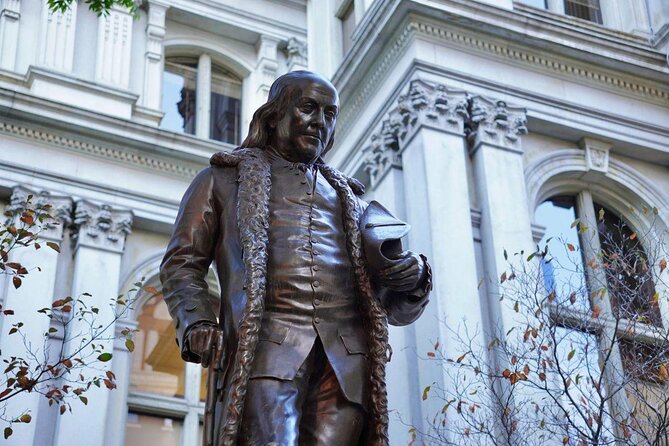
- Old State House to Faneuil Hall to Boston Common: the tour tracks the Revolutionary core with clear stops and context.
- Small “downtown-to-neighborhood” rhythm: it’s not just the Freedom Trail; you also get Beacon Hill and Back Bay street-level views.
- Public Garden moments you can’t miss: Swan Boats, Make Way for Ducklings statues, and even the ether monument are part of the story.
- Back Bay’s big idea explained: the landfill-to-land transformation is tied directly to what you see today.
- Ceremonial Marathon finish-line pass: you’ll end near the Boston Marathon Finish Line at Copley Square.
- All-weather walking, maximum 20: you’ll want to dress for wind and uneven sidewalks, but the group size stays manageable.
Starting at Old State House: setting your bearings for Boston
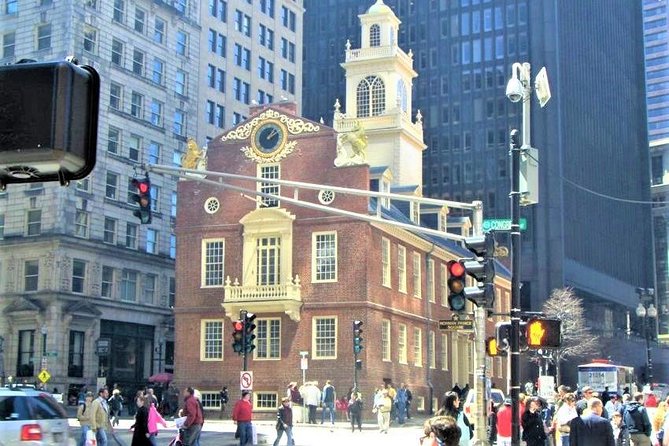
The tour kicks off at Citizens28 State St, with the meeting point across from Boston’s Old State House area. This matters because your first few steps are about orientation: where you are, what period you’re in, and why these particular streets became the spine of the city.
From the start, you’re meant to walk with purpose. This is not a “random highlights” stroll. The Freedom Trail segment sets the tone with a chain of landmarks that, together, explain how colonial Boston turned into a Revolutionary hub. If you’ve visited Boston before, this route still helps you connect dots fast—because it keeps the story anchored to real addresses you can picture later.
Practical tip: arrive a bit early and be ready to check the street corner where your group is gathering. A few reviews point out that locating the guide right away can be harder than it sounds, especially when pedestrians are flowing and everyone’s trying to match details on the same morning.
You can also read our reviews of more walking tours in Boston

Freedom Trail from Faneuil Hall to Boston Common: more than red-brick sightseeing
This is the heart of the experience: a walking arc from the Faneuil Hall/Quincy Market zone through the classic Revolutionary-era stops down to Boston Common.
Faneuil Hall, Quincy Market, and the civic center feel
You begin in the Faneuil Hall orbit. The tour doesn’t treat this as a static tourist photo spot. It frames Faneuil Hall as a working civic landmark, the kind of place where public life and public decisions happened. Quincy Market comes along as the downtown echo of that same “people gather here” tradition—busy today, but rooted in the idea that Boston streets are meant for crowds.
Old State House and the Boston Massacre site
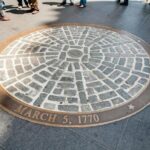
Next you move through the Old and New State House areas. The Old State House stop sets up the Revolution-era tension: this is where government and power were visible, not abstract. Then you reach the site tied to the Boston Massacre. Even if you’ve heard the event before, hearing it in the context of the streets and buildings gives it a sharper edge.
Churches, meeting houses, and cemeteries that show what mattered
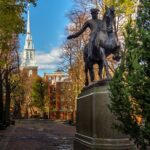
You continue past stops such as Old South Meeting House, Old Corner Bookstore, King’s Chapel, and Old Granary Cemetery. These sound like a list until your guide ties them to how Boston’s community life worked—meeting places, preaching spaces, and institutions that shaped what people believed and discussed.
Then there’s Park Street Church and the New State House, followed by Boston Common. Common space is important here: Boston Common isn’t just pretty greenery. It’s part of the same story of public life and shared ground. By the time you reach it, you’ve walked through the political, religious, and social “framework” that helped drive the era.


A city of small details (including a tiny suspension bridge)
As you transition out of the dense trail segment into the broader downtown-to-neighborhood stroll, you’ll catch quick glimpses of old Boston traits inside a modern skyline. One standout is a moment with one of the world’s smallest suspension bridges—exactly the kind of thing you’d miss if you were only following a map.
This portion is a good reminder: Boston isn’t one aesthetic. It’s layers, stacked. The tour helps you see that without making it complicated.
Beacon Hill and its iconic street cues: Federal-style and character
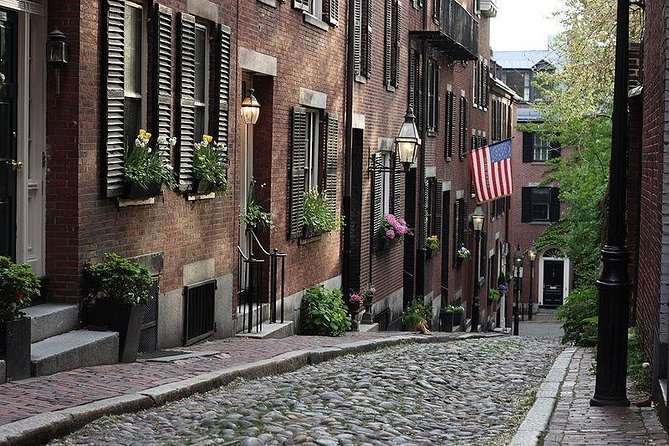
After the downtown Freedom Trail spine, the tour shifts into Beacon Hill. This neighborhood has a very specific look, and the tour points you to the cues that make it feel like Boston’s “old money meets old brick” chapter.
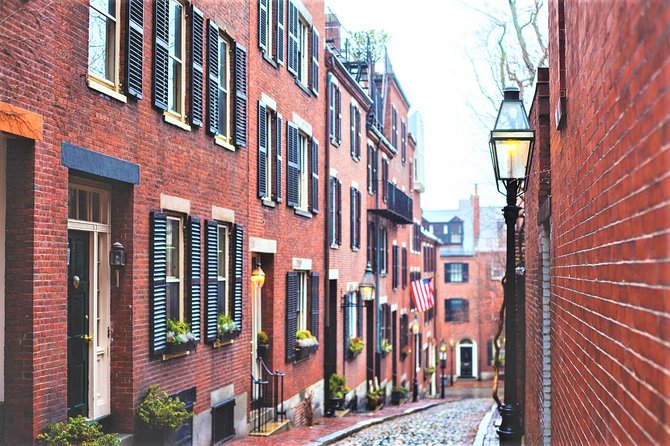
You’ll pass Beacon Hill where Boston aristocracy lived and notice Federal Style architecture. Your guide also calls out familiar Beacon Hill markers such as Frog Pond, Purple Windows, and the gas lamps.
Here’s what I like about this part: it’s not treated as museum wallpaper. It’s street-level architecture you can understand with your eyes. Once you start noticing the details your guide highlights—window colors, lantern shapes, the general rhythm of the streets—you’ll be able to recognize Beacon Hill even after the tour ends.
Time is short here, so don’t expect a long sit-and-stare. Think of it as a guided “turn on your Boston-brain” stop, a quick reset after Revolutionary downtown.
Boston Public Garden and Back Bay’s big idea: how the city got made
From Beacon Hill you’ll head toward the Boston Common and then the Boston Public Garden. This is one of the stops that breaks the walking intensity with a change of pace and a set of memorable, family-friendly sights.
Boston Public Garden: Swan Boats, ducklings, and a science footnote
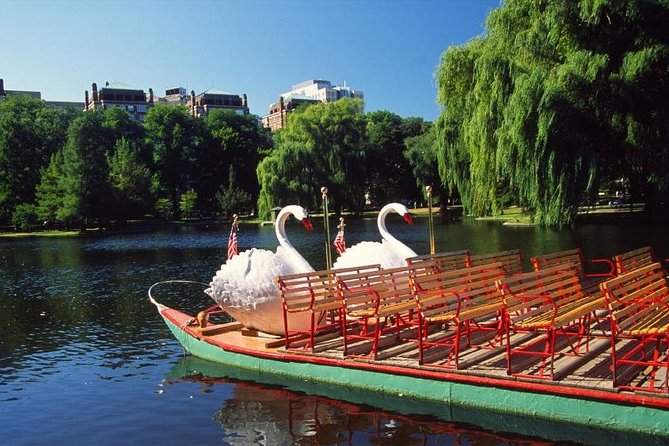
In the Public Garden you’ll see the Swan Boat Lagoon and the Make Way for Ducklings statues. You’ll also get a story tied to the Monument to the first successful use of ether.
If you’re wondering why that belongs on a history walk, that’s the point. Boston didn’t just produce political change. It also shows up in medical advances, and this stop gives you a concrete landmark tied to that progress.
And yes, Cheers shows up too. The tour uses pop-culture familiarity as a bridge so you don’t feel shut out if you’re not deep into local lore.
The Back Bay landfill transformation (and why it matters when you walk)
Then the story shifts into Back Bay: the tour explains how Boston was transformed with the largest landfill in the world using technology to fill in and create Back Bay, starting with the Boston Public Garden.
This is valuable because it makes Back Bay make sense. The neighborhood’s layout isn’t random. It’s engineered. When you later look up at Commonwealth Avenue or scan along Newbury Street, you’ll have a mental model for why the city looks the way it does.
Commonwealth Avenue and Newbury Street: the Back Bay streets you’ll remember
Back Bay is the tour’s “walk it, feel it” segment. You’ll see the Commonwealth Avenue streetscape—often described as having a Parisian-based residential vibe—and you’ll also pass by the boutique area of Newbury Street.
What you’re really getting here is context for Boston’s later identity: the city that grew beyond its Revolution-era core and became a place where fashion, wealth, and neighborhood planning all shaped daily life.
Also, this is where the walking tour works well even if you’re traveling with mixed interests. If someone in your group is more into architecture, they’ll appreciate the Victorian brownstones and the street geometry. If someone is more into shopping or food, Newbury Street gives them a starting point for later exploring.
Copley Square and the Boston Marathon Finish Line: a strong finish
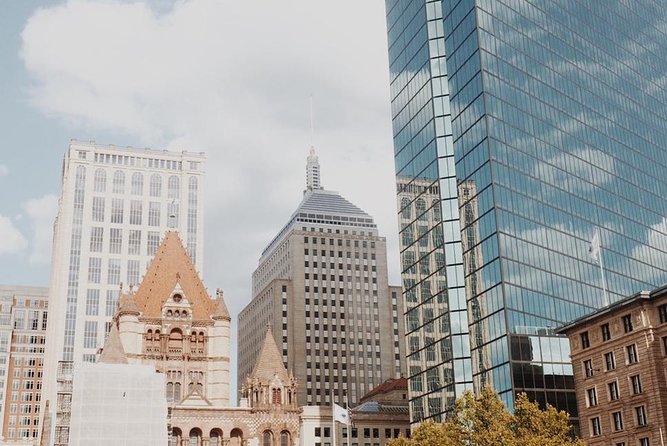
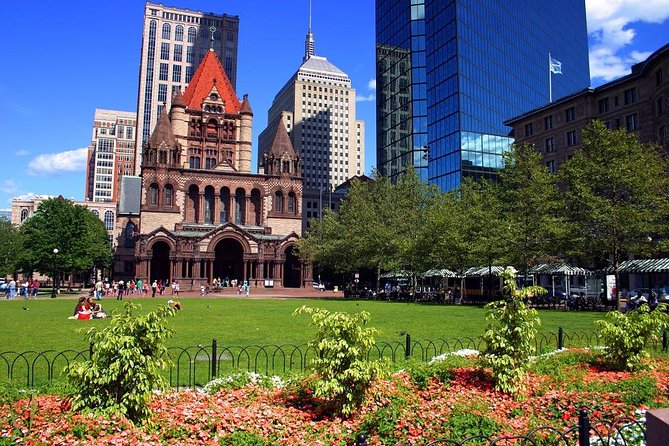
The tour ends in Copley Square, after you view major architecture around the area. Key landmarks include Trinity Church, the Boston Public Library, the New Old South Church, and John Hancock Tower.
This finish is smart because it gives you a big visual “wrap-up.” You’ve moved from the Revolution core into elegant residential streets and then landed in one of Boston’s most recognizable downtown squares.
One extra flourish: you’ll take a ceremonial pass over the finish line location for the Boston Marathon. Even if you’re not timing a race, standing in the orbit of that finish line ties Boston’s history to its modern identity. It’s a nice end point—easy to remember and easy to locate for your next plan.
Price and logistics: what $65 buys in real-world value

At $65 per person for about two hours, the value comes from what’s included rather than what’s excluded. You get a professional/local guide, a mobile ticket, and a route that hits major landmarks that would take much longer to stitch together on your own.
A key part of the value equation: many of the stops here don’t require paid museum-style entry. The tour is built around exterior landmarks and street-level viewing, so you’re mostly paying for interpretation—someone to connect buildings to the story.
A second value point: the group size caps at 20. That doesn’t mean it’s always tiny, but it helps keep it conversational. Several guide comments emphasize that people can hear clearly and get answers, and a smaller group makes that more realistic.
Booking thought: this tour is often booked a month ahead on average. If your dates are fixed (especially in prime travel weeks), I’d plan to lock it in earlier rather than later.
Who should book this tour—and who might want a different pace?
This walk is ideal if you want:
- A fast orientation to Boston’s core history plus two major neighborhoods
- A guided route that reduces guesswork (where to go, what to look for, why it matters)
- A morning plan that ends in a central location (Copley Square is easy for onward sightseeing)
It’s also a strong pick for couples and families, since the route includes both serious history and lighter, visual stops like the Public Garden’s ducklings and Swan Boats.
You might consider a different format if:
- You need minimal walking. The tour is designed to keep moving for roughly two hours, and sidewalks can vary.
- Wind and cold are rough for you. The tour operates in all weather conditions, so you’ll want real layers and comfortable shoes.
Tips to get the most out of the walk
Bring the basics that make a walking tour smooth:
- Wear shoes that handle uneven pavement and frequent curb changes.
- Carry water, especially on warm days. Some reviews explicitly call out water breaks.
- If you have lunch or reservations right after, give yourself buffer time. Timing can slide when groups ask lots of questions or when city crowds slow the pace.
If you like taking notes, do it after key stops rather than during the rush between them. The best bits—the massacre site context, state house comparisons, and the Back Bay landfill explanation—stick more when you let them settle.
Should you book Downtown Freedom Trail, Beacon Hill & Back Bay?
Yes—if you want a high-impact Boston morning with clear stops, a logical route, and a guide who turns “buildings I’ve seen before” into a story you can actually repeat.
I’d book it if you’re new to Boston, or if you’ve been before but want a better chain of context from Old State House and state houses through Boston Common, then into Beacon Hill and Back Bay. The end at Copley Square, with Trinity Church and the Marathon finish-line location, gives you a satisfying finish point instead of a mid-city drop.
Skip it only if your top priority is to linger at fewer places. This tour is about coverage and interpretation, not long museum time.
FAQ
How long is the Downtown Freedom Trail, Beacon Hill & Back Bay walking tour?
It lasts about 2 hours.
Where does the tour start and what time does it run?
The meeting point is Citizens28 State St, Boston, MA 02109, and the start time is 10:00 am. The tour ends in Copley Square, Boston, MA 02116.
How much does the tour cost?
The price is $65.00 per person.
What language is the tour offered in?
The tour is offered in English.
What’s included in the tour price?
You get the 2-hour walking tour of the Freedom Trail plus Back Bay via Beacon Hill, you’ll see major sites between Faneuil Hall and Copley Square, you’ll stroll through the Boston Public Garden, and you’ll have a professional/local guide.
Do the stops require paid admission?
The tour description lists the walking and viewing stops with admission ticket free for the listed segments.
Is the tour suitable for families and kids?
Most travelers can participate. Children must be accompanied by an adult.
How big is the group?
The tour has a maximum of 20 travelers.
Does the tour run in bad weather?
It operates in all weather conditions, so you should dress appropriately. If it’s canceled due to poor weather, you’ll be offered a different date or a full refund.
What happens if I cancel?
You can cancel up to 24 hours in advance for a full refund. If you cancel less than 24 hours before the experience start time, it won’t be refunded.