REVIEW · BOSTON
Boston: Freedom Trail History Small Group Walking Tour
Book on Viator →Operated by Hub Town Tours · Bookable on Viator
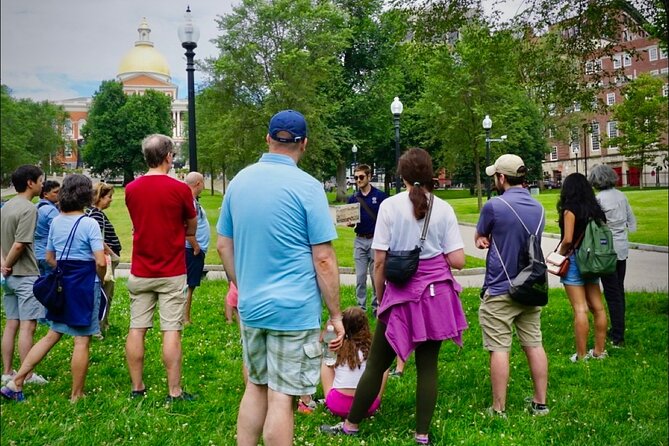
Boston history, paced like a story. This 2.5-hour Freedom Trail small-group walk stays focused on 1760–1775 and links the stops into one clear Revolutionary-era thread, led by a historian guide. I like how the route makes it easy to follow what happened when, and you’re encouraged to ask questions as you go.
My second favorite part is the scope: you cover the full set of 16 official landmarks in one outing, with time at the biggest names like Boston Common, Faneuil Hall, and Paul Revere’s area. In colder months, guides including Cyrus and Alejandro have a track record of keeping the tour moving and even building in short warm-up moments.
The only downside to flag is that this is still a walking tour: expect standing and time outdoors, and you won’t be touring inside lots of buildings along the way.
In This Review
- Key things that make this tour worth your time
- Why This Freedom Trail Tour Gets the Timeline Right
- Start at the Boston Foundation Monument and Get Oriented Fast
- Boston Common to Granary Burying Ground: Puritan Roots and Revolutionary Graves
- From Boston Latin School to the Tea Party Setup
- Boston Massacre Site and Faneuil Hall: When Politics Turned Loud
- North Square Park, Paul Revere’s Area, and the Signal Lantern Story
- Copp’s Hill Terrace Finale Over the Harbor and Fortified Views
- Price and What You’ll Actually Spend Your Time On
- Who This Tour Fits Best (and who may want a different plan)
- Should You Book This Freedom Trail Walk?
- FAQ
- How long is the Boston Freedom Trail History small-group walking tour?
- How much does the tour cost?
- Does the tour cover all 16 official Freedom Trail landmarks?
- Where does the tour start and where does it end?
- How large is the small group?
- Is the tour wheelchair and stroller accessible?
- Is museum admission included?
- What if weather is bad?
- Does the route include Charlestown?
Key things that make this tour worth your time
- Small groups (up to 16) mean more real back-and-forth, not a lecture from far away
- Focused timeline (1760–1775) helps you connect causes, not just memorize dates
- All 16 official Freedom Trail landmarks are covered in one smooth route
- Wheelchair and stroller accessible, while still keeping a moderate walking pace
- Winter-friendly guidance: many guides use sheltered stops when the weather turns
Why This Freedom Trail Tour Gets the Timeline Right
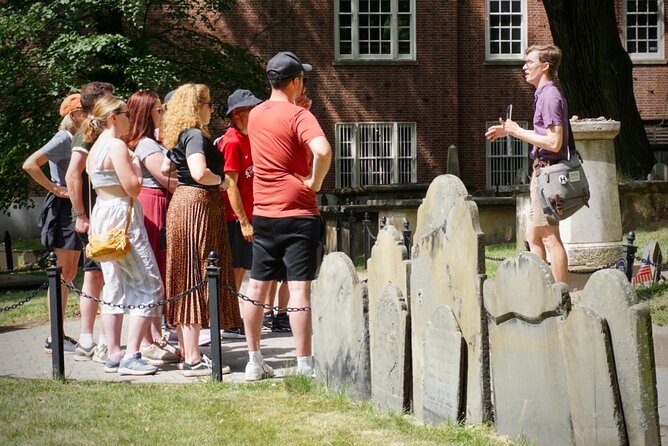
A lot of Freedom Trail visits turn into a checklist: see a marker, move on, take a photo. What makes this tour different is that the guide builds a Revolution storyline around the years 1760 to 1775. That focus matters because Boston in that era isn’t just “American Revolution trivia.” It’s protests, laws, fear, retaliation, and decisions that pile up fast.
You’ll also get a rhythm that works for first-timers. The route is designed to keep you oriented, so you’re not constantly asking yourself where you are on the map. Instead, you’ll hear how each spot connects to the political temperature of the time—who was arguing, who was organizing, and why one event escalated into the next.
One more thing I appreciate: the guides. Reviews highlight historians and storytellers who stay organized, speak clearly, and answer questions without rushing. People mention everything from guides like Jon walking things through in order to Cal making the trail feel alive with local detail.
You can also read our reviews of more walking tours in Boston
Start at the Boston Foundation Monument and Get Oriented Fast
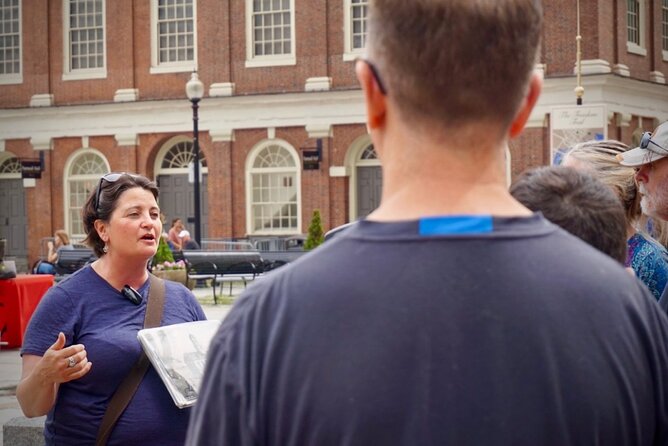
The tour meets at the Boston Foundation Monument inside Boston Common, on the northern edge of the park. It’s opposite 50 Beacon Street, and you’ll find it inside the park at the start point (this is where you’ll gather before moving as a group).
The monument itself is a small but smart way to begin. It includes a bronze relief showing two men shaking hands, tied to the Puritan arrival in 1630—an early “Boston origin story” moment before you sprint into Revolutionary-era events. Even if you’ve never studied the period, this gives you a baseline.
From there, you ease into the Freedom Trail’s built-in logic: start with the civic core, then trace how Boston’s public spaces—meeting halls, churches, squares, and the waterfront—became the stage for protest and power. If you’re the kind of traveler who likes to get your bearings fast, this opening works.
Boston Common to Granary Burying Ground: Puritan Roots and Revolutionary Graves
Boston Common is where the story stays practical. It’s not just a scenic park; it was Boston’s shared land for grazing and community use dating back to the 1600s. Standing in that space helps you understand why the next steps in the Revolution didn’t happen in a vacuum. People met in public, and they argued in public.
Right after the Common, you’ll pass landmark highlights tied to the city’s early power structure, including the Massachusetts State House and the nearby “Hub of the Solar System” reference, plus Park Street Church, known as an active church with one of the taller steeples in 19th-century Boston. These stops remind you that architecture and authority were always linked.
Then comes Granary Burying Ground, and this is one of the tour’s emotional turns. You’ll spend time at this Revolutionary-era cemetery, Boston’s third-oldest burying ground and the final resting place for Revolutionary Boston. It’s a direct reminder that politics wasn’t abstract. People lived, died, and were remembered close to where they made decisions.
A related stop in this section is the area connected to King’s Chapel (and its burial ground). The timeline there stretches back to the late 1600s and the mid-1700s, with the guide explaining how religious and civic life shaped where people gathered, how they organized, and how they saw authority.
Practical note: this section is mostly outdoors with a lot of “standing and listening.” If you tire easily, pace yourself, take breaks when the group pauses, and bring a layer you can adjust quickly.
From Boston Latin School to the Tea Party Setup
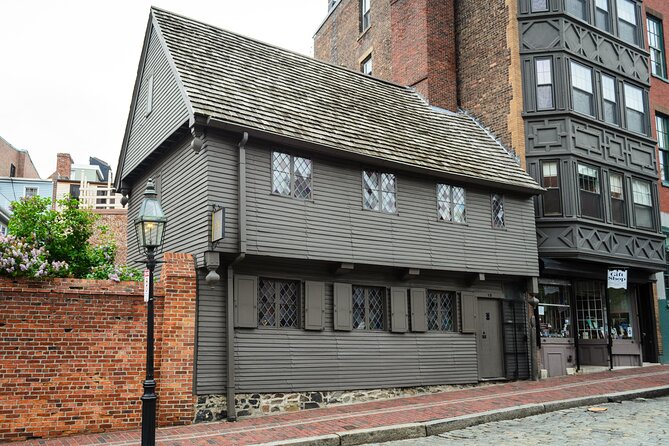
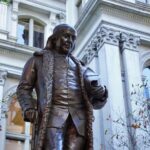
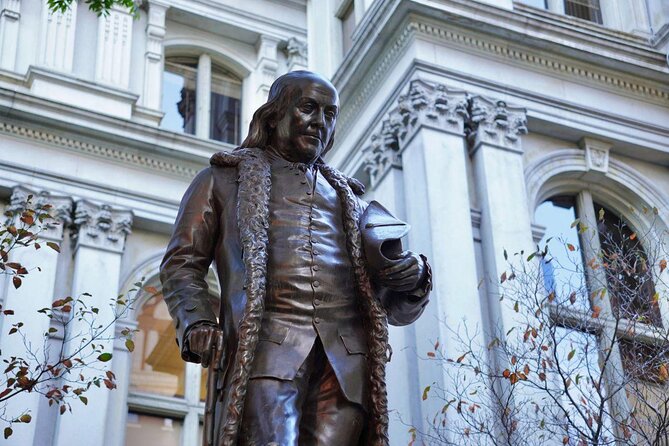
This part of the walk is where the tour starts feeling like a real plot. You’ll see the Benjamin Franklin statue area, and the guide connects it to Boston Latin School, which dates to 1635. It’s a smart inclusion because education is part of how revolutionary ideas spread and how leaders formed.
You’ll also pass the building history connected with Ticknor & Fields (1718), which ties into publishing—another underappreciated engine of influence. Then you’ll hit a cluster of church-and-meeting-house stops that explain why “public gatherings” became “political pressure.”
One of the biggest story beats here is the site tied to the Boston Tea Party (1773). The tour stops at the Congregationalist meeting house / meeting-house area associated with that event’s origin. Even if you already know the headline, the value is in how your guide frames it: what led to the confrontation, how propaganda and anger spread, and how ordinary meetings turned into loud, collective action.
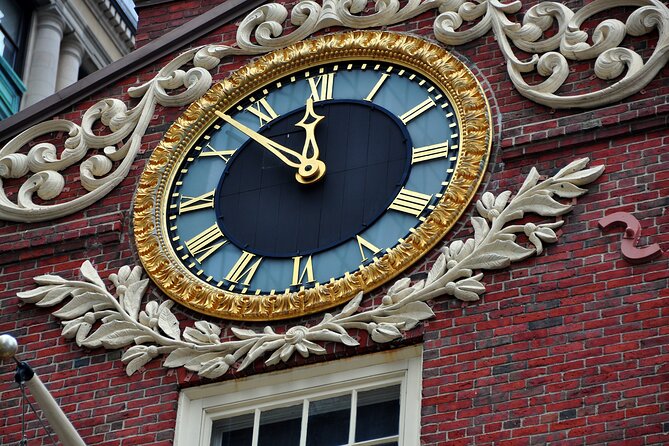
You’ll also see the colonial capitol connection. The guide points out the Old State House-style civic role—how Massachusetts Bay Colony governance sat at the center of what people argued about. That context is key because it shows the Revolution as a conflict over power, not just rebellion for rebellion’s sake.
Boston Massacre Site and Faneuil Hall: When Politics Turned Loud
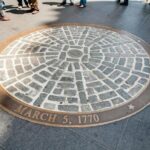
The Boston Massacre Site is a major emotional anchor on this walk. You’ll learn how British soldiers killed five Bostonians in 1770. The name alone can feel textbook. The tour helps it feel human by placing it inside the cycle of protest and retaliation that had already been building.
Your guide also connects it to Boston’s Sons of Liberty leadership. That part is useful because it turns the event into a story about organizing and persuasion, not only about violence.
Then you move to Faneuil Hall Marketplace, also tied to town meetings and famous as the cradle of liberty. It’s one of those locations where the Revolution becomes a civic action story. You’re not only seeing where history happened—you’re seeing why that kind of debate could scale from a crowd to a movement.
Even better: the area includes the historic building where what’s described as the oldest restaurant in the United States operates. The tour doesn’t turn into a food stop, but the point is that Boston’s Revolution-era spaces didn’t get locked away behind museums. They kept living and changing.
In my view, this is one of the best stretches for photos, because you’ll be moving between spots that are visually distinctive and historically loaded. Just keep an eye on your footing—crowds and uneven sidewalks can slow you down in places.
You can also read our reviews of more historical tours in Boston

North Square Park, Paul Revere’s Area, and the Signal Lantern Story
North Square Park gives you a different Boston feel—more neighborhood core than grand civic center. It’s an historic public square in the heart of the North End, dating back to the 1600s. Spending time here helps you see how the Revolution wasn’t only centered in big institutions. It was also rooted in ordinary streets where communities moved, talked, and formed loyalties.
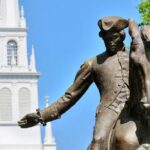
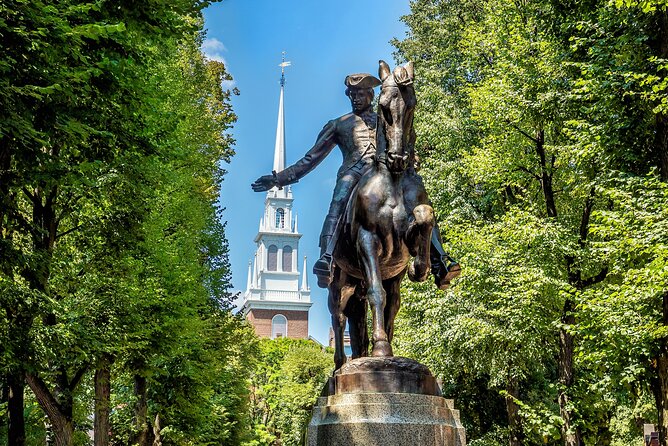
From there, the tour lands in the orbit of Paul Revere’s life and the Midnight Ride story. You’ll visit the Paul Revere Statue area, where the emphasis is the 1775 signal-and-ride moment. Nearby, the guide connects the legend to Old North Church, including how signal lanterns were used during the Midnight Ride.
Then the walk also touches Copp’s Hill burial ground area (described as the second-oldest burying ground in Boston). That makes the tour feel complete. You’ve moved from politics to protest to crisis, and you end this stretch seeing how the community remembered its people.
What I like about this portion: the guide ties everything together so it doesn’t turn into separate trivia. Revere is placed in a system: communication, urgency, and the networks that allowed messages to travel fast.
Copp’s Hill Terrace Finale Over the Harbor and Fortified Views
The tour ends at Copp’s Hill Terrace, overlooking the Charles River. On clear days, it’s an excellent “zoom out” moment. You’ll look toward major Freedom Trail landmarks across the water, including the U.S.S. Constitution and the Bunker Hill Monument.
This final stretch is valuable because it gives you perspective. Most of the walk is at street level—doors, markers, meeting halls, church fronts. Ending with harbor-and-battleground sightlines helps you understand why geography mattered: ships, routes, and positions influenced how events unfolded.
You’ll also finish on the edge of the North End, with steps from Hanover Street, where you can grab a post-walk meal. That matters more than it sounds. A tour like this spends energy on storytelling and walking; a good food landing zone makes the day feel like a complete experience, not just “a thing I did.”
One more helpful detail: the tour avoids Charlestown neighborhood. If you were expecting a Charlestown add-on, you’ll want to plan that separately after this outing. The upside is that you get a cleaner, more focused route in downtown Boston and the North End.
Price and What You’ll Actually Spend Your Time On
At $35.10 per person for about 2.5 hours, the value is mostly in the guide and the time saved. You’re paying for a historian-style narrative, the pacing, and the effort of seeing 16 official landmarks without having to figure out the best order.
It’s also a practical deal because the stops on the trail itself don’t require separate admissions in the way many museum-heavy tours do. The tour’s included content is the trail coverage plus the small group format, with no promise of museum entry time.
The tradeoff is exactly what you’d expect from a walking-focused tour: you’re outside most of the time, and the route doesn’t become a long interior sightseeing marathon. Even on colder days, guides often find indoor moments to warm up or to continue telling the story. Reviews specifically mention guided warm-up breaks halfway through, and that guides keep things going even when it’s freezing and windy.
If you’re the type who wants to spend hours inside buildings, you may need a second activity later for that. But for getting oriented, understanding the Revolution’s logic, and seeing the full trail in one go, the price-to-duration ratio works.
Who This Tour Fits Best (and who may want a different plan)
This tour is a strong match for first-time visitors who want a “Boston orientation plus Revolution timeline” package. It’s also ideal for history buffs who enjoy questions and conversation. A lot of the strongest reviews mention guides who answer questions and keep a chronological flow, which is exactly what you want if you’re trying to connect the dots.
It’s also good for families, as long as everyone can handle a 2.5-hour walk. The tour is described as wheelchair and stroller accessible. At the same time, it’s not recommended for people who have difficulty standing for extended periods. So think of it as accessible to mobility devices, but still physically demanding in duration and outdoor time.
If your goal is only photo spots with minimal listening, you might find the stops feel like a classroom. If your goal is to understand why the Revolution happened here, at this exact time, with these exact public spaces, this tour is built for that.
Should You Book This Freedom Trail Walk?
Book it if you want the Freedom Trail done in one efficient, story-driven session, with a guide leading the timeline from 1760 to 1775 and covering all 16 official landmarks. It’s also a great pick for winter or shoulder-season trips, because guides often adjust with short sheltered breaks to keep things comfortable.
Skip it (or pair it differently) if you’re mainly chasing interior museum time or you know you can’t manage extended standing outdoors. In that case, you’d probably prefer a more museum-heavy plan plus a lighter self-guided walk afterward.
If you can do a moderate walking tour, you’ll leave with a clearer Revolution story and a much better sense of Boston’s layout than you’d get from markers alone.
FAQ
How long is the Boston Freedom Trail History small-group walking tour?
It runs about 2 hours 30 minutes.
How much does the tour cost?
The price is $35.10 per person.
Does the tour cover all 16 official Freedom Trail landmarks?
Yes, it includes the full set of the 16 official historic landmarks on the Freedom Trail.
Where does the tour start and where does it end?
You meet at the Boston Foundation Monument in Boston Common (49 Beacon St) and the tour ends at Copp’s Hill Terrace (520 Commercial St).
How large is the small group?
The group is limited to a maximum of 16 travelers.
Is the tour wheelchair and stroller accessible?
Yes, the tour is described as wheelchair and stroller accessible.
Is museum admission included?
No. Admission inside museums is not included.
What if weather is bad?
The experience requires good weather. If it’s canceled due to poor weather, you’ll be offered a different date or a full refund.
Does the route include Charlestown?
No. The tour focuses on downtown Boston and the North End and does not include Charlestown neighborhood.