REVIEW · BOSTON
Boston: Freedom Trail History Small Group Walking Tour
Book on GetYourGuide →Operated by Hub Town Tours · Bookable on GetYourGuide
Boston’s revolution story follows your feet. This small-group Freedom Trail walk takes you through 16 major historic stops, with a guide who ties each place to the big tension of the era: loyalty or rebellion. Two things I really like are the tight group size (max 15, so you can actually hear and ask questions) and the way the guide uses real people’s decisions—Paul Revere and Samuel Adams show up again and again—to make the American Revolution feel personal.
The one catch is physical. You’re covering about 2 miles on downtown streets, and the tour is listed as wheelchair accessible but also not suitable for people with low mobility or low fitness.
In This Review
- Key points that make this tour worth your time
- A Revolution story you can actually track on the map
- Where the walk starts: Boston Common’s Boston Foundation Monument
- Boston’s early “power centers” you’ll recognize fast
- Massachusetts State House and Park Street Church
- Granary Burying Ground: where you meet the past face-to-face
- King’s Chapel and the Boston Latin School/Benjamin Franklin moment
- Old City Hall Boston and the Old Corner Book Store
- From gathering to confrontation: Boston’s key meeting points
- Old South Meeting House: talk that turns into momentum
- Old State House and the Boston Massacre Site
- Faneuil Hall and a quick break at Quincy Market
- Paul Revere House and the North End’s story beat
- The North End finish: Copp’s Hill and the whole trail in view
- Hanover Street and the Paul Revere Statue
- Old North Church: the lantern moment you know, plus what you might miss
- Copps Hill Burying Ground: consequences, not just triumph
- USS Constitution and Bunker Hill views on the way
- Copp’s Hill Terrace: the last look before you peel off
- $35 for 150 minutes: where the value really comes from
- What to bring (and what gets left behind)
- Who should book this Freedom Trail walk
- Should you book this Freedom Trail tour?
- FAQ
- How long is the Boston Freedom Trail History Small Group Walking Tour?
- Where do I meet the guide?
- How far will I walk?
- What landmarks are included?
- Is this a small-group tour?
- Is the tour wheelchair accessible?
- What should I bring?
- Are there restrictions on what I can bring or do?
Key points that make this tour worth your time
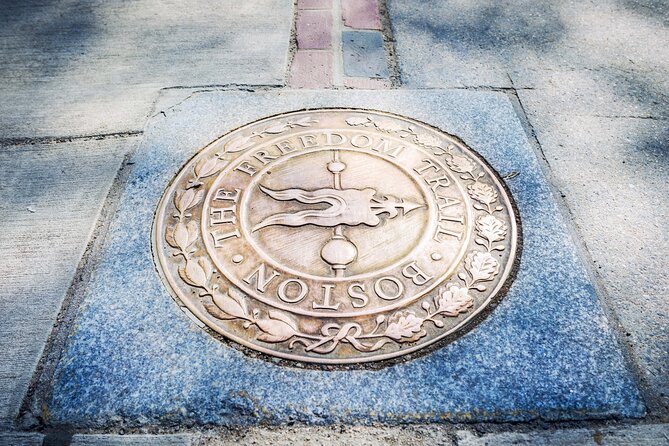
- A small group (15 max) keeps you out of the loud-swarm feeling you get on bigger walks
- All 16 official Freedom Trail landmarks are covered in one pass, from Boston Common to Copp’s Hill Terrace
- Granary Burying Ground and Old State House give you names, motives, and consequences—not just dates
- Quincy Market is built in for a reset, with time for a bathroom stop and a quick drink
- You finish with big views over toward USS Constitution and the Bunker Hill Monument
A Revolution story you can actually track on the map
The Freedom Trail is often sold as a line you follow. This version feels more like a guided chain reaction. You start in the place where Boston’s public life gathers, then you move through sites tied to organizing, arguing, and escalating conflict over a rough 15-year stretch.
What you’ll enjoy is how the guide frames the era. It isn’t just revolution as a single event. It’s people trying to figure out what loyalty means when crown rules collide with local control, trade, and everyday survival. As you walk, you’ll keep noticing that the same question shows up in different forms: Who has the power? Who gets to decide? Who pays the cost?
And because you’re in a small group, you don’t get stuck listening only for the loudest voice. You can hear explanations, and you can ask the practical stuff—what happened next, why it mattered, and what’s myth versus what’s documented.
Guides for this tour often bring standout energy. You might be led by instructors with names like Mark, Toby, Amir, Eric, Alejandro, and Nick, and the common thread is storytelling that stays organized instead of turning into random trivia.
You can also read our reviews of more walking tours in Boston



Where the walk starts: Boston Common’s Boston Foundation Monument
You meet inside Boston Common at the Boston Foundation Monument, on the northern boundary of the park, opposite 50 Beacon Street. The granite memorial has a bronze relief showing two men shaking hands, representing the Puritans arriving in 1630—one of those “origin moment” symbols that instantly sets the tone.
From here, it’s easy to understand why this tour begins at Boston Common. It’s where civic life spills outward into the streets. And once you’re walking, the guide’s job is to help you connect each landmark to the question Bostoners were wrestling with—what does a community owe to its leaders, and what does it owe to itself?
You’ll spend a short time here before you head toward the first wave of political and religious landmarks.
Boston’s early “power centers” you’ll recognize fast
Right after Common, you move into the part of downtown where decisions get made—government, institutions, and the places people gathered to talk.
Massachusetts State House and Park Street Church
The Massachusetts State House stops you in front of the building that still represents the commonwealth’s authority today. The guide uses it as a bridge: you’ll hear how Revolutionary-era conflict wasn’t only about anger. It was also about control—who gets to set rules and who gets to enforce them.
Then you head to Park Street Church, which adds a slightly different flavor. You’re not just walking politics. You’re walking the city’s worldview, the public voice of religion and community organizing.
Granary Burying Ground: where you meet the past face-to-face
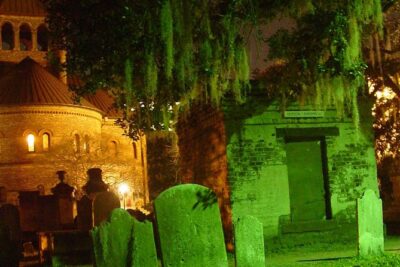
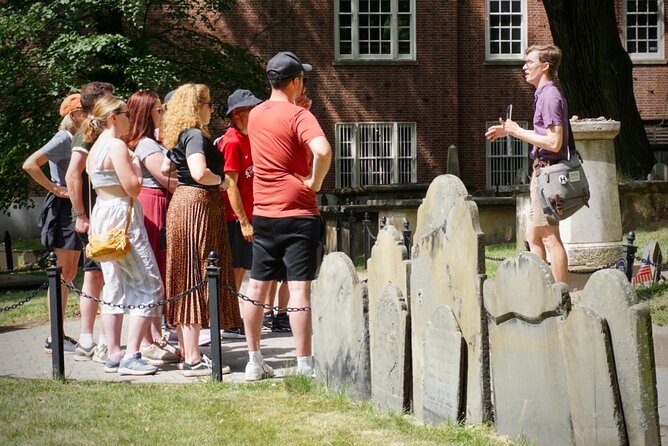
At Granary Burying Ground, the story changes pace. This is one of the strongest stops on the whole walk because it shifts from events to people. You’ll learn why certain figures mattered, and how their choices echoed after they were gone.
It also helps you understand the emotional side of the period. Revolution-era Boston wasn’t remote. Families lived close to their leaders and symbols, and cemeteries became part of public memory.
You can also read our reviews of more historical tours in Boston

King’s Chapel and the Boston Latin School/Benjamin Franklin moment
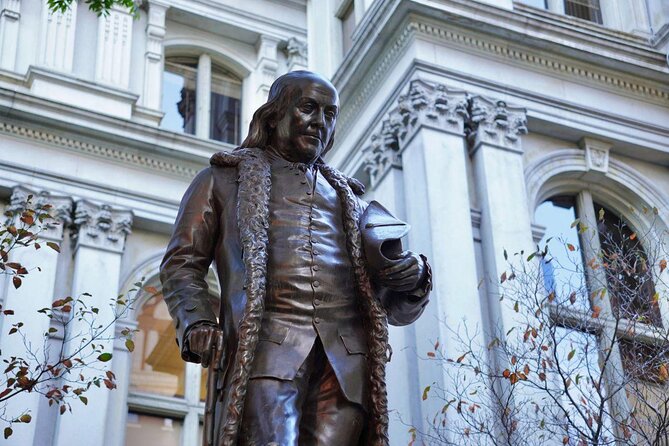
King’s Chapel adds another layer by tying civic identity to longstanding institutions. Then you’ll pass Boston Latin School and the Benjamin Franklin statue. Even if you know Franklin’s name, you’ll likely hear a connection that makes him feel less like a schoolbook portrait and more like a real Boston personality tangled in the era’s debates.
Old City Hall Boston and the Old Corner Book Store
Two quick stops can make you feel like you’re moving through Boston’s communication network. Old City Hall Boston points to governance and the machinery behind civic action. Nearby, the Old Corner Book Store helps the guide talk about print culture and public opinion—because when ideas spread fast, protest can follow fast too.
From gathering to confrontation: Boston’s key meeting points
This is where the walk starts to feel like the Revolution isn’t a lecture. It’s a sequence.
Old South Meeting House: talk that turns into momentum
At the Old South Meeting House, you’ll get context for why mass gatherings mattered. People didn’t just meet to feel patriotic. They met to coordinate: to decide what to do next, to pressure officials, and to make sure disagreement didn’t stay private.
Even if you’re not a history purist, you’ll likely appreciate how the guide explains the mechanics of organizing—who led, how crowds mattered, and why words became leverage.
Old State House and the Boston Massacre Site
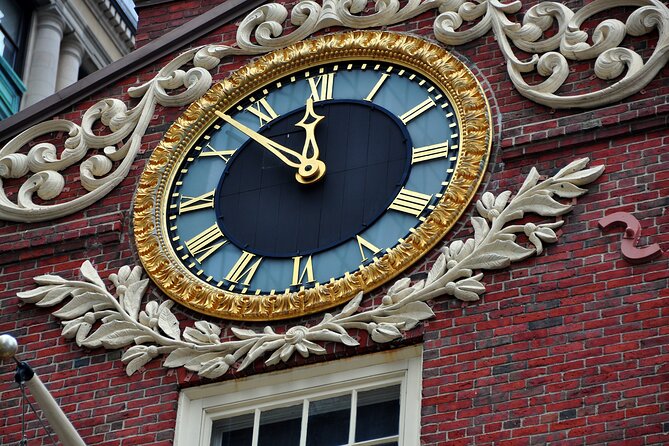
Next comes Old State House and the Boston Massacre Site area. This is one of the stops where you’ll want to listen carefully, because the guide may bring nuance to what gets called the Boston Massacre. One of the most useful things you can do here is ask yourself what you’re hearing: was this chaos, provocation, self-defense that spiraled, or something else? The guide can help you see how eyewitness stories, official reactions, and local politics all shaped the narrative.
This stop is valuable because it shows the period’s turning point energy. It’s not just violence; it’s violence becoming symbol.
Faneuil Hall and a quick break at Quincy Market
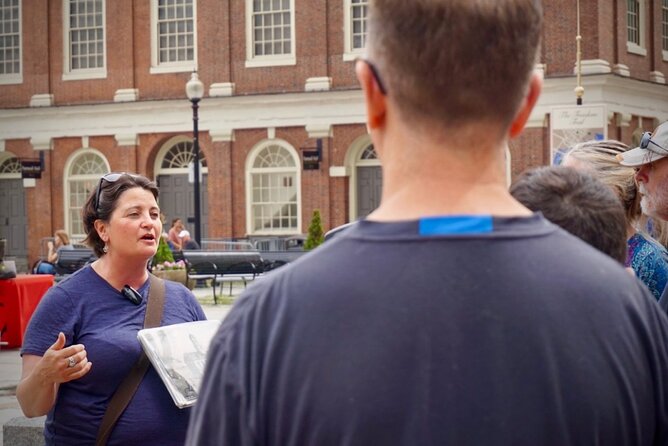
At Faneuil Hall, you’ll see a place that’s basically Boston’s megaphone for public debate. It’s the kind of building that makes it obvious why people cared about speech and assembly.
Then you hit Quincy Market for a short break. This matters more than it sounds. You’re out in the city for long enough that you’ll appreciate a pause to use the bathroom, grab a drink, and regroup—especially in cold or rainy weather. If you’re traveling with someone who needs a moment to reset, this is the built-in mercy.
Paul Revere House and the North End’s story beat
After the break, you shift toward the people whose names became shorthand for the Revolution.
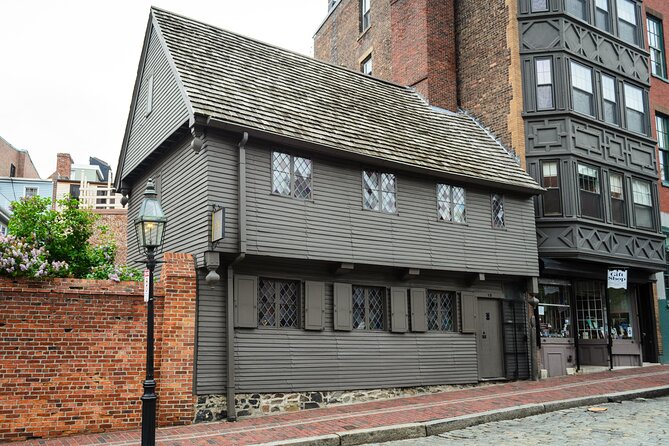
At the Paul Revere House, the guide’s storytelling usually makes Revere feel less like a statue and more like a working Boston figure caught in complicated networks. You may also hear a detail that changes the common version of the midnight ride—some guides note that Revere did not complete the entire ride as commonly told, and that the story’s popular shape came later as the lesson needed to be sharper.
This is the kind of stop where I like to look around and remind myself: the city wasn’t built for tourists, it was built for work. That changes your perspective.
The North End finish: Copp’s Hill and the whole trail in view
As you move through the final neighborhood stretch, you’ll feel the tour’s arc settle into place: from arguments and meetings to action and aftermath.
Hanover Street and the Paul Revere Statue
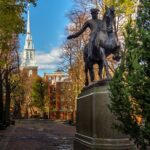
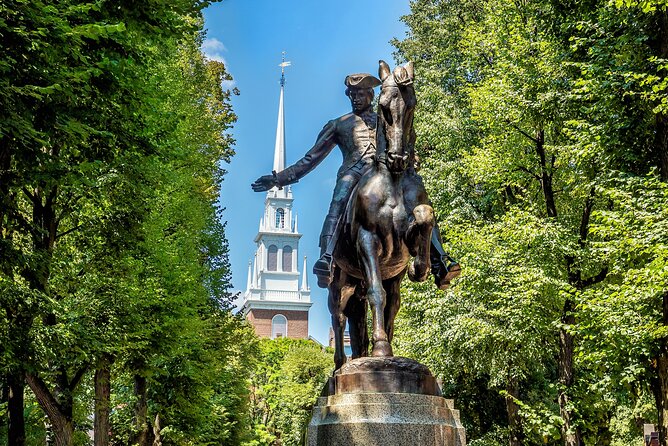
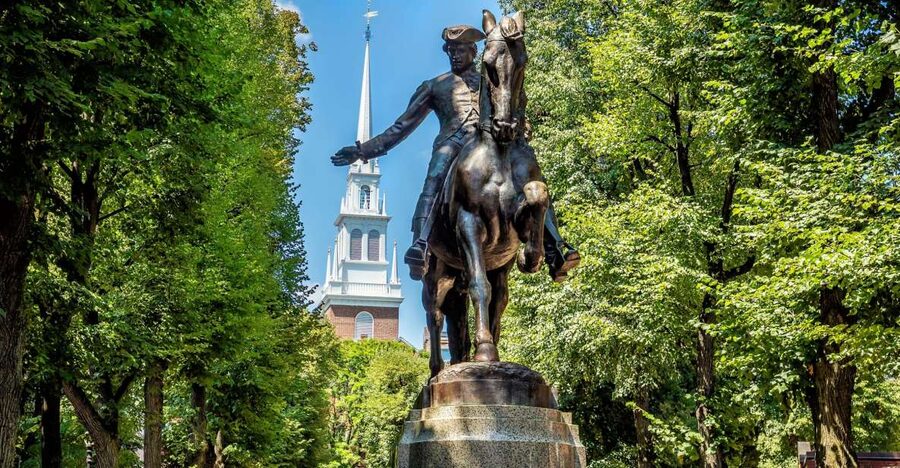
On Hanover Street, the mood turns more street-level and lived-in. The guide uses it to connect the Revolution era to the city’s later identity. Then you’ll see the Paul Revere Statue, which helps bring the story full circle from the house to the public legend.
Old North Church: the lantern moment you know, plus what you might miss
At Old North Church, you’ll likely spend a little time hearing about the famous lantern signal. But what I find useful here is the reminder that this wasn’t movie drama. It was communication under pressure in a city full of spies, assumptions, and risk.
This stop is also a good chance to notice how the guide keeps linking the landmark to the larger “why.” Not just what happened, but what it unlocked next.
Copps Hill Burying Ground: consequences, not just triumph
Then comes Copps Hill Burying Ground. Cemeteries can feel like a detour when you’re tired. Here, they don’t. This stop turns the story into consequences—who paid, who stayed, and how memory gets built. You’ll get names and context that make the Revolution’s people feel real rather than mythic.
USS Constitution and Bunker Hill views on the way
On the way, the tour includes scenic views toward USS Constitution and the Bunker Hill Monument in Charlestown. You don’t have to be a naval-history nerd to feel what this adds. It’s a visual reminder that the Revolution didn’t end with speeches. It echoed into the built environment and the next era of American identity.
Copp’s Hill Terrace: the last look before you peel off
The tour finishes at Copp’s Hill Terrace, just steps from Old North Church. The payoff here is the view line: you’re positioned to see the broader geography of the Boston area and the same landmarks you learned about earlier, now seen from a place with perspective.
It’s also how the operator sells the tour: you’ll see all 16 official Freedom Trail landmarks in one run. That’s a big deal if you only have a day and you don’t want to plan a self-guided route or worry about whether you missed a marker.
$35 for 150 minutes: where the value really comes from
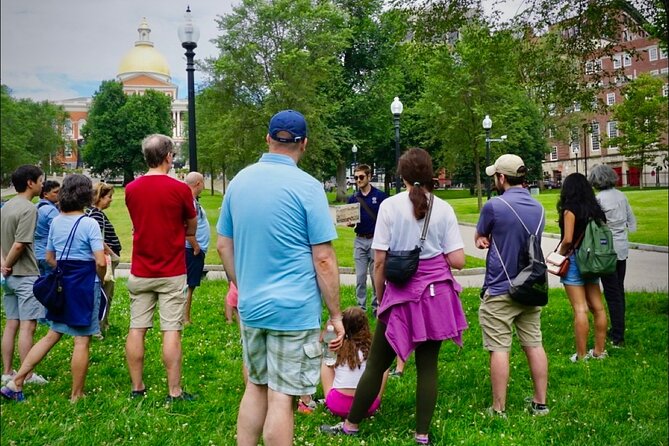
At $35 per person for about 150 minutes, the price is one of the better deals you’ll find for a guided downtown walking experience that covers all 16 official stops.
Here’s why it feels like value, not just cheap:
- You’re getting a guide to connect the dots across multiple neighborhoods.
- The group size stays small, which means you’re not just consuming information while orbiting strangers.
- You’re not paying separately for each stop, and you’re not stuck picking and choosing only the most famous landmarks.
What’s not included is also worth knowing. You won’t have guaranteed time inside museums as part of the tour, so if your goal is mostly indoor exhibits, plan those separately.
What to bring (and what gets left behind)
This is a city walk. Bring:
- Comfortable shoes you can handle on uneven sidewalks
- Weather-appropriate clothing, because Boston’s attitude changes fast
You should also plan on carrying light. Large bags or luggage aren’t allowed, and video recording isn’t allowed. If you show up with a heavy backpack, you’ll feel it more than you think.
One more practical thought: the walk is long enough that you’ll forget details unless you do something simple. I like to make my own mini checklist on my phone notes. As you pass each landmark, you jot the key person or theme the guide mentioned. Then later, the story clicks back into place.
Who should book this Freedom Trail walk
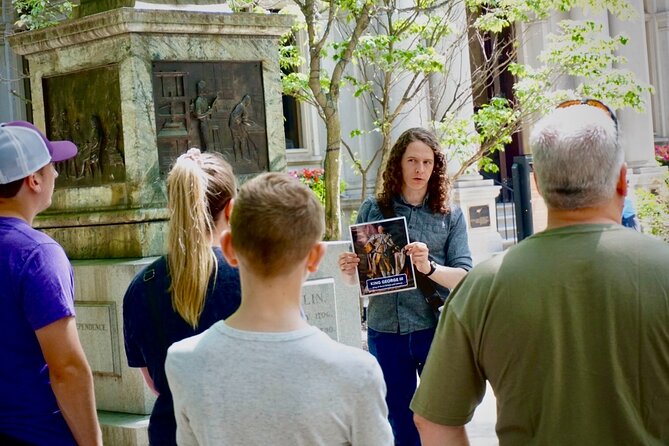
This tour is a strong fit if:
- You’re seeing Boston for the first time and want a clean overview you can build on
- You care about the American Revolution as a chain of events and choices, not just names
- You like your history told through real places you can stand in
It’s also a great option for couples and small groups who want to hear answers without yelling over a crowd.
Who should be cautious:
- It’s not suitable for children under 6
- It’s also not suitable for people with mobility impairments and it favors those with a higher walking comfort level
- With about 2 miles of walking, low fitness can turn the fun into endurance
Should you book this Freedom Trail tour?
If you want the Freedom Trail without the stress, I think this is a smart booking. The small group size, the full set of 16 official landmarks, and the guide-led storytelling make the day feel efficient and memorable.
I’d especially recommend it if you’re the type who likes turning a city into a story you can repeat later. You’ll walk away with the names and places connected in your head, and you’ll know where to go next—whether that’s deeper into the North End or back to the sites that stuck with you.
If you’re worried about the physical side, take the 2-mile reality seriously. If that part works for you, book it. It’s one of the most straightforward ways to understand why Boston became the stage for America’s break with the crown.
FAQ
How long is the Boston Freedom Trail History Small Group Walking Tour?
The tour lasts about 150 minutes, and the duration varies by start time but won’t be more than 3 hours.
Where do I meet the guide?
Meet your guide inside Boston Common at the Boston Foundation Monument, on the northern boundary of the park, opposite 50 Beacon Street (02108).
How far will I walk?
The accessible route travels approximately 2.0 miles (3.2 km).
What landmarks are included?
You’ll cover all 16 official landmarks that make up the Freedom Trail, including stops like Boston Common, Old State House, Old North Church, and the final viewpoint at Copp’s Hill Terrace.
Is this a small-group tour?
Yes. The group size is limited to 15 guests max.
Is the tour wheelchair accessible?
The activity is listed as wheelchair accessible, but it is also noted as not suitable for people with mobility impairments and involves a walking route of about 2 miles.
What should I bring?
Bring comfortable shoes and weather-appropriate clothing.
Are there restrictions on what I can bring or do?
You can’t bring luggage or large bags, and video recording is not allowed.