REVIEW · SPLIT
Diocletian Palace and Split Old Town SMALL GROUP Walking Tour
Book on Viator →Operated by Split Local Guided Tours · Bookable on Viator
Split can feel like a city inside a fortress. This 90-minute route threads you through the most important parts of Diocletian’s Palace and the surrounding Old Town, with a licensed guide keeping the story clear and the pace manageable.
I especially like how the tour focuses on “what you’re seeing” (substructures, peristyle, major entrances) instead of tossing facts from a distance. And I also love that the stops hit big visual anchors fast—Golden Gate, the cathedral area, and the Temple of Jupiter—so you leave with your bearings. The main drawback to consider is that even with a small group, you’re still walking through a very popular historic zone, so expect crowds and plan for flexible timing if it’s busy.
In This Review
- Key Highlights You’ll Care About
- Why Diocletian’s Palace Still Feels Like Living Architecture
- Starting at Golden Gate: The Fastest Way to Get Oriented
- Stop 1: Substructures in Diocletian’s Palace (Cellars and Under-the-Story Views)
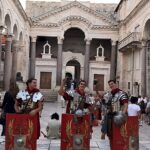
- Stop 2: The Peristyle (Center of the Palace Life)
- Stop 3: Palazzo di Diocleziano (A 1700-Year Palace in a Modern City)
- Stop 4: Golden Gate (Main Entrance and Your Built-In Reference Point)
- Stop 5: Narodni Trg (Pjaca Square and the Meaning of Public Space)
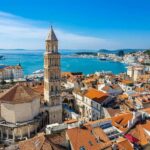
- Stop 6: Riva Harbor (Split’s Most Famous Street-Life Stretch)
- Stop 7: Vestibulum of Diocletian’s Palace (The Palace as Movement)
- Stop 8: Cathedral of Saint Domnius (Sacred Continuity in the Same Neighborhood)
- Stop 9: Temple of Jupiter (A Last Roman Anchor)
- Guides Make the Difference: Slavko, Antonia, Marta, Ante, and Mia
- Pace, Crowds, and Who This 90-Minute Route Best Fits
- Price and Value: What You’re Paying For
- Should You Book This Diocletian Palace and Split Old Town Tour?
- FAQ
- How long is the Diocletian Palace and Split Old Town small group walking tour?
- Where does the tour start, and does it end nearby?
- Is the tour in English?
- Is there an admission cost for the stops?
- How big is the group?
- Can I get a full refund if plans change?
Key Highlights You’ll Care About
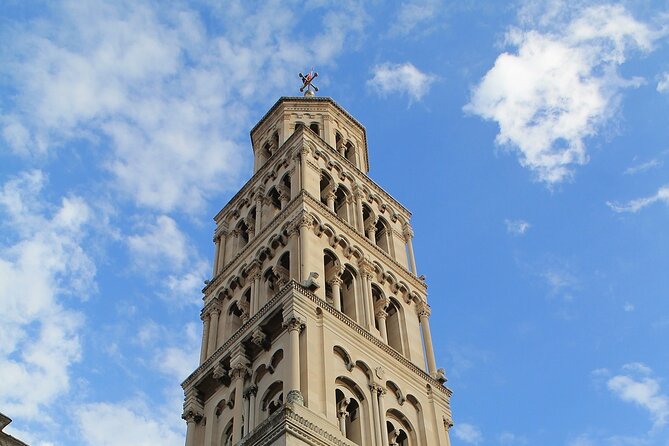
- Small group feel (up to 15 travelers), so you can actually hear your guide and ask questions.
- Nine targeted palace and Old Town stops that turn the complex layout into something you can remember.
- Free admission ticket notes for the key sites on the route, making the price feel more like a bargain.
- English-guided format (with strong impressions from guides like Slavko, Antonia, Marta, Ante, and Mia).
- Efficient 90-minute timing—good for first-time Split visitors and for days when you want variety without exhaustion.
Why Diocletian’s Palace Still Feels Like Living Architecture
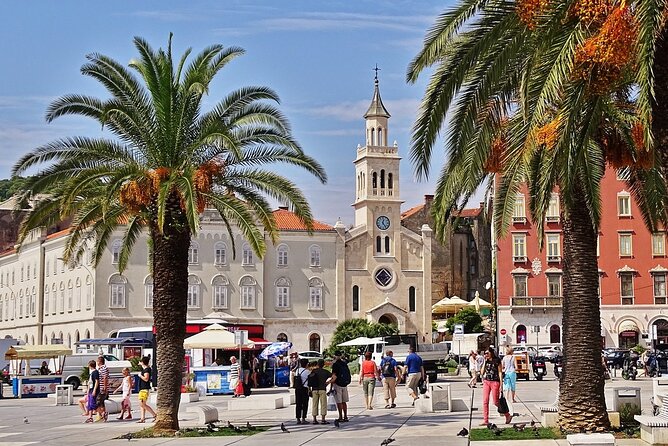
Diocletian’s Palace isn’t just ruins you pass. It’s a built environment that shaped Split into what it is today—streets, entrances, public spaces, and sacred corners all growing out of Roman stone. That’s the big reason this tour works: it walks you through the palace the way you’d actually experience it on foot, not as a museum checklist.
If you’re the type who likes to understand a place before you wander off on your own, this is a smart starter. You’ll learn the palace’s structure through the key spaces people still use and admire. And because you move from Roman-era spaces to later layers of Split, you’ll notice the city didn’t freeze in time. It kept changing—religion, rulers, and everyday life included.
One more practical point: the route is designed for a short visit. At about 1 hour 30 minutes, it’s a great “first morning” activity if you want to hit the rest of Split afterward with confidence.
You can also read our reviews of more walking tours in Split

Starting at Golden Gate: The Fastest Way to Get Oriented
Your tour meets at Golden Gate (Dioklecijanova 7, 21000 Split). This matters more than it sounds. When you start at the palace’s main entrance area, the whole complex clicks into place sooner, and you’re less likely to feel like you’re wandering in circles.
The tour also loops back to the meeting point at the end. That means you can treat it like a guided shortcut through the “must-not-miss” zone, then break away when you want a café, more photos, or a longer look at one specific corner.
Logistically, it’s built for real travel days. It’s offered in English, uses a mobile ticket, and is described as near public transportation. And with a maximum group size of 15, it stays manageable—no hour of waiting for people to catch up across the largest monument in town.
Stop 1: Substructures in Diocletian’s Palace (Cellars and Under-the-Story Views)
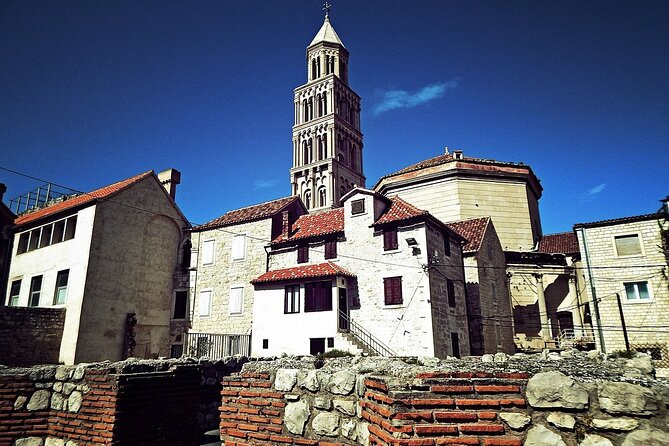
The tour starts with Diocletian’s Palace Substructures—the palace’s cellars and the parts beneath the main story. This is one of the best ways to start because it explains the palace’s “why” in physical terms: it wasn’t just decoration above ground. It was an engineered complex.
You’ll spend a short stretch here (about 5 minutes) and the timing is important. You’re not getting bogged down. Instead, you’re learning what the substructures tell you about the building’s organization. Even if you only catch the highlights, it changes how you look at the walls afterward.
The biggest payoff: once you understand that there’s a whole system underfoot, the palace’s layout feels less random. Doors and passages start to make sense, and your later stops won’t feel like separate sightseeing islands.
Stop 2: The Peristyle (Center of the Palace Life)
Next up is the Peristyle—the core open space of Diocletian’s Palace. This area is a turning point because it’s the palace’s “center,” not a side hallway. When you stand there, you can feel how a Roman compound could function as both power and everyday structure.
This stop is also about 5 minutes, which is good. The peristyle is memorable on sight, and your guide’s job is to connect what you see with how the palace worked as a unified place.
In practice, the Peristyle helps you understand direction. After this, when you look at entrances and corridors, you can start mapping the palace in your head instead of just photographing.
Stop 3: Palazzo di Diocleziano (A 1700-Year Palace in a Modern City)
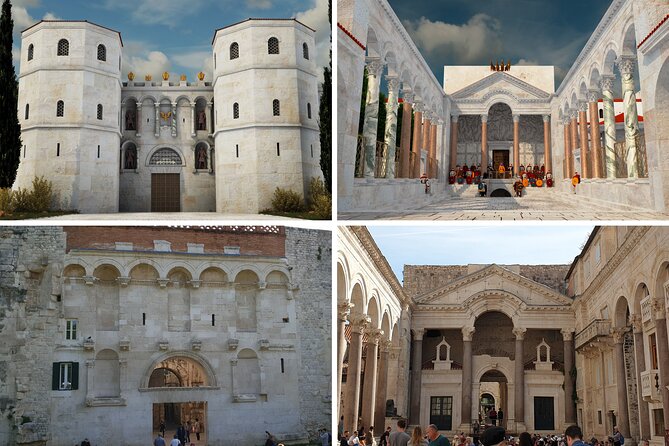
Then you move into Palazzo di Diocleziano for about 30 minutes—the longest stop on the route. This is where the tour does its most useful work: making the palace feel real and inhabited, not only ancient.
The palace is famously old, and the phrase “1700 years” is more than a trivia line. It’s why Split feels layered. You’re walking through the modern city that formed inside (and around) the structure. The guide’s narrative tends to bridge Roman context with what’s happening now, so you don’t feel like you’re watching history from behind glass.
If you’re short on time in Split, this is the stop you’re most grateful you booked. It’s also where a guide’s delivery matters—pace, clarity, and whether they can explain architectural choices without turning it into a lecture.



Stop 4: Golden Gate (Main Entrance and Your Built-In Reference Point)
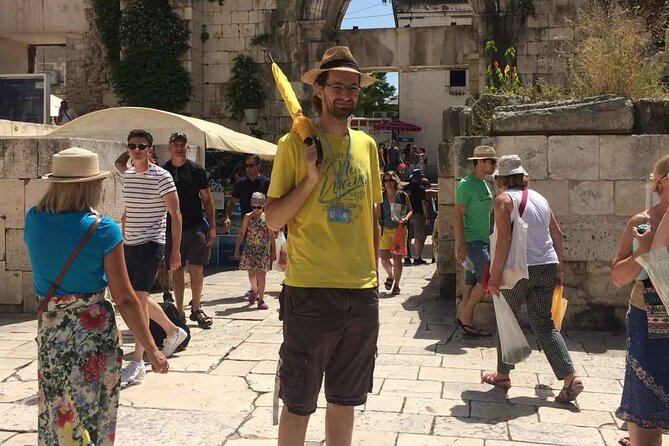
You’ll revisit the Golden Gate area as Stop 4. It’s listed as the main entrance and also your meeting point reference, so it’s not random. This is where you lock in the palace’s geography.
When you’ve walked from the understructure to the central space and then back toward the entrance, your brain starts building a simple map. That’s the whole point of a tight route with short stops: you learn enough to navigate independently afterward.
Also, because it’s an entrance area, you’ll likely notice the contrast between “grand entry” and “side streets.” That contrast is a big part of why Split feels unique: Roman scale meets human-scale daily life.
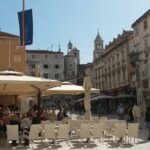
Stop 5: Narodni Trg (Pjaca Square and the Meaning of Public Space)
Next is Narodni Trg, connected to the famous Pjaca square. This stop is shorter—about 5 minutes—but it’s a key bridge between palace and city.
Public squares are where history shows its social purpose. Even in a short visit, the guide can explain why these spaces mattered: they weren’t just pretty open ground. They helped organize community life, commerce, and movement through the city.
If you like to understand how cities work, pay attention here. Once you grasp the role of the square, later stops like the harbor promenade start to make sense as extensions of that same pattern: people gather, watch, move, and trade stories.
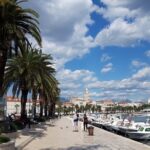
Stop 6: Riva Harbor (Split’s Most Famous Street-Life Stretch)
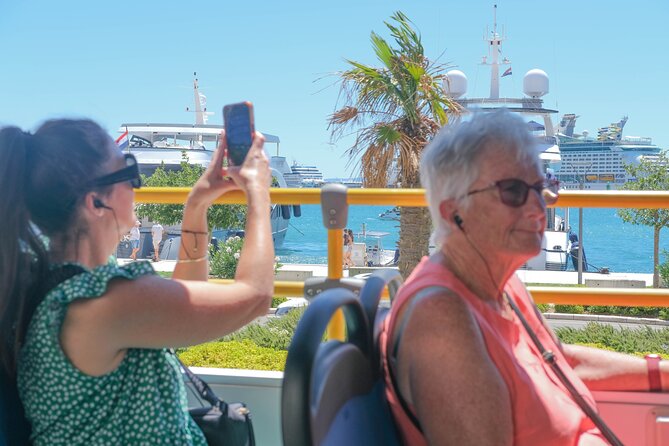
The tour continues to Riva Harbor, about 5 minutes. This is where the vibe shifts. You go from palace architecture and sacred corners to the promenade side of Split—the human, sea-facing rhythm of the city.
Riva is popular for a reason. It’s where you’ll see Split in action: movement along the waterfront, people pausing, and the constant sense of “this is where life happens.”
For your planning, this stop is useful because it gives you a direction to go next. After your tour, you’ll know whether you’re in the mood for a café break, a longer walk along the waterfront, or a quick stop back into Old Town lanes.
Stop 7: Vestibulum of Diocletian’s Palace (The Palace as Movement)
At Vestibulum of Diocletian’s Palace, you’re looking at another architectural “connector” space. It’s listed as about 5 minutes, and that’s exactly right—vestibules and transitional areas are easy to miss when you’re simply sightseeing.
A guide’s value here is interpretation. Instead of just pointing at stonework, they help you see the vestibulum as a function: a threshold where you move from one kind of space to another.
This stop also helps you train your eye. After this, when you walk through arches, passages, and doorways later on your own, you’ll start noticing the logic behind them.
Stop 8: Cathedral of Saint Domnius (Sacred Continuity in the Same Neighborhood)
The route reaches the Cathedral of Saint Domnius for about 5 minutes. This is one of the most meaningful layers you’ll touch, because it shows how the area’s importance didn’t disappear after Rome.
Even in a short time, you’ll likely get the story of how religious life became woven into the fabric of the palace district. That’s the big takeaway: the sacred part of Split isn’t separate from the Roman part. It’s connected, sometimes literally, by what remained and what was repurposed.
If you’re sensitive to “too many stops” on tours, this is where the route stays concentrated. You get a clear hit of context without dragging it into a full museum visit.
Stop 9: Temple of Jupiter (A Last Roman Anchor)
The tour ends at the Temple of Jupiter area, again about 5 minutes. This stop acts like your final Roman checkpoint, a visual punctuation mark before you head back out into Split on your own.
The practical value here is memory. When you finish at another iconic Roman site, your mental map of the tour becomes more stable. You can recall: palace substructures → peristyle → main areas → entrances → city squares → waterfront → cathedral → temple.
Then you’re free to choose how you continue: more Old Town lanes, a longer harbor walk, or deeper time in whichever palace zone caught your eye most.
Guides Make the Difference: Slavko, Antonia, Marta, Ante, and Mia
This tour is only as good as its storytelling, and the strongest pattern in the guides’ reputations is delivery: humor, pacing, and the ability to keep the group engaged without rushing.
For example, Slavko is repeatedly praised for being funny and for moving slowly enough that the group can actually appreciate what they’re looking at. Antonia stands out for turning facts into something you can picture, and Marta is noted for strong English and clear explanations. Guides like Ante and Mia add extra context—connections that can include how different eras and cultures show up in the architecture and in daily life.
Also, one very practical detail that came up in guide style: slowing down and finding shade when needed. That matters a lot in Split, where a short tour can still feel long if you’re in full sun the whole time.
If you’re booking because you want someone to translate the place into plain language, you’re exactly the right audience.
Pace, Crowds, and Who This 90-Minute Route Best Fits
With nine stops over roughly 1 hour 30 minutes, you’ll move steadily but not sprint. Most travelers can participate, and the tour notes most travelers can participate plus easy walking in the overall experience style.
That said, plan for one reality: the palace area and Old Town are popular. Even if the group is small, the surrounding streets and spaces can still be busy. If you dislike crowds, you may want to schedule this earlier in the day or after a slow start with breakfast.
This tour fits you best if:
- You’re seeing Split for the first time and want a fast orientation.
- You like architecture but don’t want to get lost reading it alone.
- You want a structured route you can follow, then expand after.
It might feel less ideal if you prefer long, quiet, uninterrupted wandering. The tour is efficient by design.
Price and Value: What You’re Paying For
At $16.94 per person for about 90 minutes, you’re paying for a licensed guide plus a smart “high-density” route through the palace district and key Old Town highlights. That’s the value equation: you get context, pacing, and a logical order that helps you remember what matters.
Two things make the price easier to swallow:
- The tour includes a licensed guide for the full guided time.
- The itinerary lists admission ticket free for the main stops, so you’re not stacking extra costs on top just to see the core sites.
Also, small-group tours don’t always mean much—15 people could still feel large in tight spaces. Here, the structure is tight enough that your guide’s attention should stay on the group, not on logistics.
One more timing note: this is commonly booked around 24 days in advance. That’s a good sign of demand. If your travel dates are fixed, book early rather than hoping you’ll find an opening last minute.
Should You Book This Diocletian Palace and Split Old Town Tour?
I’d book it if you want a clean, efficient introduction to Split’s biggest story: how one Roman palace shaped an entire city. You’ll get an easy-to-follow route, clear stops that you can later point to on your own, and the kind of guide energy that turns stone and arches into something you actually understand.
I’d think twice if you need a quiet pace, or if crowds will stress you out. The route is short and well organized, but it happens in one of Split’s busiest historic zones.
If you’re balancing time, budget, and the desire to get your bearings fast, this is a strong choice.
FAQ
How long is the Diocletian Palace and Split Old Town small group walking tour?
It’s about 1 hour 30 minutes (approximately).
Where does the tour start, and does it end nearby?
The meeting point is the Golden Gate (Dioklecijanova 7, 21000, Split, Croatia). The tour ends back at the meeting point.
Is the tour in English?
Yes. The tour is offered in English.
Is there an admission cost for the stops?
The itinerary lists admission as free for the listed stops, so you shouldn’t need extra paid entry just to cover the main sights on this route.
How big is the group?
This experience has a maximum of 15 travelers.
Can I get a full refund if plans change?
Yes, free cancellation is available if you cancel at least 24 hours in advance for a full refund. If the tour is canceled due to poor weather, you’ll be offered a different date or a full refund.