REVIEW · SPLIT
Walking Tour of Split and Diocletian’s Palace
Book on Viator →Operated by Ancient Tours · Bookable on Viator
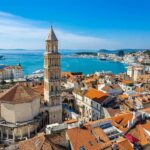
Split’s palace is a maze of wonders. This walking tour gives you a fast, guided route through UNESCO Diocletian’s Palace, with stops that help you understand where you are and what you’re looking at. I especially like the small-group size, and how guides such as Mario and Antonella can turn the stones and street corners into clear, human stories.
The main downside is simple: it can be hard to hear. Even with a good guide, the group and nearby activity can make sound carry poorly, and you may run into uneven, up-and-down steps that are not ideal if you struggle with higher stairs.
In This Review
- Key takeaways before you go
- Why this 90-minute Split walking tour works so well
- Price and what $48.37 really buys you
- Where to meet (and why Peristil helps)
- What to expect in the walk: steps, crowds, and hearing
- Stop 1: The Peristyle of Diocletian’s Palace
- Stop 2: The Vestibulum and the human side of Roman ruins
- Stop 3: Substructures of the Palace (and what you do not enter)
- Stop 4: The Golden Gate and Gregory of Nin’s statue
- Stop 5: Riva Harbor, the bronze model, and the city’s front door
- Stop 6: Fruit’s Square (Trg Brace Radic) and Marko Marulić
- Stop 7: Split Synagogue (pass by) and Jewish history in the city
- Guide impact: what makes Mario, Anton, and Antonella stand out
- Group size, tour times, and how to fit it into your day
- Who this walking tour suits best
- Should you book this Split and Diocletian’s Palace walking tour?
- FAQ
- How long is the Walking Tour of Split and Diocletian’s Palace?
- Is the tour offered in English?
- Is admission included for the palace sections?
- What are the main stops on the tour?
- Where is the meeting point?
- How big is the group?
- Is free cancellation available?
Key takeaways before you go
- 90 minutes is the sweet spot for getting oriented fast in the palace maze
- Peristyle first: you start in the palace’s central square, so directions make sense
- Real structure, not just photos: substructures and the Golden Gate explain how the place worked
- Learn Split’s language connections at the statue of Gregory of Nin
- You see more than the palace with Riva Harbor and Fruit’s Square added in
- It is short but active: expect walking on uneven ground and up/down steps
Why this 90-minute Split walking tour works so well
Split’s old core can feel like you’ve been dropped into someone else’s jigsaw puzzle. Streets bend, arches repeat, and suddenly you realize you’re standing inside a ruin that became a neighborhood. That’s why I like tours like this: they give you a mental map in a short time, without asking you to pay for full museum tickets or commit your whole day.
You also get a practical tour format. It’s about 1 hour 30 minutes, in English, and run for up to 20 people. That size matters in a place like Diocletian’s Palace, where you’re often shoulder-to-shoulder with other visitors. In a smaller group, the guide can point, slow down, and answer the question that pops up when you see one weird detail and then want to know what it means.
One more plus: it’s built around the palace’s key decision points. You’re not wandering at random. You’re walked to the spaces that connect to everything else, so you can keep exploring after the tour with more confidence.
You can also read our reviews of more walking tours in Split

Price and what $48.37 really buys you
At around $48.37 per person, this isn’t a budget bargain, but it also isn’t trying to sell you a full day of expensive admissions. The value is the guided route and the way it connects the dots: Roman emperor context, the palace layout, and the way Split grew around it.
Here’s the important part: no admission tickets are included. So think of this as a guided walk through major outdoor and pass-by areas, plus a look at parts of the palace complex where you can learn without paying for every internal ticket.
The substructures segment is a good example. You go through the substructures of Diocletian’s Palace to understand their construction and changing roles over time, but you are not taking the paid museum portion as part of the tour. You can still add that museum time later on your own, once you know what you’re looking for.
If you want to maximize value, do it early in your Split trip. A tour like this helps you decide where you want extra time afterward. If you do it on your last day, you’ll still learn a lot, but you’ll miss the chance to use that map while your feet are still flexible.
Where to meet (and why Peristil helps)

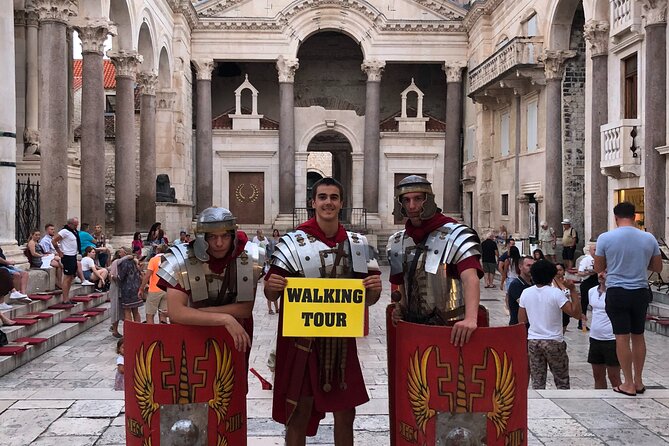
Your tour starts at Peristil ulica, 21000 Split. The Peristil area is inside the palace core, so it’s a smart starting point: you begin where the palace’s major paths intersect.
There’s also a practical detail to remember: some people find the meeting point harder than it should be, partly because the palace streets and entry points can look similar. My advice is to plan for an extra 10 minutes. Arrive a bit early, locate your exact corner, and let the group gather calmly.
The tour also ends back at the meeting point. That’s handy in Split because once you know how the palace connects to the waterfront, you can easily branch out for coffee, snacks, or a longer walk along the harbor.
What to expect in the walk: steps, crowds, and hearing
Diocletian’s Palace is not smooth marble fantasy. Expect uneven paving, occasional up-and-down motion, and tighter passages where sound doesn’t travel perfectly. The tour is marked as not recommended for travelers who have issues with high steps, which you should take seriously if you’re dealing with mobility limits.
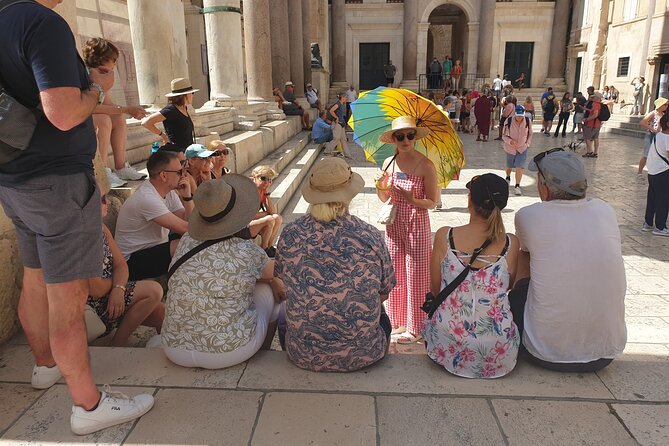
Crowds are the other real factor. Split is full of overlapping tours, and your guide may be competing with background noise. Several people flagged that audio can be tricky when multiple groups are nearby and when headsets are not provided. You can help yourself here by choosing a spot where you can see the guide’s mouth and face, not just their back.
If you know you’re sensitive to audio, bring your own small listening solution if you already use one on walking tours. At minimum, keep close during explanations. In tight areas, a half-step can make the difference between catching the story and missing the key detail.
Stop 1: The Peristyle of Diocletian’s Palace
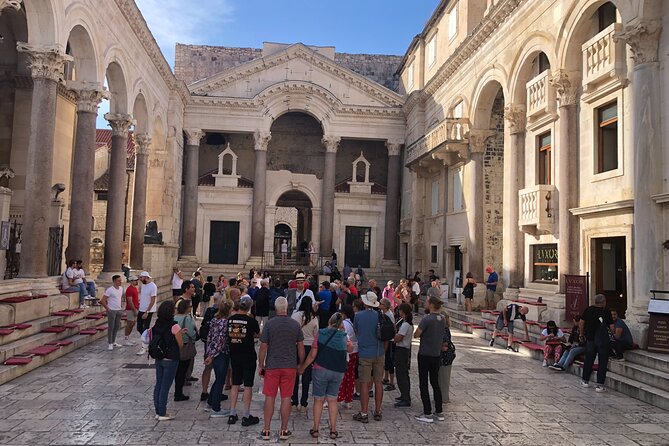
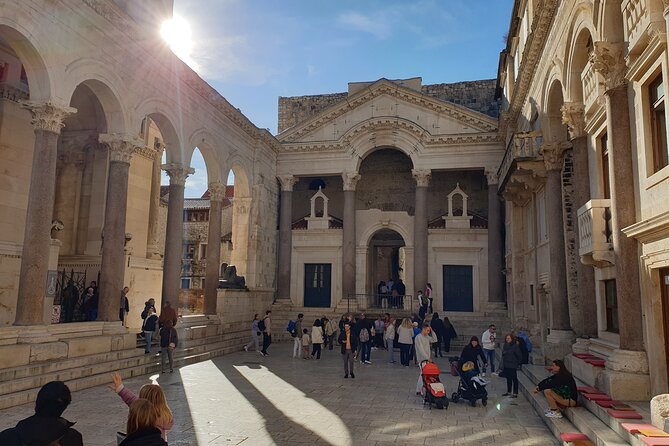
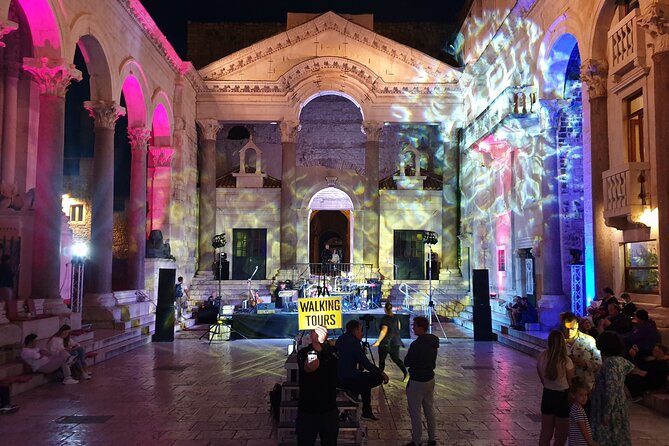
You start at the Peristyle, the palace’s central square. This is the place that sets everything else in motion. It’s not just a pretty open space. It’s the orientation hub, from which you can reach many of the other key locations inside the palace.
I love this first stop because it tells you how the palace thinks. You begin to see the geometry: where the main approach points are, how the walls frame movement, and why the palace feels like a city within a city. It’s also where many guides can explain the big picture without racing ahead.
If you like walking tours that help you understand your surroundings, this start is excellent. You get a baseline before you start mixing palace courtyards, gate areas, and street-level corners.






Stop 2: The Vestibulum and the human side of Roman ruins
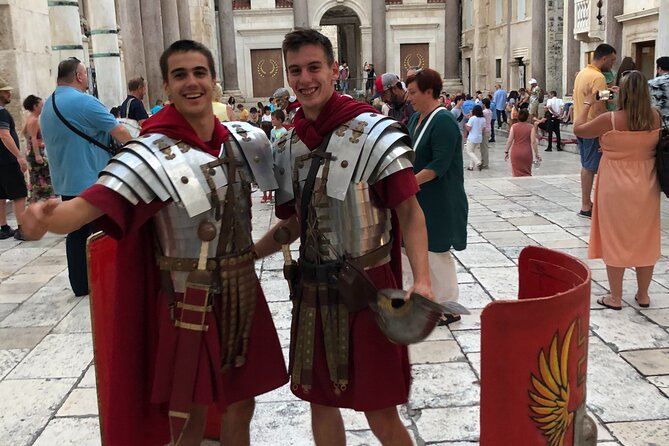
Next is the Vestibulum of Diocletian’s Palace. This is a smaller, more focused stop, centered on the vestibule area tied to Diocletian and the palace’s history.
The tour description hints that you might hear traditional Dalmatian singing. I would treat that as a possible bonus, not a guarantee. Either way, this stop is useful because it slows you down. It encourages you to look for context, not just columns.
In a building like this, it’s easy to get stuck on the drama of the emperor era. This stop helps you connect those imperial spaces to everyday life that later formed around them.
Stop 3: Substructures of the Palace (and what you do not enter)

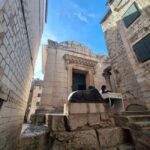
After that, you move into the Diocletian Palace substructures. This is where the tour becomes especially practical. The guide explains the palace’s construction and what the substructures were used for across different eras.
One key note: the tour does not include the museum part of the substructures. If you want to go deeper inside the museum areas, you can add that after the tour on your own time.
Why does that matter to you? Because it lets the walking tour keep its pace. You don’t get bogged down in ticket lines or spending the whole time indoors. Instead, you get the story and the layout so you can choose how much museum time you really want.
Also, substructures are often cooler and more enclosed than outdoor areas. If you’re visiting in warm weather, this can feel like a welcome break. Just wear shoes with good grip.
Stop 4: The Golden Gate and Gregory of Nin’s statue
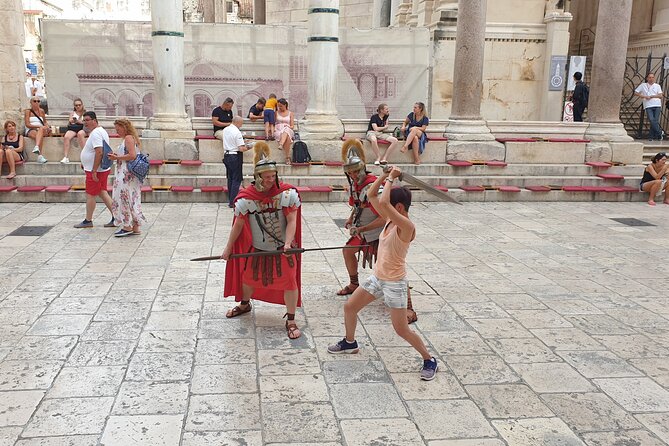
Then comes one of the tour’s headline moments: the Golden Gate. This is the main entrance area of the palace, and it’s a perfect place for the guide to connect architecture to identity.
You’ll also spend time at the statue of Gregory of Nin. The tour highlights his importance to history and language, which is a big deal in Croatia. It’s not only about monuments. It’s about how people through time have shaped the story of where they came from.
I like this stop because it prevents the tour from feeling like a museum of dead stone. You start seeing how Split uses Roman leftovers to talk about itself today.
Stop 5: Riva Harbor, the bronze model, and the city’s front door
Next is Riva Harbor, where you get two helpful things in one area. First, you’ll see a bronze model of Diocletian’s Palace. That kind of model turns the palace layout into something your brain can hold onto. After seeing the model, the places you walked past start to line up in your head.
Second, you’ll learn about the history of Riva, Split’s famous promenade. It’s the city’s front porch: boats, morning walks, and the feeling that everything important is close by.
This is also where the tour helps you plan your next steps. Once you understand the palace’s relationship to the waterfront, you can better choose where to linger after the guided portion ends.
Stop 6: Fruit’s Square (Trg Brace Radic) and Marko Marulić
From the harbor area, the tour heads toward Fruit’s Square, also known as Trg Brace Radic. Here you learn about a 15th-century Venetian citadel and the importance of Marko Marulić, described as the father of Croatian literature.
This stop is a smart change of pace. You move from Roman architecture and emperor-era symbolism into local cultural identity. If you’ve been staring at stone for the last hour, this helps the tour feel rounded.
It also gives you something practical: a reason to return to the square later. Fruit’s Square is where you can sit, snack, and let your notes and photos turn into real understanding.
Stop 7: Split Synagogue (pass by) and Jewish history in the city
The walk then includes a pass-by of the Split Synagogue, a 16th-century building. You’re taught about the history of the Jewish people in Split, though the tour notes that admission is not included.
This kind of stop is valuable even without entry because it keeps the story of Split more complete. A lot of palace-focused tours only talk about Roman layers. This adds another chapter, showing that the city’s history is made of multiple communities and time periods.
As with other pass-by moments, the goal here is awareness and context. If the synagogue visit itself interests you, you’ll need to plan that separately.
Guide impact: what makes Mario, Anton, and Antonella stand out
One of the best parts of this tour type is that the guide can make the difference between, I walked around and I learned something. The names that come up again and again include Mario, Leo, Anton, Antonella, Antonio, and Professor Marino.
What stands out in these guide reports is not just facts. It’s delivery. Some guides tell the story with humor or a teacher-like rhythm, weaving dates and details into an easy timeline you can remember later.
Still, there’s a caution worth keeping in mind. A few people reported trouble hearing or difficulty understanding certain guides when the group environment got noisy. If language clarity and audio matter a lot to you, position yourself early and stay where you can see and hear best.
Group size, tour times, and how to fit it into your day
This experience runs with several tour times, so you can usually pick a start that works with your other plans. That flexibility matters because Split’s best sightseeing routes overlap. Picking a time when you’re not trapped in the densest crowd waves can improve your enjoyment.
The tour length is short enough that you can pair it with:
- A longer waterfront walk after you learn the palace-to-Riva connection
- More independent palace wandering once you understand where the Peristyle and Golden Gate fit
- Time in Fruit’s Square for a breather and people-watching
If you’re on a cruise stop or you only have one day, this is the kind of tour that turns a tight schedule into a smarter one. You’re not buying extra entries. You’re buying clarity.
Who this walking tour suits best
This works best if you want:
- A guided orientation through Diocletian’s Palace instead of wandering blindly
- An overview that connects Roman spaces with Split’s cultural identity
- A short, group-format introduction in English
It’s less ideal if:
- You have trouble with high steps or uneven surfaces
- You’re very sensitive to sound in busy public areas
- You want paid museum time included as part of the base tour (because admissions are not included)
Should you book this Split and Diocletian’s Palace walking tour?
If you want a fast, structured start in Split’s most famous zone, I think it’s a solid pick. At about 90 minutes, with a small group and a guide-led route through major palace points like the Peristyle and Golden Gate, you get a foundation that makes your later self-guided exploring easier.
The decision comes down to expectations:
- If you’re happy with no admissions included and you want context more than ticketed interiors, book it.
- If you need guaranteed quiet and perfect audio in crowded spaces, consider timing and plan to stand close to the guide.
My practical suggestion: use this tour as your first move in Split. You’ll walk out with the palace layout in your head, know where the waterfront fits, and have fewer wrong turns while the day is still yours.
FAQ
How long is the Walking Tour of Split and Diocletian’s Palace?
It lasts about 1 hour 30 minutes.
Is the tour offered in English?
Yes, it’s offered in English.
Is admission included for the palace sections?
No. No admission tickets are included.
What are the main stops on the tour?
You’ll cover Diocletian’s Palace highlights like the Peristyle, Vestibulum, substructures, and the Golden Gate, plus Riva Harbor, Fruit’s Square, and a pass-by of the Split Synagogue.
Where is the meeting point?
The tour meets at Peristil ulica, 21000, Split, Croatia, and it ends back at the same meeting point.
How big is the group?
The tour has a maximum of 20 travelers.
Is free cancellation available?
Yes. You can cancel for a full refund up to 24 hours before the experience starts. Within 24 hours, the amount paid is not refunded.