REVIEW · SPLIT
Split Walking Tour with Professor of History
Book on Viator →Operated by Split Walking Tour with History Professor · Bookable on Viator
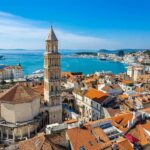
Split’s old streets teach fast. This professor-led walk turns the UNESCO-listed core into a story you can follow, from the harbor to Diocletian’s palace rooms and gates. I love how the guide spots the small visual clues—arches, corridors, and reused stones—and then explains what they meant in Roman times. I also like the human touch, with guides like Mario and Anita bringing humor, pride, and clear English so you don’t just hear dates, you understand the place.
One thing to plan for: the tour can run a bit long. Even though it’s listed around 2 hours 20 minutes, I’d treat that as a best case, not a strict clock, and wear comfy shoes so a potential extra stop or extra storytelling doesn’t ruin your afternoon.
In This Review
- Key takeaways
- Meeting at Brass Gate: start where Diocletian’s entry once mattered
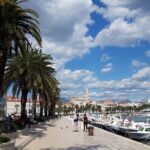
- Riva Harbor (Riva): the harbor as Split’s living front door
- Diocletian’s substructures: seeing power from underneath
- The Peristyle: the palace square where authority was performed
- Vestibule (the Rotonda): a circular hall built for select audiences
- Cathedral of Saint Domnius: what you can see, and what stays optional
- Temple of Jupiter and the path to Golden Gate: outside views plus a legend
- Golden Gate: the emperor’s entrance and a gate that survived changing centuries
- Gregory of Nin’s statue: toe-rubbing as folk tradition
- Marmontova Ulica and Prokurative: the city grows up around the ruins
- Fruit Square (Trg Brace Radic): stories of everyday life and local taste
- Why the history professor style makes this tour work (Mario and Anita)
- Price and timing: what $24.19 buys you in real value
- Practical tips so you enjoy every step
- Who should book this Split professor-led walk
- Should you book this Split walking tour?
- FAQ
- How long is the Split walking tour with a history professor?
- What language is the tour offered in?
- Where does the tour start?
- Is entrance included for the Cathedral of Saint Domnius and the Temple of Jupiter?
- What is the group size limit?
- Is there an option for a private tour?
Key takeaways
- Small group, better attention: Maximum 17 people means more chances to ask questions and see what matters.
- Diocletian’s palace, from basement to gate: You’ll move through the substructures, peristyle, vestibule, and the main entrance.
- Most stops are outside: You’ll see the big sites without buying tickets for every stop (cathedral and Jupiter are optional).
- Myths get corrected: Expect myth-busting and context, not just random trivia.
- Local “how people live” stops: Squares and streets like Let me pass street connect history to daily life.
- Back to the start point: The walk ends where it begins, so you can keep exploring with less guesswork.
Meeting at Brass Gate: start where Diocletian’s entry once mattered
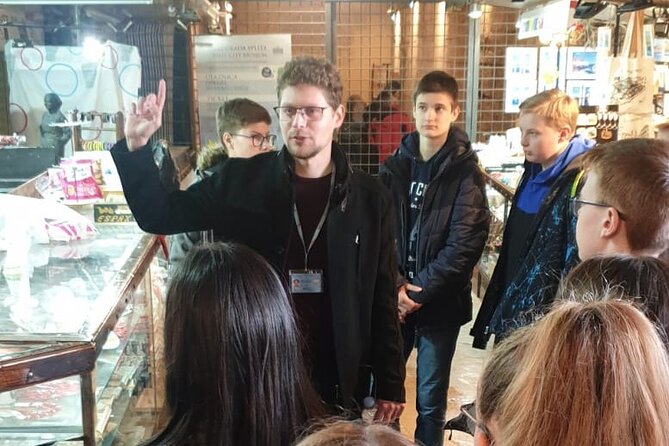
Most “walking tours” start in a generic place. This one starts at Brass Gate (Porta Aenea) on the harborfront. That’s a smart move. You begin at the edge of the historic core, right where you can also take in the rhythm of Split—coffee stops, people-watching, and that constant sense of movement along the Riva promenade.
From here, the tour has a clean path. You’re not wandering aimlessly, and you’re not stuck guessing what you’re looking at. The guide frames each stop so the next one makes sense. If you like your old cities with a little structure, you’ll appreciate that.
You can also read our reviews of more walking tours in Split
Riva Harbor (Riva): the harbor as Split’s living front door
The walk opens at Riva Harbor, on the promenade by the palace area. This is where Split’s public life shows up in plain sight. It’s where locals take coffee breaks, sit in the sun, and treat the waterfront like their backyard.
Why this stop matters: it sets the baseline for everything after. Later, you’ll be staring at Roman stonework and medieval additions. Starting at Riva helps your brain switch modes—from modern daily life to the ancient logic behind where power sat, where people gathered, and how a city organized itself around movement and trade.
Practical note: this part is outdoors, so if the sun is strong, plan for water and sun protection. You’ll have breaks in shaded spots later, but it’s still a harbor-front start.
Diocletian’s substructures: seeing power from underneath
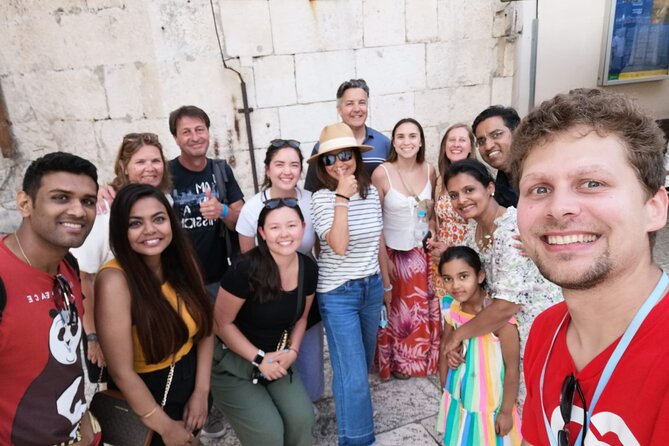
Next comes the Diocletian Palace substructures—basement halls that are some of the best-preserved spaces from classical antiquity. Standing in those spaces (or looking through them) changes how you “feel” the palace. You realize the palace wasn’t just a set of fancy rooms for one ruler. It was engineered, layered, and built to last.
What makes this stop special is how it reframes the palace. Instead of picturing only the emperor’s public face, you start thinking about logistics: storage, movement, and the hidden infrastructure that kept daily palace life running.
Also, you get UNESCO-level context without it sounding like a lecture. The guide connects why Split’s historic center earned UNESCO status back in 1979—because the palace wasn’t wiped away by time. It was preserved in a way you can still walk through.
The Peristyle: the palace square where authority was performed
Then you reach the Peristyle, the central square of Diocletian’s palace. This is the stage. The guide points out how the layout was meant for public moments and imperial visibility—where the emperor would be seen, and where subjects would approach in set ways.
If you love architecture, you’ll enjoy how the guide turns stone into behavior. The space isn’t just pretty. It was designed so rank and ritual were readable at a glance.
The drawback here is purely practical: this is a “look, listen, stand still” kind of stop. If your legs are sensitive, you’ll want to keep moving lightly and take breaks when the group shifts. Good guides manage pacing, and the small-group size helps.
Vestibule (the Rotonda): a circular hall built for select audiences
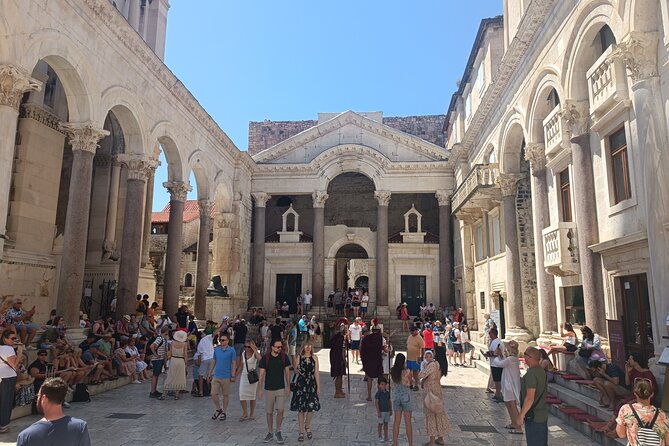
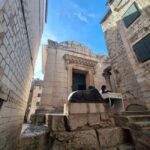
The next stop is the Vestibul (the Rotonda), an imperial corridor area that once led from the peristyle. It’s a circular hall and was designed for select audiences—ambassadors and important figures, not random visitors.
This part is a great example of why a professor-style guide is useful. A building like this can feel “mysterious” if you only see a shape. But when you understand it was meant for formal meetings, it clicks. You start noticing how the space supports ceremony: the scale, the geometry, and the way people would have entered and gathered.
If you’re the kind of traveler who loves to ask yourself what a place was for, this stop will deliver. If you only want a quick highlight reel, this might feel a touch more detailed—but it’s still short and focused.
You can also read our reviews of more historical tours in Split
Cathedral of Saint Domnius: what you can see, and what stays optional
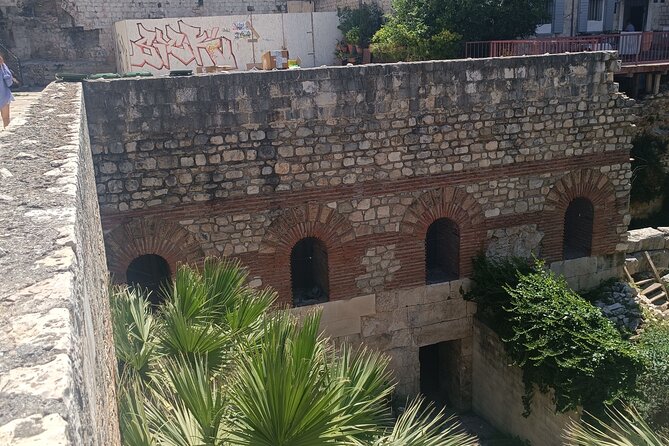
Stop five is the Cathedral of Saint Domnius. Here’s the key detail for planning: this tour is outside only at this stop. Entrance isn’t included. The guide will give detailed information, and if you want to go in afterward, that’s your choice.
Why it’s worth the outside view: Saint Domnius can be interpreted in multiple layers—as a Roman temple, mausoleum, and then a church, depending on how you look at it. The guide helps you see the overlaps without turning it into a confusing jumble.
Real-world tip: if you know you want interior time, you should budget extra hours after the tour. The walking part will move along at a steady pace, and you don’t want to feel rushed.
Temple of Jupiter and the path to Golden Gate: outside views plus a legend
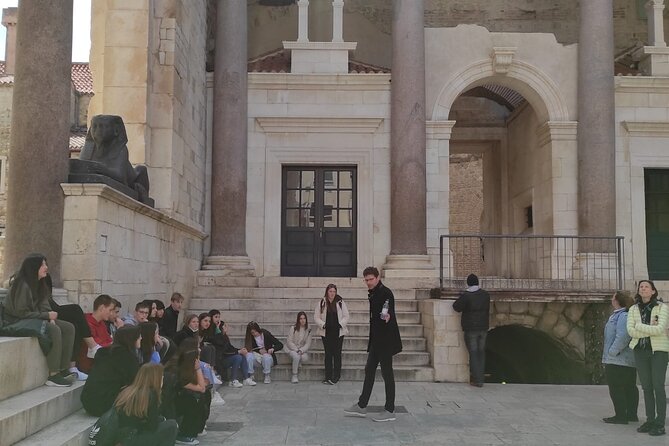
Next is the Temple of Jupiter. Like Saint Domnius, you’ll see it from the outside only, with entry not included. The guide connects how the temple was converted into a baptistery dedicated to St. John the Baptist—one more reminder that Split’s buildings weren’t just abandoned. They were repurposed, reused, and reinterpreted.
On your way to the Golden Gate, you’ll walk through a small street locals believe is the narrowest street in the world: Let me pass street. That’s a fun “side scene” that breaks the heavier architectural stops. It’s also a good moment for the guide to connect older urban planning with the way city life continues to squeeze into tight spaces.
Golden Gate: the emperor’s entrance and a gate that survived changing centuries
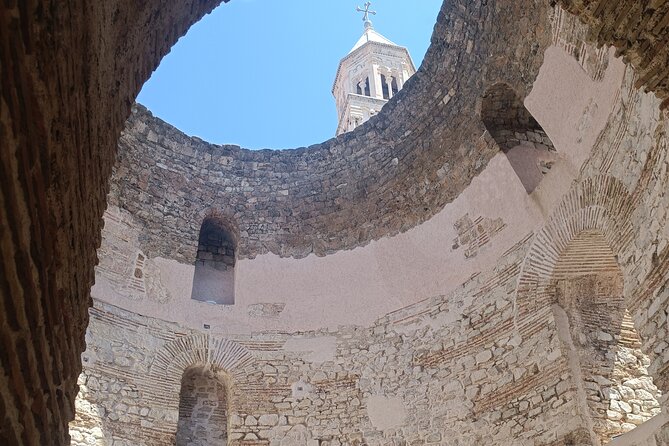
The Golden Gate (the Northern Gate) is one of the principal Roman gates into the old town of Split, built as part of Diocletian’s palace. The guide explains how it functioned as the main gate for the emperor’s entry—and how it was decorated to show importance.
Then the story shifts to the Middle Ages, when the gate was sealed off and lost columns and statuary. Finally, it was reopened and repaired in modern times and now works as a tourist attraction.
This stop is where the “history as a living timeline” idea becomes real. You can literally see how a monument changes roles across centuries—without anyone pretending the past stayed frozen.
Gregory of Nin’s statue: toe-rubbing as folk tradition
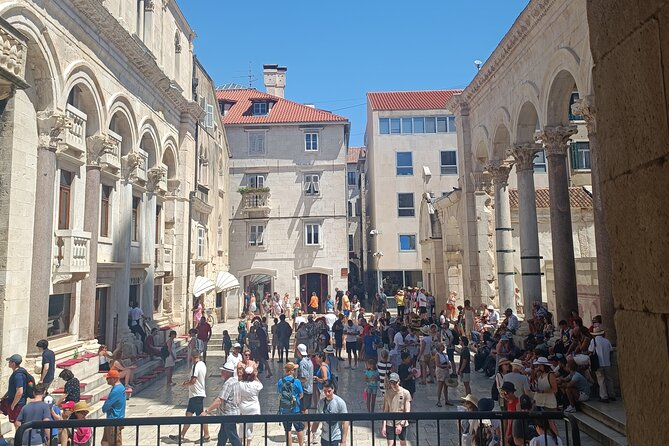
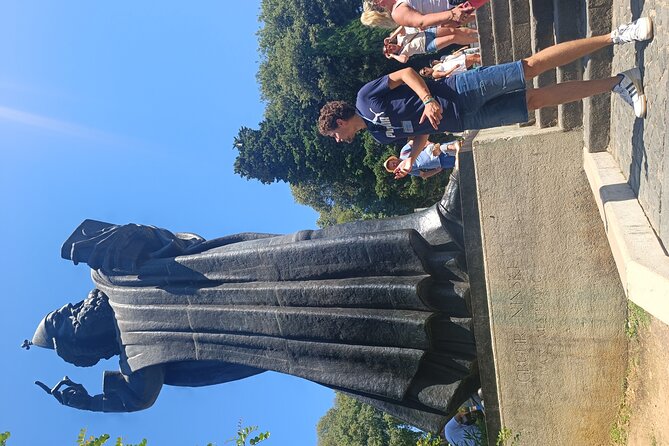
If you’ve seen photos of the statue’s shiny toe, you know the vibe. Stop eight is the Grgur Ninski Statue by Ivan Meštrović, and yes—the toe is polished from the ritual belief that rubbing it brings good luck.
It’s not “historical” in the Roman sense, but it’s cultural. Folk traditions like this are how cities carry identity through daily tourism. The guide doesn’t just point; they frame the custom so it feels like part of Split’s character, not just a gimmick.
Marmontova Ulica and Prokurative: the city grows up around the ruins
After the statue, you’ll stroll along Marmontova Ulica, a street named after Napoleon’s marshal Marmont. The key detail isn’t the politics—it’s the local twist: Split’s citizens honored him by naming their most beautiful street after him.
Then comes Prokurative, Republic Square, surrounded by neo-Renaissance buildings on three sides. This is one of those stops that helps you understand how Split kept evolving after the palace era. It’s where public life spills into open space again, but with a different architectural language.
If you’re worried this tour will feel too Roman-only, these two stops are your reassurance. You get balance: ancient structure, then later city design and civic space.
Fruit Square (Trg Brace Radic): stories of everyday life and local taste
The last stop is Fruit Square (Trg Brace Radic), a small square tied to fruit-selling history and the character of the marketplace vibe. The guide connects important local figures, including Marko Marulić, often described as the father of Croatian literature.
This is also a good moment for food and culture talk. History doesn’t end at stone walls here. It gets paired with gastronomy and how people live now. That matters because Split is a place you visit for more than monuments—you want to eat well and know where to spend your time after the tour ends.
One practical thing: this is a natural place to take notes. By the time you finish, you’ll be ready to pick a direction for your next meal and your next walk.
Why the history professor style makes this tour work (Mario and Anita)
The highest praise in this tour’s record isn’t just about places—it’s about the delivery. Guides like Mario and Anita are described as passionate, funny, and fully in command of the material. You’ll hear jokes, but they don’t replace the teaching. The humor is used to keep you awake and paying attention, which is exactly what you want in a city where the details can be overwhelming.
A few practical teaching techniques show up in the way guides manage the group:
- They explain what you’re seeing before you get lost in it.
- They keep the group moving enough that you don’t freeze in one spot with sore feet.
- They answer questions instead of rushing through a script.
- They share next-step tips for food and onward travel, which is huge when you’re seeing a new city for the first time.
If you’ve done tours where the guide reads a timeline, you’ll appreciate this one more. This style is about interpretation—turning architecture into an understandable story. And because it’s a small group (up to 17), you’re not one voice in a crowd.
Price and timing: what $24.19 buys you in real value
At $24.19 per person (about a 2 hours 20 minutes walk), this tour is strong value if your goal is orientation plus context. You’re not just buying access to a “see-this, see-that” checklist. You’re paying for expert framing of Diocletian’s palace and the surrounding old town so you can continue exploring afterward with better instincts.
Also, most stops don’t require paid entry to view. The tour includes no admission cost at Riva, substructures, peristyle, vestibule/rotunda, Golden Gate, Gregory of Nin statue, Marmontova Ulica, Prokurative, and Fruit Square. Two places are outside-only with entry not included: Saint Domnius and the Temple of Jupiter.
That mix matters. It’s a good compromise for travelers who want the big picture now and optional interior time later.
Timing consideration: a review note calls out that the tour can run closer to 3 hours than the stated time. So plan with a little buffer. If you’re trying to catch a very tight dinner reservation or a ferry right after, give yourself slack.
And if weather is bad, this experience requires good weather. If it’s canceled for weather, you’ll get another date or a full refund.
Practical tips so you enjoy every step
Here are the few things that make a difference on this kind of old-town walk:
- Wear comfortable shoes. The route is dense with stops and standing moments, even when the pace is steady.
- Bring water. The harborfront start means you can feel sun fast.
- Decide in advance if you want to go inside Saint Domnius or the Jupiter area. Since entry isn’t included, treating those as optional keeps your day flexible.
- Use the mobile ticket and head to the start at Brass Gate (Porta Aenea) on Obala Hrvatskog narodnog preporoda 22.
- If you want a more personalized experience, there’s an option to upgrade to a private tour.
Who should book this Split professor-led walk
This is a great fit if you:
- want history explained clearly, not tossed at you as facts
- are visiting Split for the first time and want your bearings fast
- like walking cities and don’t mind standing for short moments
- appreciate guides who mix humor with context
It’s also a smart choice if you hate wasting time. You’ll cover the core palace and old-town highlights in one focused pass, then you can return later to the interior sites if you want that extra level.
Should you book this Split walking tour?
Yes—if your idea of a good day in Split includes Diocletian’s palace, Roman-to-Christian layers, and a guide who can make the city feel logical instead of confusing. The price is reasonable for the access to a professor-level narrative, and the small-group size keeps it interactive.
Skip or think twice only if you strongly prefer short, purely photo-based stops with minimal explanation, or if you need a hard time limit. The tour is designed for learning, and learning takes a little extra time.
If you’re planning your first trip, this is one of the best ways to get your head around Split—then go eat well with confidence afterward.
FAQ
How long is the Split walking tour with a history professor?
It runs for about 2 hours 20 minutes (approx.).
What language is the tour offered in?
The tour is offered in English.
Where does the tour start?
The meeting point is Brass Gate (Porta Aenea), Obala Hrvatskog narodnog preporoda 22, 21000, Split, Croatia.
Is entrance included for the Cathedral of Saint Domnius and the Temple of Jupiter?
No. The tour includes outside viewing at both, and entrance tickets are not included.
What is the group size limit?
The tour has a maximum of 17 travelers.
Is there an option for a private tour?
Yes, you can upgrade to a private tour for a more personalized experience.