REVIEW · LONDON
London: Jack the Ripper Walking Tour – Ripper Vision Tours
Book on GetYourGuide →Operated by Secret Chamber Tours Ltd · Bookable on GetYourGuide
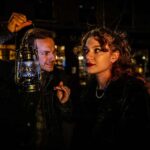
Fog, gaslight, and one handheld projector. This Jack the Ripper walking tour in Whitechapel is interesting because Ripper-Vision turns key moments into street-level visuals, so the case feels immediate instead of distant. I particularly like the way the projector-style scenes (crime scenes, photos, and suspects) help you connect what the guide is saying to what you’re standing on.
The second big win is the storytelling mix: facts and conspiracy theories, then a final attempt to identify the ripper using a style of criminal profiling. One thing to weigh: it’s a night walking tour with moderate walking over uneven ground and cobblestones, and if you’re sensitive to graphic imagery, you’ll want to pay attention to the guide’s warnings before the projector shows those scenes.
In This Review
- Key things I’d circle before you go
- Entering Whitechapel: Aldgate East Exit 3 and the Art Gallery meetup
- Ripper-Vision on the street: why the projector matters
- Following the crimes across Whitechapel: what each part of the walk does
- The facts, conspiracies, and profiling-style theory (and how to enjoy it)
- Night walking logistics: shoes, uneven ground, and weather reality
- Price and value: is $26.94 for 105 minutes worth it?
- Who should book this and who should skip
- Should you book Ripper-Vision’s Jack the Ripper walking tour?
- FAQ
- How long is the Jack the Ripper walking tour?
- Where does the tour start and end?
- What is Ripper-Vision?
- Is the tour offered in bad weather?
- What should I bring or wear?
- Is this tour suitable for wheelchair users or mobility impairments?
- Is it safe to book if I have heart problems?
- Will the tour show graphic images?
- What language is the tour guide?
- Is free cancellation available?
Key things I’d circle before you go
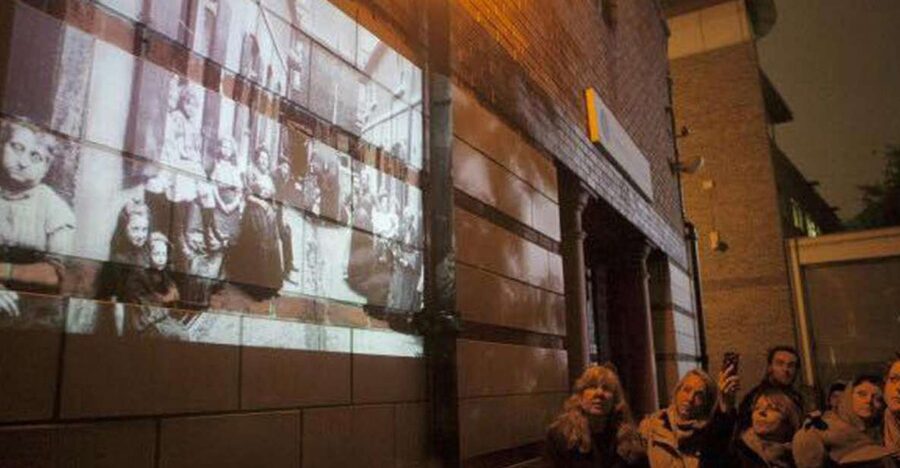
- Street projections that act like 1800s evidence rather than flat museum posters
- Crime-scene, mortuary photo, and suspect visuals projected onto Whitechapel streets via Ripper-Vision
- A case built from facts plus theories, then pushed toward an identification using profiling-style reasoning
- Graphic-scene warnings so you can choose how closely to watch the projector moments
- Guides with strong storytelling energy, including Harry, Alan, Mick, Rob, and Matt (names you may recognize from guides on past runs)
Entering Whitechapel: Aldgate East Exit 3 and the Art Gallery meetup
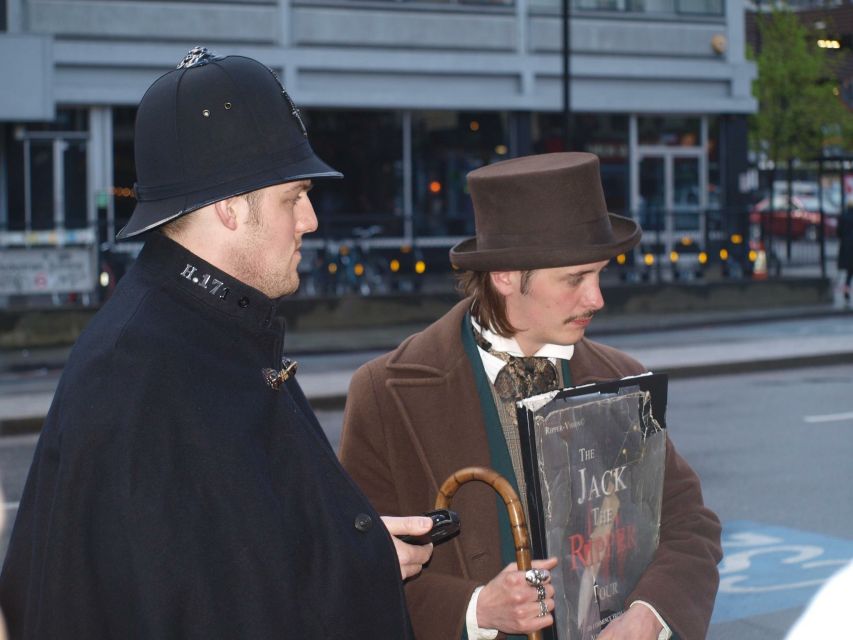
You start outside Aldgate East Tube Station, Exit 3—and yes, it specifically means Aldgate East, not Aldgate Station. The meeting spot is outside the Whitechapel Art Gallery, next to a KFC. That’s handy because it’s a clear landmark area if you’re arriving by Underground.
Before the tour starts, I’d treat this as your quick positioning moment. The streets in this part of London can be narrow, and once the group begins moving, you won’t get much time to find a comfortable viewing spot. If you care about seeing the projector visuals clearly, try to get your place early in the group line—right at the front tends to work better than hovering in the back.
This tour runs on a schedule with different starting times (duration is 105 minutes). Since it’s a night-style experience built around projections, picking a start time when it’s darker can make a visible difference. If you arrive while it’s still bright out, the projector images can be harder to see from your exact spot.
You can also read our reviews of more walking tours in London


Ripper-Vision on the street: why the projector matters
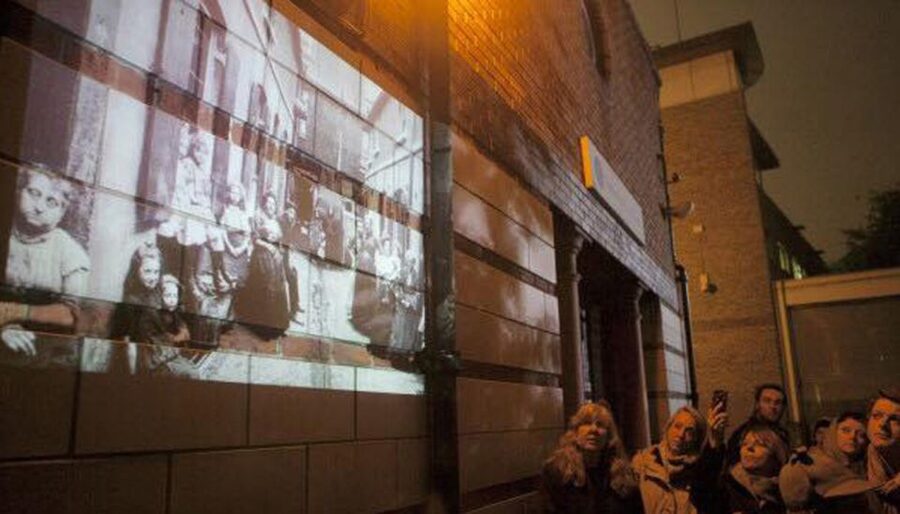
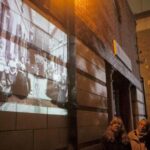
This is not your usual Jack the Ripper walk where you just listen and hope your imagination fills in the gaps. The star is a hand-held projector called Ripper-Vision, carried by your guide. As you move through Whitechapel, the guide projects images onto the streets, including crime-scene visuals, mortuary photos, and suspects.
Here’s why that works so well for most people: it gives your brain something concrete to latch onto. You’re not only hearing a timeline of events—you’re seeing corresponding images at street level while the guide explains what’s going on. It can be the difference between a tour that’s mostly facts in your ears and one that feels like the case is unfolding right around you.
Practical tip: expect to stand and angle yourself to view the projection. On narrow streets, the group can pack in, which may affect sightlines and hearing. One review highlighted that when the group gets large, it can get difficult to see and hear at moments—again, this isn’t a guide problem, it’s just physics and crowded streets. If you want the visuals to land, stay near where you can see the projection area clearly and keep your attention on the guide’s voice before the projector kicks in.
Following the crimes across Whitechapel: what each part of the walk does
I like to think of this tour as a sequence of “evidence moments.” You’ll move through Whitechapel with the guide narrating, and the projector adds a visual layer at the key stops. Even without a posted stop-by-stop landmark list, you can still understand the tour flow based on what the experience is designed to show.
1) The street briefing and case setup
Right after you meet near the Whitechapel Art Gallery, your guide sets the tone and frames what you’ll be investigating. This is where you learn how the night’s story will work: Victorian London mood, the case timeline, and what your guide plans to emphasize later.
2) Crime-scene image moments
As the walk continues, the guide uses Ripper-Vision to flash crime-scene images onto the streets. The value here is clarity. The guide can point out details in the story while you see the visuals aligned with the narration, making the locations feel more grounded than a generic retelling.
3) Mortuary-photo projection pauses
Then come the mortuary photos. Expect the guide to handle this carefully. One recurring practical detail from past experiences is that guides provide warnings about graphic scene pictures before they show them, so you can look away if you don’t want to watch every image.
4) Suspects projected, then analyzed
Next, the projector shifts toward suspect-related visuals. This is where the tour becomes more than a history walk. The guide guides you through who might fit the patterns, and why certain theories stick while others don’t.
5) The profiling-style theory and final push
Near the climax, your guide tries to identify who Jack the Ripper was using modern methods of criminal profiling—presented in an understandable, story-first way. Past guides have done this with a “big manhunt” framing, and they may end with a strong candidate and the reasoning behind it. If you like a tour that reaches an ending rather than stopping at open-ended trivia, this part is the payoff.
The facts, conspiracies, and profiling-style theory (and how to enjoy it)
Jack the Ripper stories are famous for two things: there’s a lot of information floating around, and there’s also a lot of disagreement. This tour leans into both. You’ll learn facts and conspiracies around the identity of Jack the Ripper, and you’ll also get a profiling-style attempt to narrow the possibilities.
What makes that valuable is the structure: you don’t just hear a single theory and leave. Instead, the guide explains the reasoning behind the claim—why police might have overlooked certain angles, and how modern profiling methods are used to argue for a particular suspect type. That’s a more satisfying way to handle a mystery that has no confirmed final answer.
I also like that some guides invite discussion in a controlled way. Names that have popped up from past runs include Harry, Alan, Mick, Rob, Andre, and Andrew. The common thread is strong storytelling energy and a willingness to talk through the case logic, not just rattle names. If you’re the type who enjoys comparing theories in your head while you walk, you’ll get more out of this.
One note: if you’re squeamish about crime-scene material, this still isn’t a soft ride. The tour handles graphic content with warnings, but the subject matter is what it is. You can choose not to stare at the projector when warnings come up—just be aware that it’s still part of the experience design.
Night walking logistics: shoes, uneven ground, and weather reality
This tour runs in all weather conditions, which is classic London honesty. Your best bet is to dress for rain or chill and treat this like a real walking activity, not a casual stroll. Wear comfortable shoes—the tour includes moderate walking and may involve uneven ground and cobblestones.
The tour also isn’t suitable for everyone. It’s not recommended for people with mobility impairments, wheelchair users, or people with heart problems. If that’s you, it’s worth skipping this one and choosing a different kind of Whitechapel experience.
If you’re healthy and able to walk, you’ll still want to plan for night conditions: keep warm layers handy, and don’t assume you’ll be able to stop for long photo breaks. This is a guided flow, and the projector moments happen as you move.
One extra practical point comes up from experience: starting while it’s still light can make the projections harder to see. If you have scheduling flexibility, pick a later starting time when it’s darker so you get the full point of Ripper-Vision.


Price and value: is $26.94 for 105 minutes worth it?
At $26.94 per person for 105 minutes, you’re paying for two things: a live guide plus the technology and story craft that comes with Ripper-Vision.
For value, consider what you’re actually getting:
- A live guide who tells the story and frames the theory
- A guided walk through Whitechapel focused on the Jack the Ripper case
- Projected visuals of crime scenes, mortuary photos, and suspects, right where the story is set
This isn’t just “sound-guided history.” The projector component is the core differentiator, and the reviews show that it’s the feature people remember most. The tour also has a 4.5 rating from 1,752 ratings, which suggests the formula works consistently, especially around guide performance and the impact of the visuals.
If you’re someone who likes history told through atmosphere, places, and visual cues, the price-to-time ratio feels fair. If you prefer quiet, museum-style learning with fewer graphic elements, you might find the tone heavy for the money. But as a night walking experience built around the case, it’s reasonably priced.
Who should book this and who should skip
I’d book this if you want:
- A night-focused Jack the Ripper walk in Whitechapel, not a daytime lecture
- A tour where visuals support the story through Ripper-Vision projections
- Someone like me who enjoys mystery-solving energy, including a profiling-style theory at the end
- Guides who bring the case to life, with storytelling names like Harry, Alan, Mick, Rob, Matt, Sinead, Andre, and Andrew appearing from past runs
I’d skip it if you:
- Use a wheelchair, need mobility accommodation, or can’t handle uneven cobblestones
- Have heart problems and can’t manage prolonged standing and nighttime walking
- Know you can’t handle graphic crime-scene visuals even with warnings before they’re shown
If you do go, tip your future self: bring your best listening attitude. The tour gets better when you’re paying attention to the guide’s explanations as you watch the projected moments.
Should you book Ripper-Vision’s Jack the Ripper walking tour?
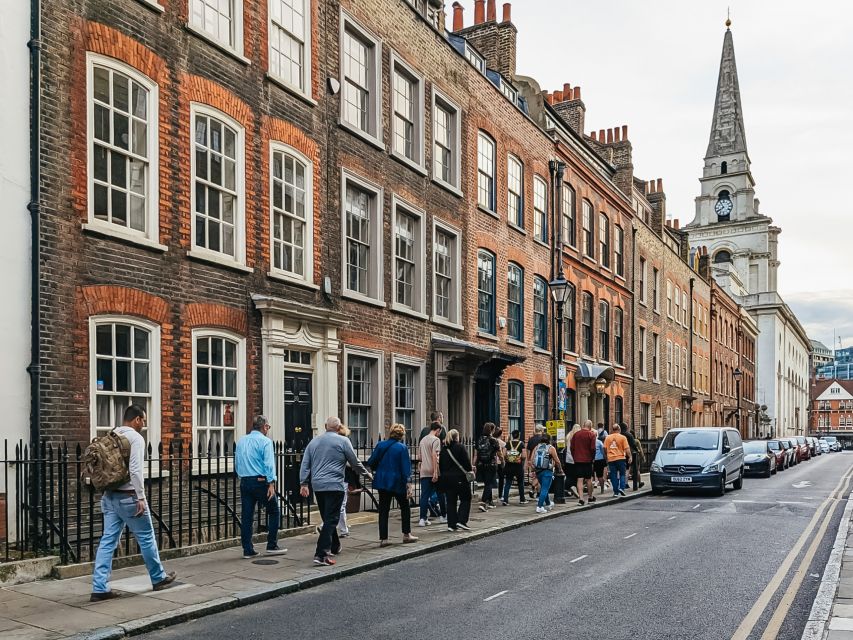
Book it if you want Whitechapel at night plus a visual storytelling tool that places evidence images right on the street. The combination of a live guide, the Ripper-Vision projections (crime scenes, mortuary photos, suspects), and a final profiling-style attempt at the identity makes this more than a typical walking tour.
Skip it if walking over uneven ground in cold or wet weather isn’t realistic for you, or if you know graphic images won’t work for your comfort level.
If you can handle the walk and you’re curious about how theories get built and tested, this is a strong choice for your London time—especially if you pick a start time when it’s dark enough for the projector to actually shine.
FAQ
How long is the Jack the Ripper walking tour?
The tour duration is 105 minutes.
Where does the tour start and end?
Meet outside Aldgate East Tube Station, Exit 3 (not Aldgate Station), outside the Whitechapel Art Gallery next to KFC. The tour ends back at the meeting point.
What is Ripper-Vision?
Ripper-Vision is a handheld projector used by the guide to project images of crime scenes, mortuary photos, and suspects onto the streets in Whitechapel.
Is the tour offered in bad weather?
Yes. The tour operates in all weather conditions, so dress appropriately for rain and cold.
What should I bring or wear?
Wear comfortable shoes and clothing appropriate for the weather.
Is this tour suitable for wheelchair users or mobility impairments?
No. It is not suitable for people with mobility impairments and is not suitable for wheelchair users.
Is it safe to book if I have heart problems?
The tour is not suitable for people with heart problems.
Will the tour show graphic images?
The guide may show graphic scene pictures, and warnings are provided so you can choose whether to look away during those moments.
What language is the tour guide?
The tour guide provides the tour in English.
Is free cancellation available?
Yes. You can cancel up to 24 hours in advance for a full refund.