REVIEW · DUBLIN
2-Hour Historical Walking Tour from Dublin
Book on Viator →Operated by Historical Walking Tours of Dublin · Bookable on Viator
Dublin’s past comes fast, on foot. This 2-hour historical walking tour strings together key places that explain how Dublin—and Ireland—kept changing, from medieval power to 20th-century political rupture. It’s led by history postgraduates, small group size capped at 25, and it’s built for doing early in your trip.
I love how the walk gives you an instant sense of direction: you meet on College Green by the Grattan statue opposite Trinity College Dublin, then you move site to site in a clear storyline. I also like that the stops are practical stops you can revisit later, like the Trinity area, Christ Church Cathedral, and Dublin Castle, with explanations that connect the buildings to the big events.
The one thing to watch is tone: this tour is history and politics heavy, and the guide packs in a lot of detail, so you’ll want to pay close attention. If you prefer a lighter chatty walk focused more on culture than conflict, you might find it a bit dense.
In This Review
- Key things to know before you go
- Why a 2-hour Dublin history walk is a smart use of your time
- Meeting on College Green: finding the group without stress
- Trinity College and the Book of Kells: why this first stop matters
- Bank of Ireland and the colonial timeline you can actually picture
- Temple Bar to cultural quarter: repurposed streets, repurposed meaning
- Wood Quay Amphitheatre: where Viking Dublin shows up in the ground
- Four Courts: law headquarters and the shock of June 1922
- Christ Church Cathedral and City Hall: faith, conquest, and Catholic emancipation
- Dublin Castle: from King John to British administration to the Black Pool name
- Guide style: history postgrads who tell it like a story
- Price and value: $22.98 for a fast Dublin context boost
- What to wear and how to pace yourself
- Who should book this tour (and who might skip it)
- Should you book the 2-hour Historical Walking Tour from Dublin?
- FAQ
- How long is the Dublin historical walking tour?
- What does the tour cost?
- Where do you meet the guide?
- Where does the tour end?
- Is entry to the Book of Kells included?
- How many people are in the group?
- Is the tour offered in English?
- What fitness level do I need?
- Are service animals allowed?
- Is there free cancellation?
Key things to know before you go
- Small group, big guidance: max 25 people, English-speaking, and guided by history postgraduates
- Meet at Trinity’s doorstep: start at the Henry Grattan Monument on College Green, opposite Trinity’s front gate
- You’ll hear about the Book of Kells, but it’s not included: plan on an extra ticket if you want to go inside
- A “from myth to modern” route: Vikings, colonial rule, legal headquarters, and revolution-era Dublin in one loop
- Comfy shoes matter: it’s about a 2-hour walk and you’ll want to stay warm if the weather turns
- Good for first-day context: it helps you understand Dublin’s layout and why these landmarks matter
Why a 2-hour Dublin history walk is a smart use of your time
If Dublin feels like a lot of stone, pubs, and street names, this tour is a fast way to add meaning. In two hours, you get the threads that tie Trinity, cathedrals, courts, and castles to the political and religious stories that shaped the city.
I like the pacing because the timing is honest: you’ll walk, stop, listen, and keep moving. Then you’re free to roam the rest of the day with a clearer sense of what you’re looking at. It’s also priced in a range that makes sense for a guided introduction, especially with a group kept to a small size.
You can also read our reviews of more walking tours in Dublin



Meeting on College Green: finding the group without stress
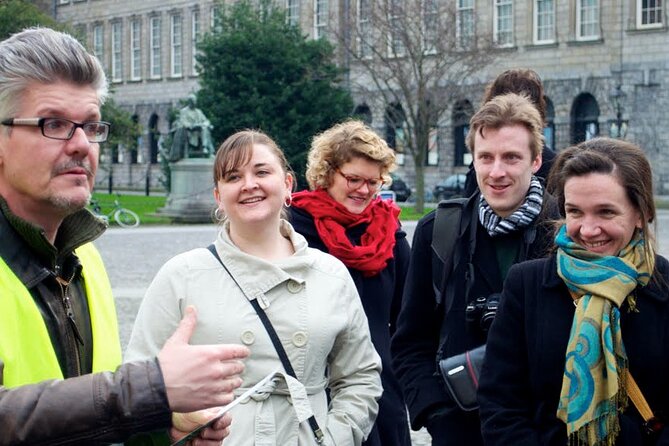
You start at the Henry Grattan Monument on College Green, Dublin. The key detail is where you look: it’s opposite the Trinity College Dublin front gate area, so you’re not hunting down a guide in the middle of nowhere.
The tour uses a mobile ticket, and you get confirmation at booking. It’s also designed to be easy to access by public transport since you’re starting right in central Dublin.
Quick tip: arrive a few minutes early, especially if you’re also trying to orient yourself around Trinity. The group starts from the Grattan statue area, not from inside the campus gates.
Trinity College and the Book of Kells: why this first stop matters
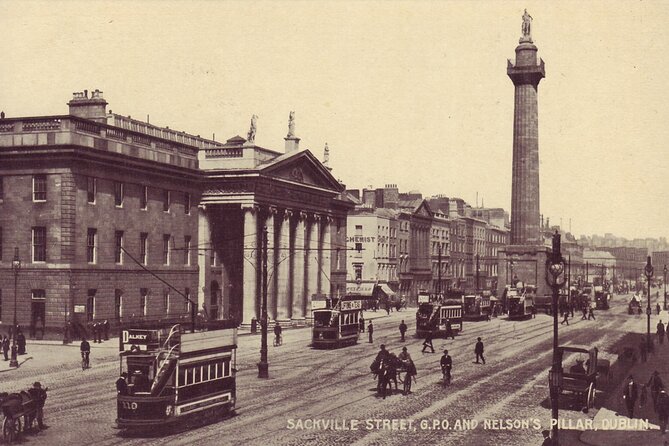
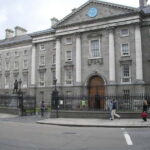
Your first stop is Trinity College Dublin, with about 20 minutes on site. This isn’t just “old college bragging rights.” You’ll learn why Trinity became Ireland’s oldest university (since 1592) and how it fits into Dublin’s story of power and culture.
The tour also connects Trinity to the Book of Kells, an 8th-century manuscript of the four Gospels written in Latin. Here’s the practical part: the tour covers the story and significance, but entry to the Book of Kells itself is not included. If you want to see it, you’ll need your own ticket.
What I like: starting here gives you a reference point for everything that follows. You leave with a mental map of how Ireland’s institutions formed and why certain symbols carried weight.
Possible drawback: Trinity is a big, high-energy site. If you’re the kind of person who gets overwhelmed by crowds and entrances, you’ll still do fine, but it helps to keep your focus on the guide’s storyline.
Bank of Ireland and the colonial timeline you can actually picture
Next you head to the Bank of Ireland area, where the guide puts a spotlight on what the building represented when it was first used. The building dates to 1729, and it was originally Ireland’s colonial parliament. Later, it was abolished by the Act of Union in 1800.
This stop is a good reminder that architecture is political. You’re not just looking at a façade. You’re seeing a physical marker of what power looked like during the period often associated with Protestant Ascendancy.
I like this stop because it turns vague “history talk” into something you can picture. The building becomes a timeline anchor, not just a photo backdrop.
At this point in the walk, you’re also moving quickly—about 10 minutes here—so don’t worry if you can’t absorb every detail on the first pass. You’ll get repeating patterns as the story continues.
Temple Bar to cultural quarter: repurposed streets, repurposed meaning
From there, you walk to Temple Bar. The guide explains how the area was once marked for demolition and how narrow streets survived and later shifted into what Dublin branded as a cultural quarter in the 1990s.
This stop works as a palate cleanser. After colonial rule and institutional power, it gives you a sense of how places change function over time. Streets that were once threatened ended up being re-imagined, and that’s a very Dublin theme.
A practical note: Temple Bar is near where lots of people end up anyway. If you want quieter photos, you might prefer a return visit later, after the tour crowd moves on.
You can also read our reviews of more historical tours in Dublin

Wood Quay Amphitheatre: where Viking Dublin shows up in the ground
Wood Quay is a standout stop because it brings you from big political institutions into archaeology. You’ll hear that Wood Quay became a major excavation site in the 1980s, uncovering parts of the Viking city founded around AD 840.
The word “Viking” gets used casually in tourism. This stop helps you treat it as real urban history: a city wasn’t just raids and stories—it was walls, trade, and everyday settlement.
You’ll spend about 10 minutes here. That’s enough time to get the point and the context, but not enough to become an archaeologist. Still, it gives you a way to interpret the rest of Dublin’s medieval layer with more clarity.
Four Courts: law headquarters and the shock of June 1922
Then you move to the Four Courts, Ireland’s legal headquarters. This stop connects the idea of law to civil conflict, which is a through-line on this tour.
The guide explains that a Civil War started in June 1922 between those who supported and those who opposed the Treaty of December 1921, which ended the War of Independence from 1919–21.
This is where the tour leans hardest into politics. If you came for mostly architectural sightseeing, you may notice the shift here: the guide is painting causes, factions, and consequences.
I appreciate this stop because it helps you understand why certain debates still matter. You don’t just learn dates—you see why the same streets and buildings can become symbols during different periods.
Christ Church Cathedral and City Hall: faith, conquest, and Catholic emancipation
Next comes Christ Church Cathedral, Dublin’s oldest cathedral, with origins to around 1030 and stone rebuilding in the 1170s connected to Strongbow. The guide ties it to the early English invasion of the 1170s.
Then you continue to City Hall, about 10 minutes, and the focus shifts again. Inside is a statue of Daniel O’Connell, Dublin’s first Catholic Lord Mayor (1840). The guide explains O’Connell’s role in pushing Catholic Emancipation and the end of anti-Catholic laws in 1829—hence the nickname The Liberator.
These two stops sit next to each other in the storyline for a reason. Together, they show how religious power and political power tangled over centuries.
What you’ll get from listening: a clearer sense of how religion wasn’t only about worship; it was tied to civic rights, legal identity, and who could hold influence.
Dublin Castle: from King John to British administration to the Black Pool name
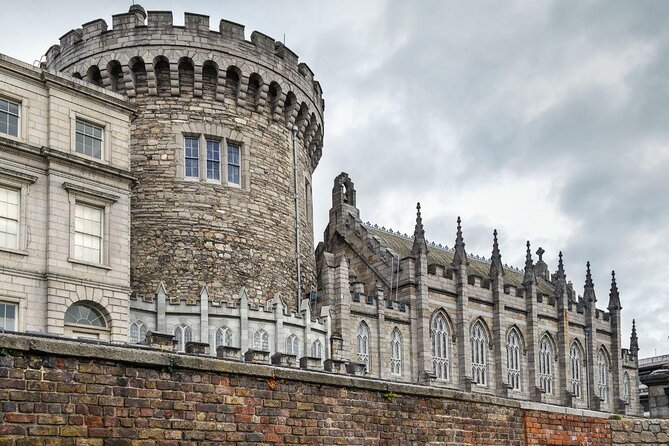
Your final major anchor is Dublin Castle. The tour covers that it was originally built by King John in 1204 and served as the seat of British administration until 1922. It’s also linked to the Dubh Linn, or Black Pool, which is part of how Dublin gets its name.
This stop is about endings and transitions. You’ll hear why the castle mattered, but also why it became a symbol in the period when British administration ended.
The tour finishes near Christ Church Cathedral (Christchurch Pl, Wood Quay). After that, you’re positioned well for exploring on your own, especially if you’re walking toward the wider city center sights.
Guide style: history postgrads who tell it like a story
A big reason this tour gets such strong ratings is delivery. The guides are history postgraduates, and the best thing about that is how they structure information so it lands. In past tours, guides such as Eoin, Jodie, Jody, Daragh, Caolan Maher, John D., and Colm have led groups, and the common thread is strong storytelling and clear speaking.
You’ll hear everything from funny side notes to deeper political context. One thing to remember: this is a “listen closely” experience. If you tune out for even a few minutes, you may miss the connecting logic that makes the stops feel like one continuous narrative instead of random landmarks.
Price and value: $22.98 for a fast Dublin context boost
At $22.98 per person, the value comes from the combination of three things: a small group, a trained history guide, and a route that covers major central sites you’d otherwise spend time bouncing between on your own.
You also get time leverage. Two hours gives you the “why this place matters” layer for places you’ll likely see again during the rest of your trip. And because many stops are exterior or general-site viewing, you’re not paying separately for most of the route.
The main exception is the Book of Kells. The tour talks about it, but entry isn’t included. If you know you want to see it, factor in that extra ticket cost so you don’t feel surprised later.
What to wear and how to pace yourself
The walk is described as moderate physical fitness and it’s near public transportation, but you’re still moving for about two hours. Wear comfortable shoes. If you’re visiting in colder months, you’ll want a warm layer because it can get windy in central Dublin.
Also plan to stay mentally present. This tour is dense enough that it rewards attention. If you’re looking for a casual stroll with minimal dates and fewer political references, you might find it more intense than expected.
Who should book this tour (and who might skip it)
This tour is a great fit if you want to understand Dublin beyond postcards. It’s ideal for first-time visitors who want a solid foundation, and for history lovers who like timelines, institutions, and the real reasons behind political change.
It’s also a strong starting point if you like returning to landmarks later with more context. The tour covers enough major sites that you’ll recognize them again without trying too hard.
You might think twice if you prefer a lighter focus on culture and daily life only, because the route includes political turning points and legal conflict. It’s not a “just enjoy the scenery” format.
Should you book the 2-hour Historical Walking Tour from Dublin?
If your goal is to get oriented fast and understand Dublin’s complicated layers, I’d book it early in your trip. The price feels fair for the guided context you get, and the route hits big-name places you’ll likely want to revisit.
If you’re easily overwhelmed by dates or want a less political tone, consider it only if you’re ready to pay close attention for the full two hours. In short: book it if you want answers. Pass if you want only vibes.
FAQ
How long is the Dublin historical walking tour?
It runs for about 2 hours.
What does the tour cost?
The price is $22.98 per person.
Where do you meet the guide?
You meet at the Henry Grattan Monument on College Green, Dublin, opposite the Trinity College Dublin front gate area.
Where does the tour end?
It ends at Christ Church Cathedral, Christchurch Pl, Wood Quay, Dublin.
Is entry to the Book of Kells included?
The tour discusses the Book of Kells, but entry to it is not included.
How many people are in the group?
The tour has a maximum of 25 travelers.
Is the tour offered in English?
Yes, it’s offered in English.
What fitness level do I need?
It’s suitable for travelers with a moderate physical fitness level.
Are service animals allowed?
Yes, service animals are allowed.
Is there free cancellation?
There is free cancellation. You can cancel up to 24 hours in advance for a full refund.