REVIEW · PARIS
Paris: Montmartre Must-See Walking Tour with a Local Guide
Book on GetYourGuide →Operated by French Tales · Bookable on GetYourGuide
Montmartre works best when someone points you to the right corners. This 150-minute local-guided walking tour ties the famous sights to the smaller stories that made Montmartre the creative engine of Paris. I love how the route balances big landmarks like Sacré-Cœur with quieter stops where you actually get the neighborhood’s mood.
You’ll also get practical guidance for real-world walking: uphill paths, cobblestones, and plenty of photo moments without feeling rushed. One drawback to plan for is the hills and stairs, so comfortable shoes are not optional.
In This Review
- Key Highlights You’ll Care About
- Montmartre in 150 Minutes: What You’ll Actually See
- Starting at Carrousel de Saint-Pierre: Find the Guide Fast
- Square Louise Michel Gardens to Sacré-Cœur: The Big-View Payoff
- Place du Tertre and Le Poulbot: Artist Square Energy with Context
- Secret Streets and Iconic Photo Spots: How the Tour Keeps It Fun
- Dalí, Dalida, and Cabaret Au Lapin Agile: Art That Pop Culture Remembered
- Vignes du Clos Montmartre and Moulin de la Galette: Wine and Windmill Reality
- Bateau-Lavoir: Where Modern Artists Worked
- Le Mur des Je T’aime and Place des Abbesses: A Romantic Ending
- Price, Pace, and Photo Planning for $29
- Who Should Book This Montmartre Walk (and Who Should Skip)
- Should You Book the Paris Montmartre Walking Tour with French Tales?
- FAQ
- Where does the tour start, and how do I find the guide?
- How long is the Montmartre walking tour?
- Is the tour in English?
- What should I bring for this tour?
- Is the tour wheelchair accessible?
- What is the cancellation policy?
Key Highlights You’ll Care About
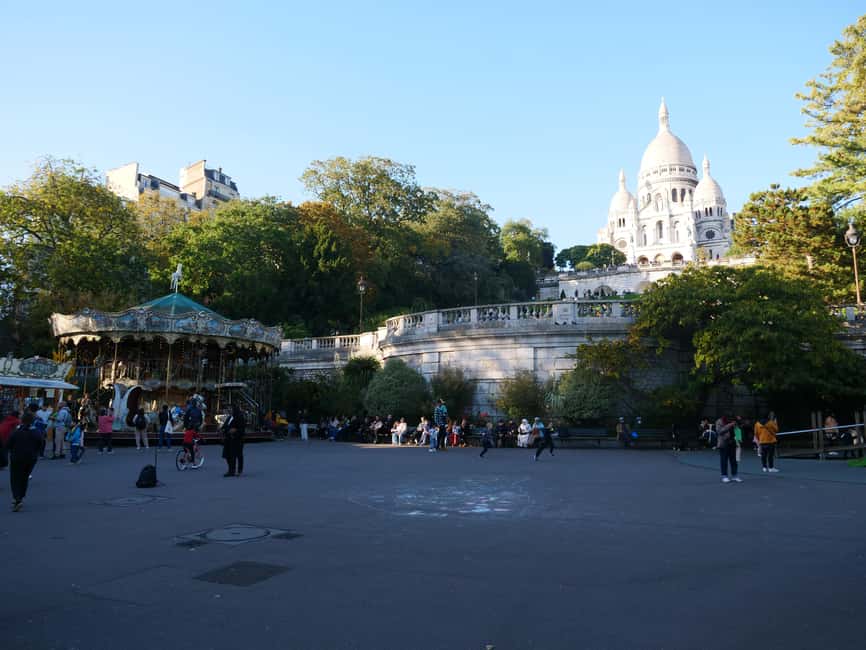
- Carrousel de Saint-Pierre start point that’s easy to find, near a recognizable café spot
- Sacré-Cœur parvis plus indoor time for mosaics and classic Paris panoramas
- Place du Tertre for artist-square energy and smart picture angles
- Vignes du Clos Montmartre for the rare vineyard-side view of winemaking history
- Bateau-Lavoir linked to Picasso and Modigliani, not just a generic “art spot”
- Wall of Love at the end, a clean romantic finish to your walk
Montmartre in 150 Minutes: What You’ll Actually See
Montmartre is one of those Paris neighborhoods where a self-guided walk can turn into “wow, stairs again.” This tour keeps you moving with a local guide who connects each landmark to the neighborhood’s changes over time.
The pace is built around short guided segments and photo pauses. That matters because Montmartre is compact, but it feels steep and twisty. You’re not just ticking off sights; you’re learning why those sights are here and why people cared about them in the first place.
At $29 per person for a 150-minute live guided walk, the value comes from coverage. You get iconic stops plus story-driven side locations, and the guide also shares café and attraction recommendations you can use after the tour.
You can also read our reviews of more walking tours in Paris



Starting at Carrousel de Saint-Pierre: Find the Guide Fast
You meet at Place Saint-Pierre at the bottom of Square Louise Michel, by the Café Le Ronsard (the storefront has a red look). The guide is easy to spot with a French Tales sign and a stick themed to Ratatouille.
If you want to get there without stress, plan to arrive 15 minutes early. The area around Montmartre can be busy, and you’ll be happier if you’re standing in the right spot before the group gathers.
For transit, the tour is set up for an easy metro approach. Line 2 at Anvers is about a five-minute walk, and Line 12 at Abbesses is about a 7–10 minute walk. There’s a strong hint here: use elevators if you’re coming from Abbesses, because the hill can be rough on the way up.
Square Louise Michel Gardens to Sacré-Cœur: The Big-View Payoff
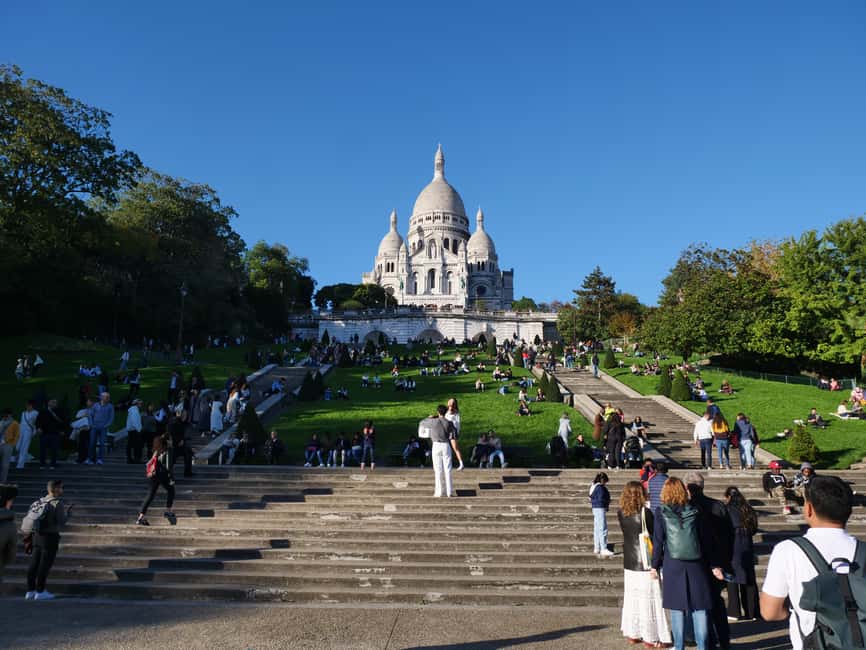
The walk begins with Square Louise Michel, where you get a view toward the hill before the climb fully hits. It’s a good warm-up stop because the gardens give you breathing room and direction at the same time.
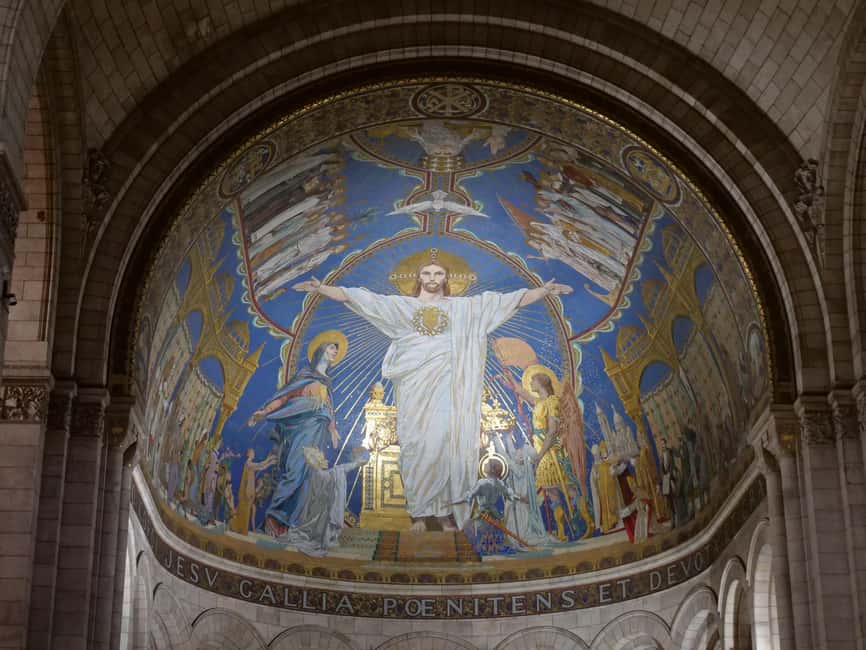
Then comes Sacré-Cœur Basilica, one of the best reasons to visit Montmartre in daylight. You’ll go up to the parvis for panoramic Paris views, and you’ll also step inside. The basilica’s mosaics and the way the space feels cooler inside are exactly the kind of contrast that makes this stop more than just a photo.
Practical note: Sacré-Cœur is worth planning around. The parvis can be crowded, and inside can take a bit longer than you expect. The guide’s timing helps you avoid the feeling of standing still while everyone else mills around.
Place du Tertre and Le Poulbot: Artist Square Energy with Context
Place du Tertre is Montmartre’s showpiece for street art and caricaturists, with cafés stacked around the edges. It’s easy to fall into the “just photos” mode here, but the guide steers you toward what to notice.
You’ll also stop for Le Poulbot, a beloved local eatery named after the illustrator connected to Montmartre street children. That detail changes the tone of the neighborhood: it’s not only painters and poets, it’s also the people who lived through tougher times.
If you’re trying to understand Montmartre quickly, this part helps. You see the creative surface, then you get the cultural backstory that explains why that surface exists.
Secret Streets and Iconic Photo Spots: How the Tour Keeps It Fun
This tour is built for photography without turning into a camera workshop. You’ll have repeated short photo stops where the guide positions you so you’re not only shooting from wherever you happen to stand.
Some of the best moments in Montmartre happen on small streets where you get sudden angles—pink walls, old facades, view lines that open up for a few seconds. This itinerary leans into that. Between major landmarks, you get “pause and look” breaks instead of nonstop walking.
It also helps that the guide is interactive. In recent tours, Jean-Baptiste (often called JB) has a reputation for keeping everyone engaged, even teenagers. If you’re traveling with mixed ages, that’s a big plus.
You can also read our reviews of more guided tours in Paris






Dalí, Dalida, and Cabaret Au Lapin Agile: Art That Pop Culture Remembered
Montmartre didn’t only attract painters. It also pulled in performers and legends who kept the neighborhood’s mystique alive.
You’ll pause at a tribute to Salvador Dalí through the Dali Museum stop. Then the route includes Place Dalida and Dalida’s House, plus a look at Cabaret Au Lapin Agile, a legendary cabaret tied to artists and writers of the 20th century.
Why this set of stops matters: it shows Montmartre as a multi-genre stage. You go from surrealism to music to live entertainment without the walk turning into a random list of names.
And yes, some guides bring extra fun facts. One example from the experience set includes oddball cultural trivia, the kind that makes you remember the street even after you leave it.
Vignes du Clos Montmartre and Moulin de la Galette: Wine and Windmill Reality
Most people expect Montmartre to be art shops and cafés. This tour adds two surprises that make the neighborhood feel older and more agricultural than you’d guess.
First is Vignes du Clos Montmartre, a small vineyard area that offers a rare view of Paris winemaking history still alive today. It’s a short stop, but it changes your mental map. Montmartre wasn’t always just a backdrop; it also produced food and wine within the city.
Then you’ll reach Moulin de la Galette, the historic windmill that connects to Montmartre’s artistic and social life. It’s a symbol you’ve probably seen in photos, but here it becomes a story beat: why it mattered, and how the area’s public life formed around it.
If you love when a city shows layers—modern street to historic production—this section is a strong reason to book.
Bateau-Lavoir: Where Modern Artists Worked
The tour continues to Bateau-Lavoir, a famous workshop connected with artists like Picasso and Modigliani. This stop is worth your full attention because it moves you from “Montmartre as scenery” to “Montmartre as workplace.”
Bateau-Lavoir represents the creative grind, not just the final gallery look. The guide’s storytelling helps you understand why workshops like this mattered in the early days of modern art.
In practical terms, it’s also one of the calmer stops visually. If you’ve had your fill of crowds at Place du Tertre, this is a good reset.
Le Mur des Je T’aime and Place des Abbesses: A Romantic Ending
Most Montmartre tours end with tired legs. This one ends with a tidy emotional finish.
You’ll finish at Place des Abbesses, with the Wall of Love (Le Mur des Je T’aime) as the photo stop anchor. The wall features “I love you” written in over 250 languages, and it’s an easy, satisfying final moment. You get romance without needing to chase a specific museum ticket.
Place des Abbesses is also a smart ending point because it’s a transit-friendly zone compared to the top-heavy parts of Montmartre. Once you’re done, you can head out without feeling trapped near the steepest streets.
Price, Pace, and Photo Planning for $29
Let’s talk value in plain terms. At $29, you’re paying for:
- live English guidance (not just a self-walk PDF)
- a route that strings together big landmarks with smaller story locations
- repeated photo pauses so you’re not sprinting between stops
- built-in pacing across a 150-minute walk, rain or shine
This is also a tour where the guide’s style matters. Many bookings tied strong praise to Jean-Baptiste (JB) and his ability to keep people engaged, answer questions, and adjust to conditions. If you’ve ever done a walking tour where you can’t hear the guide over street noise, you’ll appreciate how often these guides keep the group moving while still making stops feel worth it.
Photo tip that actually helps: wear shoes that let you move fast on cobblestones. You’ll want to step into views at Sacré-Cœur and around the artist square, and good footing saves time and stress.
Who Should Book This Montmartre Walk (and Who Should Skip)
This tour is ideal for you if:
- it’s your first time in Paris 18th arrondissement
- you want the Montmartre story, not just landmark photos
- you like art, music, and neighborhood history connected through real places
- you’d enjoy restaurant and café recommendations afterward
It may be less suitable if:
- you have mobility issues, since the terrain includes uneven ground and stairs
- you’re using a wheelchair
- you’re traveling with very young kids who may struggle with the walking (children under 12 must be accompanied by an adult)
- you prefer flat ground walking days
Also, if you’re traveling in heavy rain, expect the tour to still run. That’s usually good for itinerary reliability, but you should still pack rain gear and plan for slippery cobblestones.
Should You Book the Paris Montmartre Walking Tour with French Tales?
Book it if you want a guided Montmartre experience that connects the famous stops—Sacré-Cœur, Place du Tertre, Moulin de la Galette, Bateau-Lavoir, and Wall of Love—to the lesser-known story beats that make the neighborhood feel human.
Skip it if stairs and uphill walking will ruin the day for you. There’s no avoiding the hill here, and this route is designed for people who can comfortably handle uneven streets.
For most people paying attention to value, I’d say this is a smart first Montmartre move. You’re not just seeing postcard landmarks; you’re learning how Montmartre became Montmartre, and you’re getting recommendations you can use after the walk.
FAQ
Where does the tour start, and how do I find the guide?
The meeting point is Place Saint-Pierre, 75018 Paris, at the bottom of Square Louise Michel, in front of Café Le Ronsard with a red storefront. Arrive about 15 minutes early, and look for the guide holding a sign for French Tales with a Ratatouille-themed stick.
How long is the Montmartre walking tour?
The tour runs for 150 minutes.
Is the tour in English?
Yes. The live guide is English, and an English audio guide is also included.
What should I bring for this tour?
Wear comfortable shoes. Bringing a bottle of water is recommended, and the tour runs rain or shine so dress accordingly.
Is the tour wheelchair accessible?
No. The tour is not wheelchair accessible due to uneven terrain and stairs.
What is the cancellation policy?
There is free cancellation up to 24 hours in advance for a full refund.