REVIEW · DUBROVNIK
Dubrovnik By Night Walking Tour
Book on GetYourGuide →Operated by Experience Dubrovnik · Bookable on GetYourGuide
Night turns Dubrovnik into a calmer storybook. I love how the Stradun streetlights make the Old Town feel softer, and I really enjoyed seeing Orlando’s Column in Luza Square in the evening light. One thing to consider: this is still a walking tour, so comfy shoes matter more than you think.
This is a simple, well-paced plan for your first night in town. It starts at Pile Bay, then moves through the old streets while your guide shares what life in medieval Ragusa was like, plus how Dubrovnik’s social world works today.
You’ll be with a local, professional licensed guide speaking English for $23, for 90 minutes. With a 4.8 rating across 208 reviews, the common thread is clear: guides keep the pace friendly, stories varied, and the group small enough to ask questions (names like Anne-Femica, Mikayla, Mihaela, and Ines show up again and again in people’s write-ups).
In This Review
- Key highlights worth targeting
- Why Dubrovnik by night feels like a different city
- Pile Square meeting point: the easiest way to start
- Pile Bay and Lovrjenac Fortress: seeing the coastline with context
- Stradun Placa at night: the lit main street that sells the city
- The Jesuit Stairs: a classic landmark with real reasons behind it
- Luza Square and Orlando’s Column: civic Dubrovnik after dark
- The medieval cathedral area: architecture you notice more when it’s quiet
- Side streets and a drink stop: where the fun fits in
- 90 minutes, no rush: how the pace helps you enjoy Dubrovnik
- Price and value: is $23 worth it?
- Who should book this night walk?
- Should you book Dubrovnik By Night Walking Tour?
- FAQ
- How long is the Dubrovnik By Night Walking Tour?
- How much does it cost?
- Where do I meet the guide?
- What language is the tour in?
- What’s included in the tour?
- What are the main sights you see?
- Where does the tour end?
- Is there free cancellation?
- Can I reserve without paying right away?
- Will there be Game of Thrones references?
Key highlights worth targeting
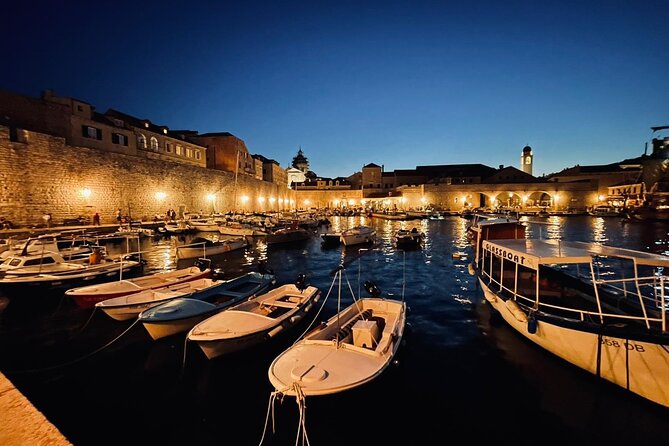
- Pile Bay start with Lovrjenac fort context so you read the coastline better as you walk
- Stradun Placa after dark for lit architecture without the worst crowds
- Jesuit Stairs for a classic Dubrovnik photo moment with story attached
- Luza Square and Orlando’s Column as the civic heart of the Old Town
- Cathedral area views that feel more medieval when the streets quiet down
- Side streets for a relaxed drink stop once you’re back off the main flow
Why Dubrovnik by night feels like a different city
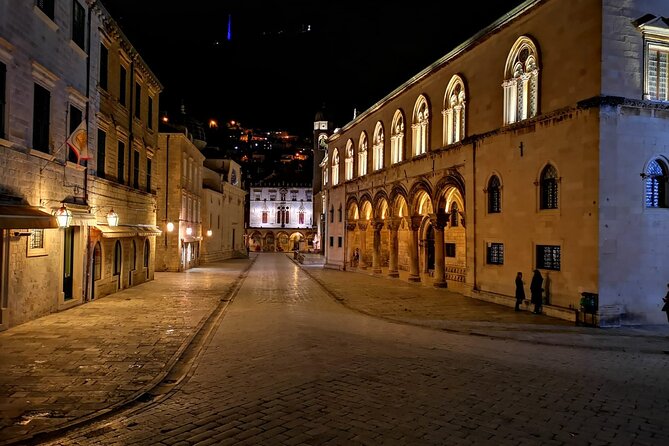
Dubrovnik by day is gorgeous. Dubrovnik after sunset is more human. The streets cool off, the light turns warm, and you spend less time threading through crowds just to see stonework.
That change matters for understanding the city. At night, the details stop feeling like a checklist and start feeling like a place. You notice how the Old Town streets bend, where people pause, and why the city’s layout made sense for defense and daily life long before anyone talked about tourism.
I also like that this tour keeps your brain on the facts without turning it into a lecture. The best guides you’ll see praised here do three things well: they explain what you’re looking at, they connect it to Dubrovnik’s broader story, and they keep the tone light enough to stay interested for 90 minutes.
You can also read our reviews of more walking tours in Dubrovnik


Pile Square meeting point: the easiest way to start
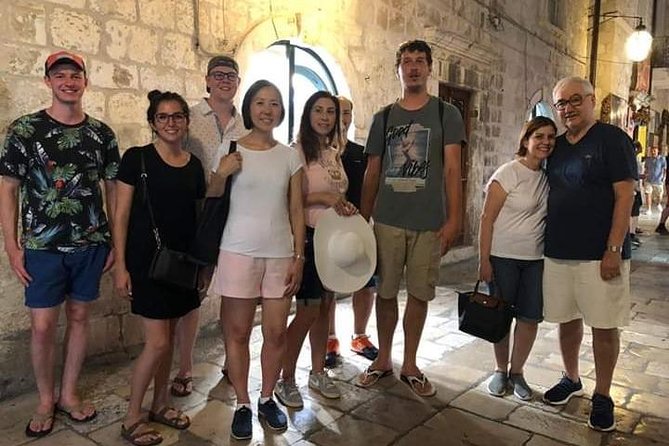
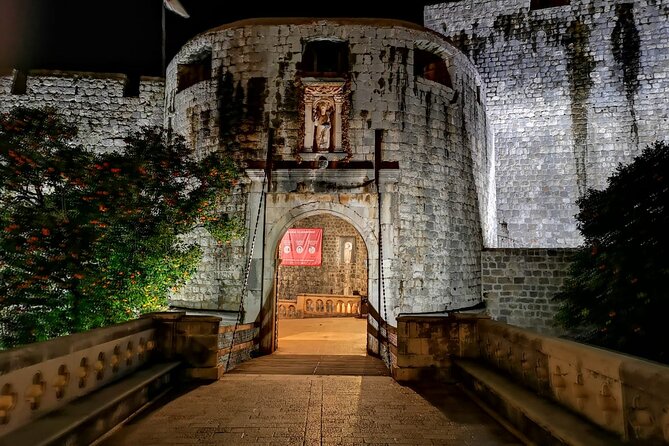
Your tour meets at Pile Square, by the Amerling Fountain, outside the Old Town next to Dubravka restaurant. Look for the blue umbrella with the local tour provider logo.
This matters because Dubrovnik’s Old Town edge can look similar from a distance. A clear meeting point plus a visible umbrella reduces the stress of trying to spot a group in the dark.
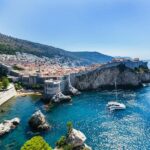
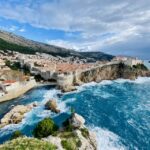
Once you’re together, you’ll begin at Pile Bay. This is a strong first move. It sets the stage: you’re standing where the city faces the sea, and you’ll get stories tied to Lovrjenac Fortress, which helps you understand why Dubrovnik guarded the coastline so carefully.
Pile Bay and Lovrjenac Fortress: seeing the coastline with context
At the start, the guide frames Dubrovnik’s night mood with history you can actually picture. You’re not just hearing dates—you’re getting the reason the view is there.
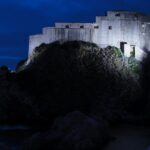
The Lovrjenac connection is useful because it gives you a mental map. Even if you don’t climb anywhere on this tour, your guide’s explanation helps you connect the fort’s role to what you see along the shoreline and walls.
This is also where you get a feel for local behavior and social life. That might sound vague, but it’s practical: Dubrovnik isn’t only “a monument.” People live around these streets, hang out near the main thoroughfares, and return to the same nighttime rhythms, especially after the day-tripping crush fades.
Stradun Placa at night: the lit main street that sells the city
Next comes the walk on Stradun Placa, Dubrovnik’s most famed and well-preserved main street. By day, Stradun can feel crowded and fast. At night, it feels like a long corridor of glowing stone.
I like that the tour doesn’t just rush you straight down the middle. You’ll also explore side streets that connect into Stradun. That gives you quick variety: one moment you’re on the main axis, the next you’re slipping into narrower lanes where the atmosphere relaxes.
Several guides mentioned in people’s experiences are praised for keeping the storytelling grounded in what you’re seeing. That means you’re more likely to remember the shape of the city, not just the headlines.
The Jesuit Stairs: a classic landmark with real reasons behind it
The Jesuit Stairs are one of those Dubrovnik stops that looks incredible in photos, but even better when someone explains why they’re there. Your guide will point out the features that make them such a recognizable piece of the Old Town’s architecture.
Even in a short tour, the Jesuit Stairs work because they slow you down just enough. You pause, you look upward, and suddenly the city’s verticality makes sense—how different levels of the town connect and why certain routes became important over time.
A good guide here also blends the landmark into the larger Ragusan story. In practical terms, it turns a staircase into a clue about planning, faith, and daily movement through the old streets.
You can also read our reviews of more evening experiences in Dubrovnik


Luza Square and Orlando’s Column: civic Dubrovnik after dark
Luza Square is where Dubrovnik’s Old Town starts feeling like a civic center, not just scenery. In the evening light, the space opens up, and the architecture reads cleaner because there’s less visual noise from crowds.
The highlight here is Orlando’s Column. It’s a recognizable symbol, but the value comes from understanding what that symbolism meant—and why it’s placed in a public square where people would notice it.
I also like how this stop anchors the tour. You’re not wandering randomly; the walk is building toward the places where Dubrovnik’s public identity showed up in stone and ceremony.
The medieval cathedral area: architecture you notice more when it’s quiet
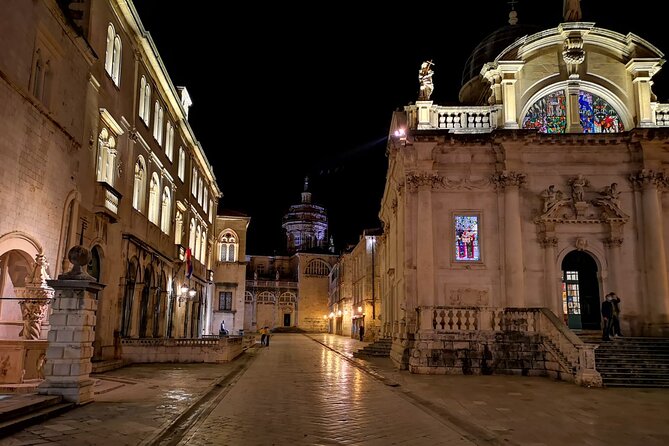
The tour also includes observing the medieval cathedral area in the Old Town. When streets are busy, cathedrals can blend into the background. At night, the details pop: edges, textures, and the way light bounces off older stone.
This is a strong moment for slow-looking. Your guide’s job is to give you enough context that the building stops being just a pretty shape and becomes a piece of how Ragusa functioned—socially, religiously, and politically.
If you like tours that help you read architecture fast, this part is a good payoff. You’ll leave with a clearer sense of what the Old Town “means,” not only what it “looks like.”
Side streets and a drink stop: where the fun fits in
One of the best parts of this tour format is the chance to leave Stradun’s main flow and wander into side streets. That’s where you’ll find a more relaxed atmosphere and the kinds of bars people actually choose when they want an easy night out.
This isn’t a heavy “go here, buy this” experience. The idea is to show you the little offshoots so you can decide what to do next. You’ll have a sense of where to return for a drink, without needing to rely on luck.
If you’re traveling with anyone who worries about tours becoming too serious, this is a smart ingredient. History stays present, but the mood stays human.
90 minutes, no rush: how the pace helps you enjoy Dubrovnik
A 90-minute tour is ideal for Dubrovnik at night. The Old Town is beautiful, but it’s easy to lose time when you’re deciding what to do next. A guided walk gives you a “best of” route in the exact window when the streets feel calm.
The small group feel shows up in the feedback people share—some mention groups around 6, and others praise how guides handle questions and photo stops. That’s not guaranteed for every tour, but it tells you what to expect from the style: friendly, adjustable, and not overly scripted.
You’ll also learn things you can use right away. Some guides are praised for tying in how Dubrovnikers treated the city during the early 1990s war period, including first-hand accounts. That kind of context changes how you look at the Old Town walls and fortifications once you know what they mean beyond tourism.
Price and value: is $23 worth it?
At $23 per person for a licensed local guide and 90 minutes, the value is solid—especially if you’re trying to get oriented quickly. You’re paying for three things: a clear route, interpretation of landmarks like Orlando’s Column and the Jesuit Stairs, and the ability to ask questions while you’re walking.
If you already know Dubrovnik’s history cold, you might skip the tour. But for most people, the payoff is learning what you’re looking at while the city looks its best. Night tours are also a practical win: less heat, less daytime crowding, and lighting that makes stone and arches look dramatic without effort.
Who should book this night walk?
Book this if you want your first night in Dubrovnik to feel organized but not rigid. It’s a great match for:
- couples or solo travelers who want an easy intro route
- anyone who loves architecture and wants story attached to what they see
- Game of Thrones fans who’d like references woven in (many guides earn praise for that angle)
- families who want a guided walk that stays engaging without feeling like a classroom
It’s also a good choice if you want current-life context, not just medieval dates. People repeatedly mention guides balancing history with how Dubrovnik works today.
Should you book Dubrovnik By Night Walking Tour?
I’d book it if your main goal is to understand the Old Town fast and see it lit up. The route hits the big landmarks without taking over your entire evening, and the $23 price feels fair for a licensed guide who can explain what makes each spot matter.
Skip it only if you strongly prefer unguided wandering, or if you have no interest in history at all. Otherwise, this is a smart way to make your first Dubrovnik night feel like it has a plan.
FAQ
How long is the Dubrovnik By Night Walking Tour?
The tour lasts 90 minutes.
How much does it cost?
It costs $23 per person.
Where do I meet the guide?
Meet at Pile Square, by the Amerling Fountain, outside of the Old Town next to Dubravka restaurant. Look for the blue umbrella with the local tour provider logo.
What language is the tour in?
The tour is in English.
What’s included in the tour?
A local professional licensed guide is included.
What are the main sights you see?
You’ll see Pile Bay and Stradun Placa, the Jesuit Stairs, Luza Square with Orlando’s Column, and the medieval cathedral in the Old Town.
Where does the tour end?
It finishes in the Old Town.
Is there free cancellation?
Yes. You can cancel up to 24 hours in advance for a full refund.
Can I reserve without paying right away?
Yes. You can reserve now & pay later.
Will there be Game of Thrones references?
Some guides are praised for connecting the walk to Game of Thrones lore, so if you are a fan, you’ll likely enjoy that bonus layer.