REVIEW · BARCELONA
Barcelona in 2 Hours: Guided Walk Through History and Sights
Book on Viator →Operated by Carpe Diem Tours · Bookable on Viator
Barcelona starts talking when you hit the Gothic Quarter. This two-hour guided walk is packed with stories behind Picasso, Gaudí, and the city’s key Catalan moments, so you’re not just ticking sights off a list. You’ll move through the heart of Ciutat Vella learning why these places matter, from medieval streets to religious and political landmarks.
I love how the route connects art and identity. Els Quatre Gats is framed as a real meeting point for thinkers, with the Picasso and Gaudí link turning an old café into a human story, not a postcard. I also like that the guide brings the “why” to the famous details, including the deeper meaning behind public art like El Mon Neix En Cada Besada.
One thing to keep in mind: this is a walking group tour, and if your departure day is noisy on the street, you might miss a few bits if you rely on hearing every word. Some guides also may not use extra amplification, so bring a little patience and keep an eye on the guide when the group bunches up.
In This Review
- Key highlights worth your time
- A two-hour Barcelona walk that keeps the story moving
- Starting at Plaça del Vuit de Març and ending at Santa Maria del Mar
- Els Quatre Gats: where Picasso and Gaudí’s Barcelona “hangout” story starts
- El Mon Neix En Cada Besada: beyond the Instagram shot
- Gothic Quarter landmarks: Barcelona Cathedral and the story of Eulalia
- Casa de l’Ardiaca: Roman water lines inside a tiny Gothic-Renaissance mix
- Pont del Bisbe and Plaça Sant Felip Neri: legends and scars you can feel
- MUHBA El Call and Plaça de Sant Jaume: medieval streets to Catalan power
- Plaça del Rei and the shadow of the Spanish Inquisition
- Plaça de l’Àngel and Santa Maria del Mar: from grain trading to maritime Barcelona
- The value question: is $22.99 a good deal for this 2-hour format?
- How the group size and guide style affect your experience
- Who should book this Barcelona walk (and who might skip it)
- Should you book this Barcelona in 2 Hours tour?
- FAQ
- How long is the Barcelona in 2 Hours walk?
- How much does the tour cost?
- What language is the tour offered in?
- How big is the group?
- Where does the tour start and end?
- Is a mobile ticket used?
- Are entrance fees included?
- When should I book?
- Will I get confirmation after booking?
- Is free cancellation available?
Key highlights worth your time
- Two hours, maximum 20 people means you get city-scale learning without a day-long commitment
- Picasso and Gaudí connections are explained through Els Quatre Gats, not just name-dropping
- Catalonia’s history shows up in street art and squares, including the meaning behind La Diada
- A real Gothic Quarter rhythm: you’ll see churches, bridges, squares, and medieval streets in sequence
- Some entrances aren’t included at the cathedral and Santa Maria del Mar, so plan for optional add-ons
- Strong guide energy, with examples like Darren, Petra, Jorge, Sonia/Sonja, and Lydia highlighted in guide experiences
A two-hour Barcelona walk that keeps the story moving
If you’ve got limited time in Barcelona, this tour works because it’s built like a short film: you get scenes, not speeches. In about 2 hours, you’ll cover a tight chunk of Ciutat Vella, with each stop timed so the group keeps moving and you don’t spend your whole day waiting around.
The big win is the focus. Instead of selling surface-level sightseeing, the walk emphasizes heritage and local identity. You’ll hear why Barcelona’s architecture looks the way it does, why certain public spaces feel heavy with history, and why Catalonia’s story keeps showing up in places you might otherwise breeze past.
You can also read our reviews of more walking tours in Barcelona


Starting at Plaça del Vuit de Març and ending at Santa Maria del Mar
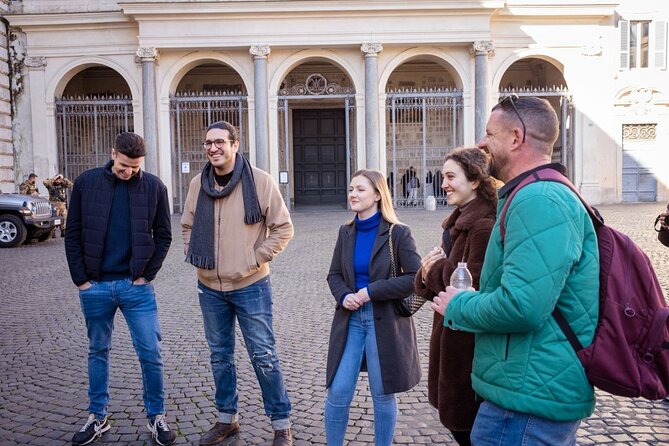
Your tour begins at Plaça del Vuit de Març in Ciutat Vella. The finish point is Basílica de Santa Maria del Mar in Ciutat Vella as well, which is handy if you want to keep wandering afterward toward El Born.
Because the route is centered in the old core, you’ll likely find it easy to tie into the rest of your day. It’s also scheduled so it functions as a first-day orientation. If you like the idea of seeing the main threads of the city early—art hangouts, Gothic landmarks, medieval streets—you’ll get a usable mental map before you branch out on your own.
Els Quatre Gats: where Picasso and Gaudí’s Barcelona “hangout” story starts
The tour kicks off at Els 4 Gats (Els Quatre Gats), a historic café and restaurant with an unmistakable Art Nouveau feel. It’s a stop that makes sense early, because it gives you a cultural lens for everything that comes next.
What I like here is how it’s framed as a meeting place for great thinkers. That detail matters. When a guide connects the building’s design to the people who used it, you stop treating it like a decorative exterior and start seeing it as part of a creative network. With the Picasso and Gaudí connection woven in, you get a clearer picture of why Barcelona became a magnet for artists and ideas in the first place.
If you’re the type who likes photos, you’ll still get those. But the smarter move is to listen for the human story first, then snap your pictures.
El Mon Neix En Cada Besada: beyond the Instagram shot
Next up is El Mon Neix En Cada Besada, a photomosaic many people recognize instantly. The tour’s value is that it doesn’t let the “cool image” be the end of the story.
You’ll learn how this street art ties into Catalan defeat on September 11, 1714, and why it connects to La Diada, Catalonia’s day of celebration. That context changes how you look at it. A mural like this isn’t just visual decoration; it’s public memory, placed in the middle of daily life.
This is one of those stops where you’ll appreciate the pace. You won’t stand for a long lecture, but you’ll get enough background to understand the emotional weight behind the artwork.
Gothic Quarter landmarks: Barcelona Cathedral and the story of Eulalia
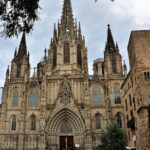
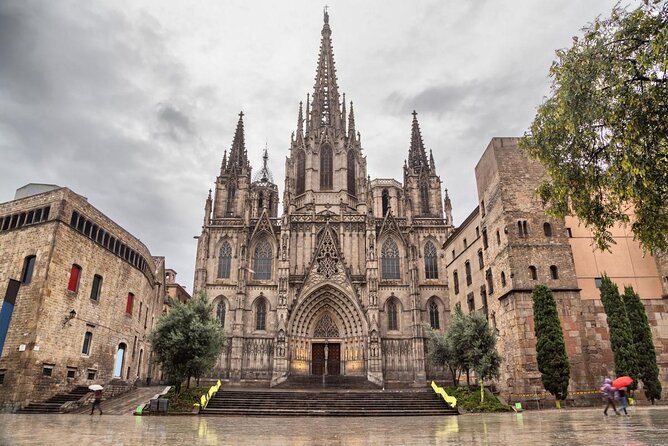
From there, you hit Catedral de Barcelona. This stop is Gothic, centuries in the making, and it’s also a place where the narrative is tied directly to the city.
The guide explains that the cathedral illustrates the life and death of Eulalia, Barcelona’s patron saint, including her martyr story. That detail matters if you usually skip religious buildings because you think you’ve seen everything before. Here, the cathedral becomes a visual timeline of local belief and civic identity.
Practical note: cathedral admission is not included on this tour. You’ll be able to see and learn from the area, but if you want to go inside, you should expect an additional ticket cost.
You can also read our reviews of more guided tours in Barcelona


Casa de l’Ardiaca: Roman water lines inside a tiny Gothic-Renaissance mix
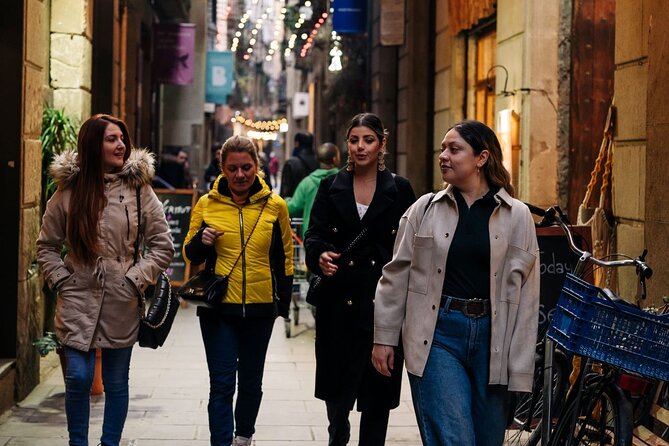
Casa de l’Ardiaca is the kind of stop that rewards you for slowing down, even if it’s brief. It’s described as small, but it blends Gothic and Renaissance elements in a way that feels like a time machine.
Here’s what makes it more than a quick glance: you’ll get pointed toward remnants connected to Roman-era Barcelona, including wall pieces and arcades of an aqueduct that once supplied Barcino with water. That’s the sort of detail that makes older cities feel real. You’re not just looking at “old architecture.” You’re seeing evidence of how daily life worked long before modern plumbing and traffic existed.
This is also a strong stop for photos, but again, the best move is to listen while you look.
Pont del Bisbe and Plaça Sant Felip Neri: legends and scars you can feel
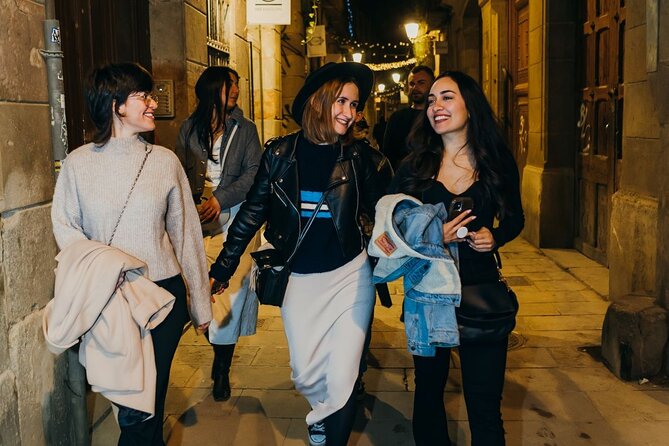
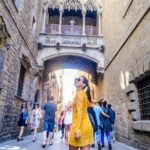
Pont del Bisbe is known for being photographed, and the tour leans into that. You’ll hear the legend tied to walking underneath it, with a story meant to captivate superstitious visitors and also raise eyebrows for skeptics. Even if you don’t buy the legend, you’ll walk away remembering the tone that stories like this bring to a city.
Then the tour shifts mood at Plaça Sant Felip Neri. This square holds a sombre story linked to Catalan independence and still shows scars from its tragic past. I like that the route doesn’t treat every landmark as equally light and charming. Barcelona has more than one emotional register, and this stop helps you understand why.
MUHBA El Call and Plaça de Sant Jaume: medieval streets to Catalan power
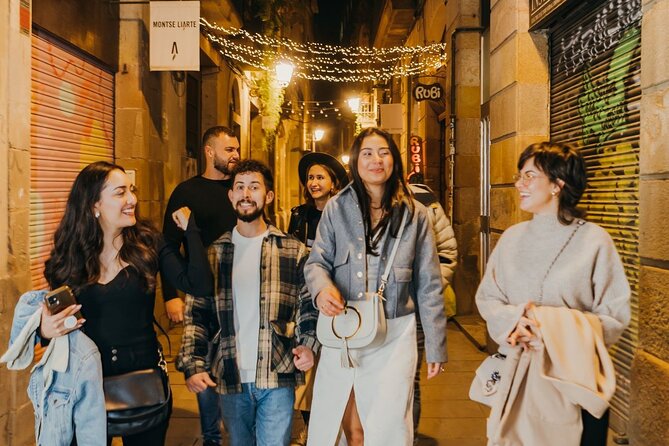
At MUHBA – El Call, you step into a district with medieval architecture and narrow streets connected to Barcelona’s former Jewish population. This stop is useful because it expands the story beyond the most obvious “tourist center” version of the city.
Narrow streets are easy to walk past without noticing them. But with a guide’s framing, you start paying attention to the way a neighborhood layout shapes community life. Even with a short time window, you get enough context to recognize this as a historical space, not just an attractive lane for wandering.
Next is Plaça de Sant Jaume, the main square where the seat of Catalan government and City Hall are located. This is where you’ll feel the political heartbeat of the city. The tour explains that the square serves as both celebration and protest, and it connects the story to an important figure marked during a beloved holiday.
Plaça del Rei and the shadow of the Spanish Inquisition
Plaça del Rei is another place where the guide keeps things grounded in story. It’s described as the home of the Royal Palace, and it brings up Barcelona’s dark past during the Spanish Inquisition.
This is one of those stops where you might feel a shift after the earlier art and saint stories. The city isn’t only sacred and creative. It’s also political and coercive at various points in its history. When you know that, the architecture around the square doesn’t feel random. It feels like the physical shell around real decisions and real consequences.
Plaça de l’Àngel and Santa Maria del Mar: from grain trading to maritime Barcelona
Plaça de l’Àngel is tied to commerce and to legend. You’ll hear that it was once the Wheat Square, a hub for grain trading. Then it was renamed when a heavenly apparition appeared during the procession of Saint Eulalia’s body.
That blend is what I find useful. Barcelona’s old squares aren’t just pretty open spaces. They often started as economic infrastructure, then gained spiritual and myth layers over time. With the Eulalia connection again, the tour also reinforces a key theme: her story shows up repeatedly across the city.
Finally, you end at Basilica de Santa Maria del Mar, a Gothic basilica strongly associated with El Born. The tour frames it as a testament to Barcelona’s maritime history. If you continue exploring afterward, this ending spot sets you up well for the seaside-and-city vibe of that neighborhood.
Practical note: admission for Basilica de Santa Maria del Mar is not included. You can still enjoy learning and observing the exterior area, but if you want to go inside, plan on additional ticketing.
The value question: is $22.99 a good deal for this 2-hour format?
At $22.99 per person for about 2 hours, this is a solid “get oriented fast” option, especially if you like context. You’re paying for guided storytelling across a concentration of landmarks, not for a single museum or one big ticket attraction.
Here’s how the value math works in real life:
- Many stops are listed as free to access, so your money mostly goes to interpretation and route pacing.
- Two major church stops are noted as not included for admission: Barcelona Cathedral and Santa Maria del Mar. If you add those, your total day cost rises, but you’ll also get more out of the religious architecture the guide is pointing out.
You’ll probably feel best about the price if you’re the type who uses a guide to understand what you’re seeing. If your style is mostly photo-walk and you hate structured stops, you may feel like the value depends on how engaging your specific guide is.
How the group size and guide style affect your experience
This tour caps at 20 travelers, which helps. You can still hear the guide at most points, and the pacing stays human. In the real world, that matters in Barcelona where streets can get tight and sound can bounce around.
You’ll also notice that guides are the secret sauce. In past experiences shared for this tour, guides like Darren, Petra, Jorge, Sonia/Sonja, Lydia, Sarah, Vanessa, Rolene, and Mariah are praised for clarity, enthusiasm, and fitting a lot of history into a short walk. So if you care about storytelling tone—high energy, clear explanations, and answering questions—this is the kind of tour that tends to deliver.
That said, keep the earlier drawback in mind. If the street is loud and the group forms up close, you might miss a sentence or two if there’s no amplification. The fix is easy: stand where you can see the guide clearly, and don’t multitask with your phone during the key explanations.
Who should book this Barcelona walk (and who might skip it)
Book it if:
- You want a first-day orientation to Ciutat Vella that connects art, religion, and politics
- You care about Catalan history and want context for places that look like regular sights
- You prefer a guided route over building your own itinerary from scratch
Consider skipping if:
- You only want iconic architecture photos and plan to read everything later
- You’re allergic to any structured walking pace
- You want a full museum-style visit inside every building the route mentions
Should you book this Barcelona in 2 Hours tour?
I think you should book it if you like short, story-driven walking tours and you want your Barcelona days to start with meaning. It’s paced for a quick hit of the Gothic Quarter, and the focus on Picasso and Gaudí connections, Catalan identity, and repeated saint-linked stories helps you connect the dots across multiple neighborhoods.
If you’re on a budget, this can be especially attractive because many stops don’t require paid entry. Just remember: you may pay extra if you choose to go inside Barcelona Cathedral or Basilica de Santa Maria del Mar. If that’s your plan, you’ll get a more complete payoff.
FAQ
How long is the Barcelona in 2 Hours walk?
It runs for about 2 hours.
How much does the tour cost?
The price is $22.99 per person.
What language is the tour offered in?
The tour is offered in English.
How big is the group?
The tour has a maximum of 20 travelers.
Where does the tour start and end?
It starts at Plaça del Vuit de Març, Ciutat Vella, and ends at Basílica de Santa Maria del Mar, Plaça de Santa Maria.
Is a mobile ticket used?
Yes, it uses a mobile ticket.
Are entrance fees included?
Some stops are marked as free, but admission is not included for places like Barcelona Cathedral and Basilica de Santa Maria del Mar.
When should I book?
It is commonly booked about 42 days in advance on average.
Will I get confirmation after booking?
Yes, confirmation is received at the time of booking.
Is free cancellation available?
Yes, you can cancel for a full refund up to 24 hours before the experience starts.