REVIEW · FRANKFURT
Frankfurt Highlights English Walking Tour
Book on Viator →Operated by Frankfurt on Foot Walking Tours · Bookable on Viator
Frankfurt is best understood on foot. This English walking tour stitches together old power, everyday city life, and modern planning, all with a local guide who keeps the story moving. Small group size keeps it relaxed, and you’ll spend time at major sights like the Römerberg and the Jewish cemetery without rushing.
I especially like how the route mixes big-name landmarks with meaningful stops, like the medieval Jewish quarter and the Holocaust remembrance wall. One possible consideration: the walk can be long for some people, with intermittent steps along the way and a pace that works best if you’re comfortable strolling for about 2 to 3 hours.
In This Review
- Key Highlights You’ll Feel Immediately
- Why This Frankfurt Highlights Walk Makes Sense
- Meeting on Braubachstraße and What the Group Experience Feels Like
- Stop-by-Stop: Cathedral Power, the Römerberg, and the Old Nicholas Church
- Frankfurt Cathedral (Dom St. Bartholomäus) — why it matters
- Römerberg — city hall, Justicia, and the book burning memorial
- Old Nicholas Church (Alte Nikolaikirche) — one of the oldest pieces
- Wall Paintings at Karmeliterkloster, Then a Market Break at Kleinmarkthalle
- Karmeliterkloster — art from the early 1500s
- Kleinmarkthalle — indoor food culture stop
- Old Jewish Cemetery: A Quiet, Important Stop You’ll Remember
- City Planning Details at the Stadtplanungsamt and a Shortcut Through the Past
- Stadtplanungsamt — how Frankfurt shapes itself today
- New Old Town and the coronation path
- Eiserner Steg Love-Lock Views and the Medieval Wall at Staufenmauer
- Eiserner Steg — quick views with big pay-off
- Staufenmauer — 1100s city wall and Jewish wall connection
- Price and Value: Is $36.28 a Good Deal?
- When the Schedule Shifts: Sundays, German Holidays, and Closures
- Pace, Comfort, and What to Do Before You Go
- Should You Book This Frankfurt Highlights English Walking Tour?
- FAQ
- What is the duration of the Frankfurt Highlights English Walking Tour?
- What time does the tour start, and where does it meet?
- Is the tour offered in English?
- How big is the group?
- Are admissions included at the stops?
- Which stops are not available on Sundays or German holidays?
- Can I cancel for free?
- Is the tour accessible for strollers, and are service animals allowed?
Key Highlights You’ll Feel Immediately
- Local storytelling at every turn: the guide connects buildings to real events, including the Holy Roman Emperor era
- Free admission at most stops: many sights are exterior-focused, so you’re not paying again and again
- A moving Jewish-history segment: you’ll see the Old Jewish Cemetery area and the remembrance wall at the gate
- Main River viewpoints and the Love-lock Bridge: quick photo stops on both sides of the river
- Market time for food lovers: Kleinmarkthalle adds an indoor, sensory break (not open Sundays or German holidays)
Why This Frankfurt Highlights Walk Makes Sense
If you’ve ever tried to “do Frankfurt” solo, you might notice something fast: the city has layers. You can see Roman-era traces in the broader story, then jump to medieval free imperial power, then watch how modern Frankfurt plans itself today. This tour’s strength is that it doesn’t treat history like a museum label. It turns the street layout into a timeline.
You also get the practical benefit of an organized route. You’re not bouncing between distant neighborhoods, guessing what’s important, and hoping you chose the right angle for a photo. The plan moves you through the old town core, then extends toward the river, so you finish with views instead of ending in a maze of alleys.
And the pace is built for real-world sightseeing. Stops are short, with time at each place to absorb context. Even when a building is only viewed from the outside, you get enough framing to know what you’re looking at.
You can also read our reviews of more walking tours in Frankfurt

Meeting on Braubachstraße and What the Group Experience Feels Like
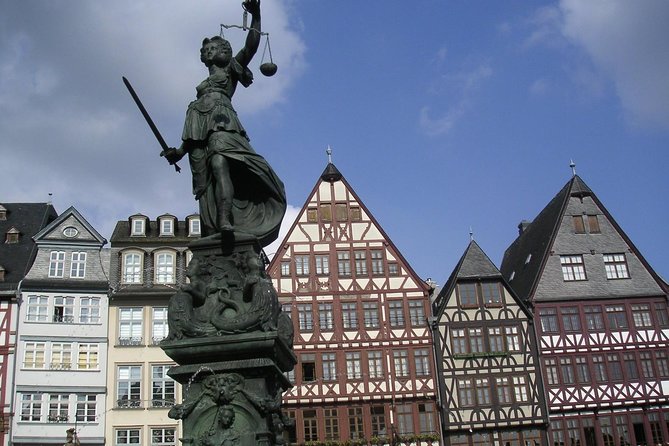
The tour starts at Braubachstraße 41, 60311 Frankfurt am Main and ends back at the same meeting point. The start time is 10:00 am, which is a smart choice: you get your main sightseeing done before the day fully heats up or crowds thicken.
One thing I’d call out: this is capped at 20 people. In practice, that size keeps the guide’s attention on you. You can ask questions without a wall of silence forming. It also makes it easier for the group to stay together at turns and crossings.
The tour is offered in English, and you’ll receive a mobile ticket after booking. Since the start is near public transportation, you can pair it with other plans without it hijacking your entire day. Service animals are allowed, and the route is described as stroller-friendly, which usually means you’re not wrestling with constant heavy terrain.
Stop-by-Stop: Cathedral Power, the Römerberg, and the Old Nicholas Church
Frankfurt Cathedral (Dom St. Bartholomäus) — why it matters
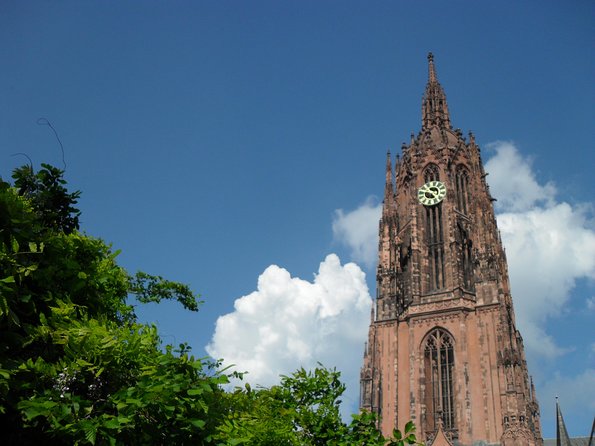
Your first stop is Frankfurt Cathedral, an imperial church tied to elections and coronations of the Holy Roman Emperor. You’ll mostly see it from the outside, and on Sundays the tour notes it as exterior-only. Even from the outside, the cathedral works as an anchor. It tells you that Frankfurt wasn’t just another trading city—it was part of the political machinery of Europe.
Practical note: if you’re the type who likes to understand what a building represents before you photograph it, this stop is a great start. You’ll get the political context early, so the rest of the walk won’t feel like disconnected landmarks.
Römerberg — city hall, Justicia, and the book burning memorial
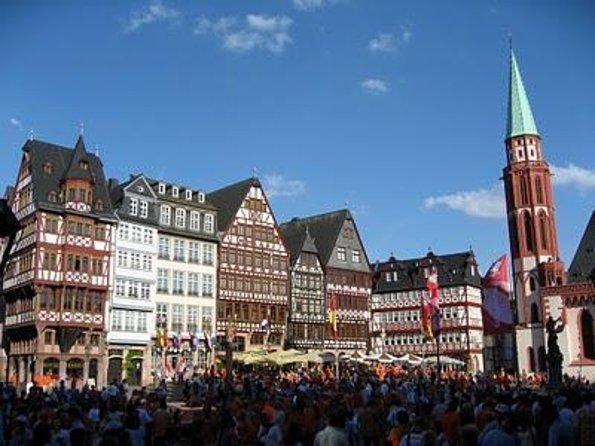
Next up is the Römerberg, Frankfurt’s famous square. Here you’ll learn about the Römer (city hall) and the figure Justicia, plus the Book Burning Memorial. This mix is the magic: government power, symbolic justice, and then a reminder of how ideas have been targeted and defended.
If you care about more than architecture—if you want to understand what citizens value—this is where the tour becomes thoughtful without getting gloomy for the sake of it.
Old Nicholas Church (Alte Nikolaikirche) — one of the oldest pieces
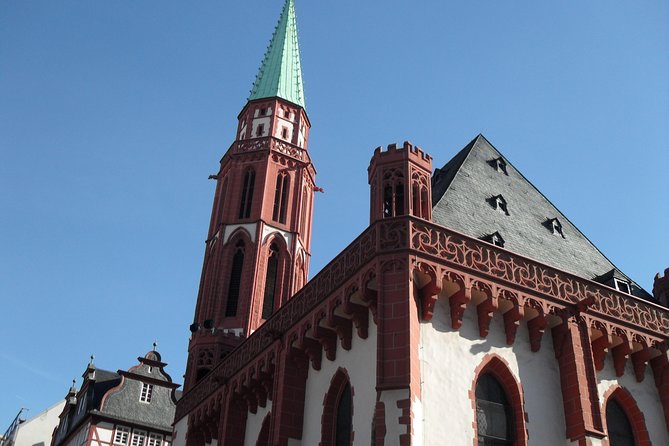
You also stop at Old Nicholas Church, one of Frankfurt’s older churches. Again, the plan is exterior-only on Sundays. Still, this small pause helps you shift from imperial power back to a long-running city identity.
This sequence—cathedral, square, old church—creates a smooth “time jump” feel. It’s not random. You’re learning how Frankfurt’s authority and community landmarks sit close together.
Wall Paintings at Karmeliterkloster, Then a Market Break at Kleinmarkthalle
Karmeliterkloster — art from the early 1500s
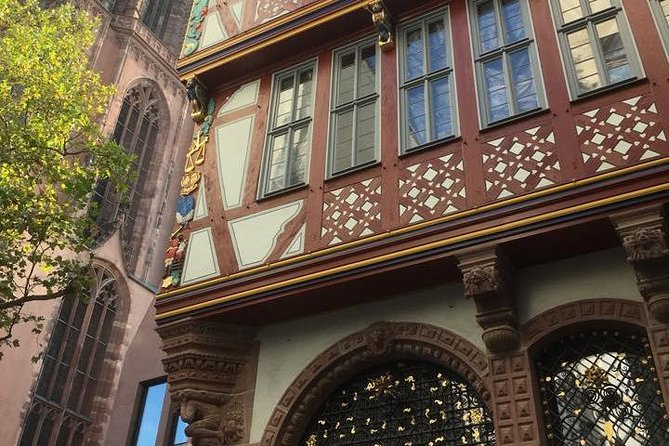
At Karmeliterkloster, you’ll learn about wall paintings created between 1513 and 1521. Even though you’re not spending a long time inside, this stop gives you a different kind of history. Instead of only focusing on rulers and public monuments, you get a glimpse of what people saw on everyday walls during the Renaissance era.
This works well because the tour isn’t just about what happened. It’s also about what the city looked like and what it felt like to live there.
Kleinmarkthalle — indoor food culture stop
Then comes Kleinmarkthalle, an indoor market that’s packed with produce, chocolate, cheeses, meats, pastries, and more. This is a perfect mid-walk reset. You’re out of the wind, you can browse, and you’re reminded that Frankfurt isn’t frozen in past centuries.
Two important constraints:
- It’s not on Sundays or German holidays.
- So your experience on those days may shift focus away from the market segment.
If you’re visiting Frankfurt for a day or two, this market stop is a strong way to taste local food culture without needing a separate planning mission.
Old Jewish Cemetery: A Quiet, Important Stop You’ll Remember
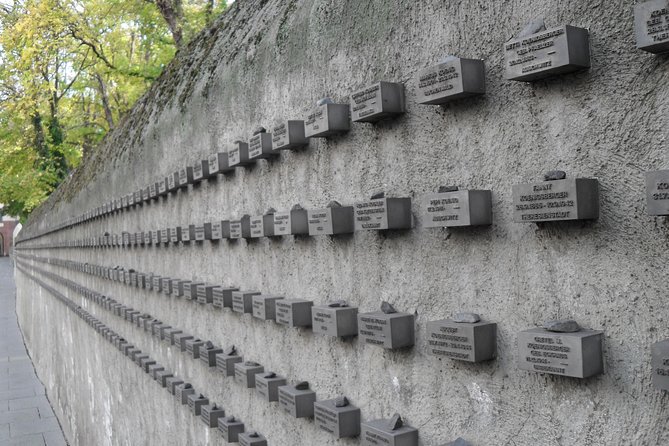
The walk then brings you to the Old Jewish Cemetery. You’ll learn about the Jewish community in Frankfurt dating back to the 1100s, and about the medieval Jewish Ghetto. The Jewish Holocaust Remembrance Wall surrounds the medieval cemetery, and you view the cemetery through the gate.
This is the kind of stop that benefits from a guide’s framing. Otherwise, you might just see a gate and assume you’ve already gotten the main point. With the context provided, the site becomes part of a larger story of presence, restriction, survival, and memory.
One practical advantage: the stop is timed for attention—about 30 minutes—so it’s not just a quick photo and move on. You get enough time to process what you’re seeing and what the place communicates.
City Planning Details at the Stadtplanungsamt and a Shortcut Through the Past
Stadtplanungsamt — how Frankfurt shapes itself today
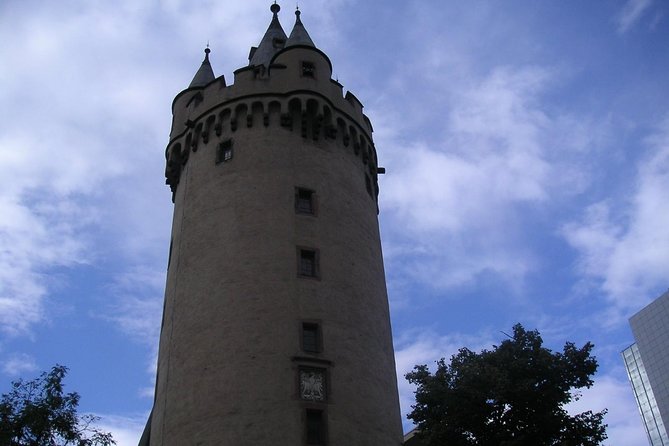
At Stadtplanungsamt (City Planning Department), you’ll see a huge scale model of present-day Frankfurt. It’s not a museum model for show. It connects the city’s history to how it’s being built, rebuilt, and decided today.
This is a great stop if you like the logic behind cities: why streets curve, why certain areas were preserved or changed, and how recovery and growth shape the map you walk on.
It’s also marked as not open on weekends or German holidays, so on those days you may get a different emphasis elsewhere on the route.
New Old Town and the coronation path
Then you walk through New Old Town (Alt Stadt) and along the former coronation path for Holy Roman Emperors. This part adds movement and meaning. Instead of only stopping at monuments, you’re walking through the urban corridor that once mattered for major ceremonies.
It’s the kind of historical “route literacy” that’s hard to get on your own. After this, you’ll look at streets differently—less like just a way to get from A to B.
Eiserner Steg Love-Lock Views and the Medieval Wall at Staufenmauer
Eiserner Steg — quick views with big pay-off
Your river moment comes at Eiserner Steg, also known as the Love-lock Bridge. The value here is the viewpoint: you get views from both sides of the Main River, including sights like the ECB, the museum river bank, and Sachsenhausen.
Even with a short stop (about 10 minutes), it works because you’re not just looking. You’re understanding where things sit relative to the river and why the river matters to the city’s identity.
Staufenmauer — 1100s city wall and Jewish wall connection
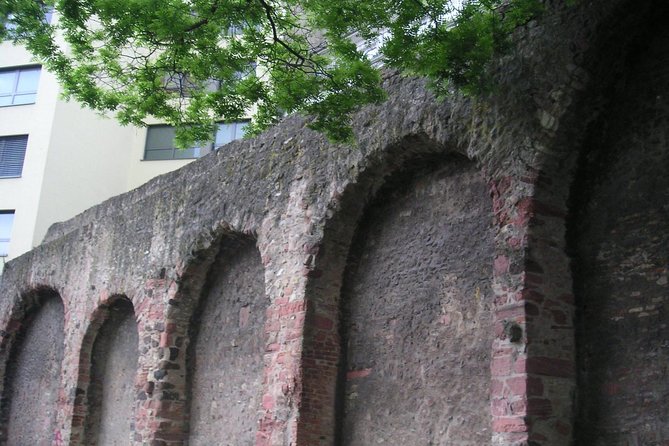
Finally, you reach Staufenmauer, a city wall segment dating back to the 1100s, plus part of the Medieval Jewish Wall. This stop ties together threads from the earlier Jewish history segment with the broader medieval layout of Frankfurt.
It’s a good end to the story arc. You start with imperial power, move through civic symbols, pass through community and memory, then end on the physical boundaries that shaped the old city.
Price and Value: Is $36.28 a Good Deal?
At $36.28 per person for roughly 2 to 3 hours, this tour is priced like a smart mid-range guided experience. The biggest value boosters are:
- English-language guidance that frames what you’re seeing
- A route with many free admission stops
- A maximum group size of 20, which helps quality and questions
- A balanced schedule that includes both major landmarks and a market stop when open
To judge value, think about what you’d otherwise pay for. Without a guide, you’d still need to plan your route, chase context at each stop, and decide which sites are worth your time. Here, the guide does that thinking for you, while you spend your energy walking and looking.
If your goal is to get your bearings fast and learn the “why” behind the streets, this is a strong spend.
When the Schedule Shifts: Sundays, German Holidays, and Closures
A walking tour has one built-in variable: the city’s weekly rhythm. This one flags a few key differences:
- On Sundays, Frankfurt Cathedral and Old Nicholas Church are noted as exterior-only.
- Kleinmarkthalle is not operating on Sundays or German holidays.
- Stadtplanungsamt is not open on weekends or German holidays.
So if you’re planning this on a Sunday, don’t expect the exact same market-and-model feel. You’ll still get the old-town core and the key historical stops, but the emphasis will lean more toward exterior landmarks and outdoor viewpoints.
Pace, Comfort, and What to Do Before You Go
This is a walking tour. That sounds obvious, but it matters for comfort. The stop durations add up to about 2 hours 50 minutes if you run close to the full plan, and you’ll likely move through the route with short pauses. Some stops include intermittent steps, so if your mobility is limited, plan for careful footing.
A smart approach:
- Wear shoes that handle uneven pavement and short stair sections.
- Bring a light layer, since weather can change the feel of a cathedral or river-side viewpoint quickly.
- Use break moments to reset. Many guides keep the group moving with short pauses, which you’ll appreciate on a long day.
Also, go with the right mindset. This isn’t a checkboxes-only tour. It’s designed to give you a clear story from place to place, which means you should allow yourself to listen and look rather than rush to your next photo.
Should You Book This Frankfurt Highlights English Walking Tour?
Yes, if you want a guided Frankfurt that balances major sights with meaning, and you like your history connected to real street scenes. This is especially worth it if you:
- Prefer English guidance instead of piecing context together on your own
- Want a route that covers both the old town core and river viewpoints
- Appreciate a guide who can turn monuments into stories that make today’s city feel understandable
- Like the idea of a market stop at Kleinmarkthalle (when it’s open)
I’d skip or rethink it if you have trouble with sustained walking, since the plan runs close to three hours and includes some steps. Otherwise, it’s a solid way to see Frankfurt with less guesswork and more payoff per minute.
FAQ
What is the duration of the Frankfurt Highlights English Walking Tour?
It runs about 2 to 3 hours.
What time does the tour start, and where does it meet?
It starts at 10:00 am and meets at Braubachstraße 41, 60311 Frankfurt am Main, Germany. The tour ends back at the meeting point.
Is the tour offered in English?
Yes, the tour is offered in English.
How big is the group?
The tour has a maximum of 20 travelers.
Are admissions included at the stops?
Most stops are marked as free admission in the tour plan.
Which stops are not available on Sundays or German holidays?
Kleinmarkthalle is not on Sundays or German holidays, and Stadtplanungsamt is not open on weekends or German holidays.
Can I cancel for free?
Yes. You can cancel up to 24 hours in advance for a full refund.
Is the tour accessible for strollers, and are service animals allowed?
The tour route is described as stroller-friendly, and service animals are allowed.