REVIEW · BARCELONA
Barcelona Historical Walking Tour: Gothic Quarter and El Born
Book on Viator →Operated by Carpe Diem Tours · Bookable on Viator
Gothic lanes hide stories in plain sight. This 2-hour walk through the Gothic Quarter and El Born strings together art, religion, and politics on foot, including stops tied to Picasso and Gaudí. You don’t just look at stone—you hear how each place fits into Barcelona’s larger story.
I especially like the small group size (max 20) and the relaxed pace, which leaves breathing room for photos and questions. From what you’ll experience on the ground, the guides keep the energy high; guides like Juan, Lidia, and Sonia come across as lively, and some even use an iPad to help you picture what older Barcelona looked like.
One thing to plan for: two of the big churches here have admission not included (Catedral de Barcelona and Basilica de Santa Maria del Mar). If you want to go inside both, budget a little extra time and money.
In This Review
- Key highlights at a glance
- Why this Gothic Quarter to El Born walk works in 2 hours
- Your route, stop by stop, from Els 4 Gats to El Born squares
- What makes the stories feel real (not just dates)
- Entrance fees: what’s free and what costs extra
- Group size, pacing, and weather reality
- Price and value: is $30.25 a good deal?
- Who should book this tour, and who might skip it
- Should you book this tour?
- FAQ
- How long is the Barcelona Historical Walking Tour: Gothic Quarter and El Born?
- What is the price per person?
- Is the tour offered in English?
- How large is the group?
- Where do I meet the tour, and where does it end?
- Is the ticket mobile?
- Are entrance fees included for all stops?
- What is included in the tour price?
- Is the tour easy enough for most people?
- Can I cancel for a full refund?
Key highlights at a glance
Picasso and Gaudí connections right in the middle of the Gothic streets
Roman and medieval layers you can literally see as you walk
Free stops at most points, with only two major entrances ticketed
Catalan identity moments like the La Diada-linked photomosaic
Jewish Quarter focus (El Call) with synagogue area context and legends
Guides who answer questions and add extra details on the spot
Why this Gothic Quarter to El Born walk works in 2 hours
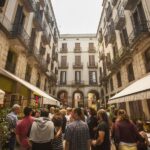
Barcelona’s old center can feel like a puzzle: streets twist, buildings repeat, and it’s easy to miss why any one corner matters. This tour is built to fix that fast. In about 2 hours, you cover the kind of streets that buses won’t touch and learn what you’re actually looking at.
The sweet spot here is the mix. You go from an artist-favorite café to places tied to saints, empires, and street legends. You also get Catalan cultural references that make the modern city feel connected to what came before.
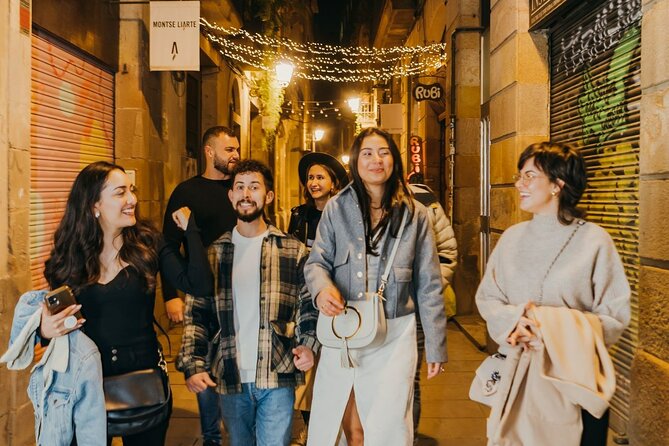
And because it’s a maximum of 20 people, the tour stays conversational. When I’m hunting for a “first day” activity, I want to ask a question without shouting across a crowd. This format generally does that job well.
You can also read our reviews of more walking tours in Barcelona


Your route, stop by stop, from Els 4 Gats to El Born squares
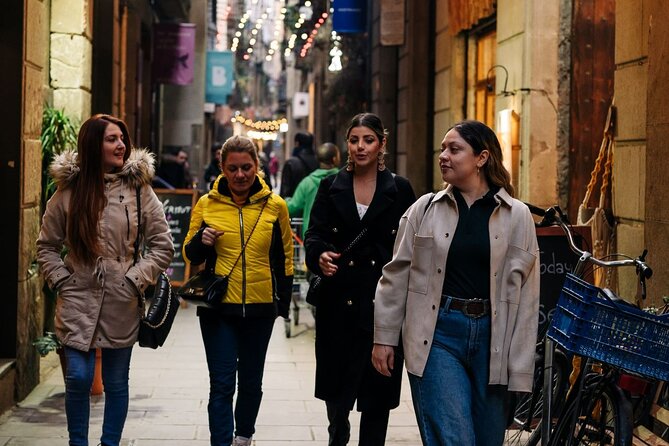
You begin near Plaça del Vuit de Març in Ciutat Vella and end at Basílica de Santa Maria del Mar. That one-way flow matters: you’re walking through the heart of the old city instead of doubling back.
Stop 1: Els 4 Gats
This is a historic café and restaurant that became a gathering place for artists, intellectuals, and modernists. You’ll hear how figures like Pablo Picasso and Antoni Gaudí were linked to this creative scene. The Art Nouveau design is part of the point: it’s not just a name on a wall, it’s a snapshot of a Barcelona that wanted to be new.
Stop 2: El Mon Neix En Cada Besada (photomosaic)
This photomosaic, installed in 2014, ties into Catalan remembrance linked to September 11, 1714 and the War of the Spanish Succession. You’ll connect it to La Diada, Catalonia Day—so the story isn’t only about buildings, it’s about identity and what people remember when they look at the street.
Stop 3: Catedral de Barcelona
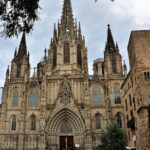
This Gothic-style church honors the life and death of the city’s patron saint, Eulalia, including her torture under Roman rule (as the story goes in the city tradition). You’ll stand in the center of it all, which helps you understand why “Gothic” here isn’t an art style only—it’s also a way Barcelona organized faith and public life.
Stop 4: Casa de l’Ardiaca
This spot is unusual even by Gothic Quarter standards. You’ll see a blend of Gothic and Renaissance touches, plus the presence of a vertical face of the Roman wall and aqueduct elements. The takeaway: Barcelona’s layers aren’t buried in a museum—they’re showing up in the open when you know where to look.
Stop 5: Pont del Bisbe
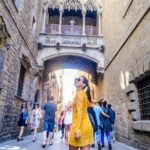
Bishop Street (Carrer de Bisbe) was a major road in Roman Barcino. The Neo-Gothic bridge here comes with a superstition legend, which is exactly the kind of detail you’d miss if you were only speed-walking through photos.
Stop 6: Placa Sant Felip Neri
This square is tucked away, but it has a heavy side. You’ll learn it connects to the Spanish Civil War and that scars from that time are still visible. It’s not “morbid” for the sake of it—the point is that Barcelona’s present-day charm sits on top of real events.
Stop 7: MUHBA – El Call (Jewish Quarter)
El Call gives you the medieval street layout feel in a way the rest of the Gothic Quarter can blur together. You’ll pick up context about Barcelona’s Jewish history, including synagogue area references and local legends.
Stop 8: Placa de Sant Jaume
This square is a government hub, ringed by historic buildings. The value here is perspective: you’re not only learning about worship and art, you’re seeing how power and civic life played out in the same streets.
Stop 9: Placa Del Rei
Royal Palace territory makes this square feel like it’s still holding its breath. You’ll hear about regal heritage and also darker chapters tied to that power.
Stop 10: Plaça de l’Àngel (Angel’s Square)
Wheat Square once worked as a grain trading hub. You’ll connect the name Angel’s Square to a heavenly legend. It’s a quick story with big payoff: it helps you understand why markets, food, and religion overlap in older European city centers.
Stop 11: Basilica de Santa Maria del Mar
Santa Maria del Mar is Catalan Gothic, and you’ll get why it matters to maritime Barcelona. If you like church architecture but also want the human angle—who built it, what kind of city paid for it, and what the skyline meant—this is one of the stops that can land hard.
What makes the stories feel real (not just dates)
This tour works because the guide brings the details together. You hear how artists, rulers, and ordinary people all shared the same streets—just at different times.
You’ll also notice how the guide handles the “why.” For example, the tour doesn’t just point to a Gothic facade; it ties it to the saint’s story. It doesn’t stop at a photomosaic; it connects it to La Diada and why Sept 11, 1714 still echoes.
I also like that the pace keeps room for interaction. In past experiences on similar walks, I’ve often had to choose between reading signs and asking questions. Here, guides like Juan and Petra are described as answering questions well and adding trivia that helps the city stick in your mind after the walk.
Some guides also use visuals—one group’s guide used an iPad to supplement history on the spot. That helps when you can’t easily picture medieval streets from the current sidewalks.
Entrance fees: what’s free and what costs extra

Most stops are free to view, which keeps your total out-of-pocket reasonable. The two places that have admission not included are:
- Catedral de Barcelona
- Basilica de Santa Maria del Mar
If your goal is to do quick exterior viewing only, you can keep costs close to the tour price. If you want to go inside both churches, plan for an extra expense and a bit more time during your Barcelona day.
A practical trick: decide early whether you want “walk-and-look” or “walk-and-enter.” This tour is great for the first style, and it’s still worth it for the second—you just need to budget the entrances.
Group size, pacing, and weather reality

This tour caps at 20 travelers, which tends to keep the crowd from swallowing the guide’s voice. Many guides in this program are described as energetic and able to keep kids and teens interested too, so it’s not only for adults in a museum mood.
The walking is described as easy and doable for most people, and the pace is slow enough for photos. That’s a big deal in the Gothic Quarter, where people often rush and then feel like they missed the point.
Weather can change the flow. One guide reportedly spent extra time explaining while dodging downpours, so if it rains, assume the mood may shift slightly toward stories and sheltered stops. Bring a compact umbrella or poncho if you’re going in shoulder season.
You can also read our reviews of more historical tours in Barcelona



Price and value: is $30.25 a good deal?
At $30.25 per person for roughly 2 hours, this tour is priced like a solid “orientation plus stories” experience. What makes it good value is the structure: you get a guide for the walking time, plus you visit a string of key sites without needing to piece together tickets on your own.
The value math also improves because many stops are free. You’re mostly paying for guidance and context, not for a long list of entrances.
Two small costs to watch:
- You may pay for the Catedral de Barcelona and Santa Maria del Mar entrances if you choose to go in.
- If you’re budgeting tightly, you’ll want to factor that into your plan rather than treating the tour as “all-inclusive.”
On a practical note, this is also a tour that’s commonly booked ahead (it averages 26 days in advance). If you have firm dates, booking early is smart.
Who should book this tour, and who might skip it
Book it if you want:
- A first-time grasp of the Gothic Quarter and El Born without getting lost
- A story-led walk that connects modern Catalan identity with medieval and Roman layers
- A guide who answers questions and uses extra tools (like iPad visuals in some cases)
Consider skipping (or pairing something else) if you:
- Only want museum-style interiors and hate exterior-focused sightseeing
- Have zero interest in saint legends, civil war memory, or El Call context
- Prefer fully independent touring where you choose every entrance and stop length
This tour is best as a backbone for your next few days in Barcelona. It gives you names, themes, and a sense of direction for exploring on your own right after.
Should you book this tour?
Yes, if you want to get your bearings fast and understand what you’re looking at while you’re still walking through it. The combination of free stops, a small group, and high-energy guides (Juan, Lidia, Jorge, Darren, Vanesa, and others are mentioned in the program) makes it a strong way to start an old-city day.
If your “must-do” list includes entering every major church, budget a little extra for the Catedral de Barcelona and Basilica de Santa Maria del Mar. Also, consider booking a morning slot if you can, because you’ll often find it cooler and easier to move through the area.
FAQ
How long is the Barcelona Historical Walking Tour: Gothic Quarter and El Born?
It lasts about 2 hours.
What is the price per person?
The price is $30.25 per person.
Is the tour offered in English?
Yes, it’s offered in English.
How large is the group?
The tour has a maximum of 20 travelers.
Where do I meet the tour, and where does it end?
You start at Plaça del Vuit de Març, Ciutat Vella, 08002 Barcelona, Spain. You end at Basílica de Santa Maria del Mar, Plaça de Santa Maria, 1, Ciutat Vella, 08003 Barcelona, Spain.
Is the ticket mobile?
Yes, you get a mobile ticket.
Are entrance fees included for all stops?
No. Admission is not included for Catedral de Barcelona and Basilica de Santa Maria del Mar. Other listed stops are free.
What is included in the tour price?
It includes a guided walking tour with a local guide, city highlights, and hidden gems.
Is the tour easy enough for most people?
The information says most travelers can participate, and the walking is described as manageable.
Can I cancel for a full refund?
Yes. Free cancellation is available up to 24 hours in advance for a full refund.
If you tell me your travel dates and whether you want to go inside the two ticketed churches, I can help you decide if this should be your first morning in the old city.