REVIEW · FLORENCE
Florence Evening Walking Tour: Stories of Power, Love & Betrayal
Book on Viator →Operated by City Wonders Ltd · Bookable on Viator
Florence at night has a way of making politics feel personal. This evening walking tour threads Medici-era power struggles through iconic landmarks you know, plus palazzi and corners that most people walk past. I like that it’s tightly timed (about 1 hour 30 minutes) and you get a crisp hit of context about Florence’s ruling families without needing museum tickets. Audio headsets also mean you can actually hear your guide at street level.
My favorite part is the mix of big-name sites with the “wait, what happened here” details—power, love, betrayal, and the kind of intrigue that turns buildings into plot points. One potential drawback: it is a mostly standing-and-walking experience with frequent story stops, so if you want lots of time for photos or you need slow pacing, plan accordingly.
In This Review
- Key Highlights You’ll Feel in the Streets
- Why This Evening Walk Works in Florence
- Price and What $21.72 Buys You
- Meeting Point to Final Stroll: How the Route Flows
- Why this order matters
- Stop-by-Stop: Palazzi, Factions, and the “How Did This Happen” Details
- Palazzo Strozzi: A Facade Over a Fight for Power
- Palazzo Buondelmonti: Feuds That Spilled Into Centuries
- Chiesa dei Santi Apostoli: Church Exteriors, Medieval Intrigue
- Palazzo di Parte Guelfa: Political Factions in Stone
- Torre degli Amidei: A Tower That Holds the Memory of Violence
- Auditorium Santo Stefano al Ponte Vecchio: Lesser-Known, Still Complicated
- Piazza della Signoria: Florence’s Political Stage
- Palazzo Vecchio: Conspiracies Tied to the Power Center
- Gallerie degli Uffizi (From the Outside): A Museum With a Political Past
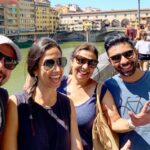
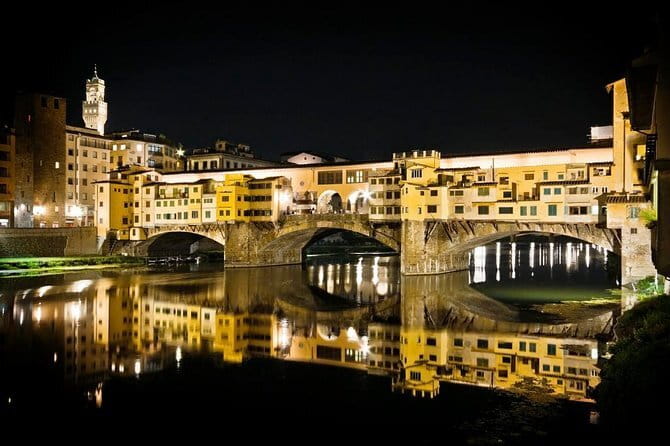
- Ponte Vecchio: The Bridge Where Whispery Stories Live
- Palazzo Pitti: Another Seat of Power, Another Layer of Scheming
- Palazzo di Bianca Cappello: Love, Scandal, and an Untimely End
- Ponte Santa Trinita: The Walk’s Calm Finish Near Dinner
- Guides, Group Size, and How the Night Storytelling Feels
- Walking Comfort: Shoes, Stopping Points, and Photo Expectations
- Is This the Right Tour for You?
- Should You Book This Florence Evening Walking Tour?
- FAQ
- What’s the duration of the Florence evening walking tour?
- How much does the tour cost?
- Where do I meet the guide?
- Where does the tour end?
- Is the tour offered in English?
- Do I need to download anything?
- Are audio headsets provided?
- What group size should I expect?
- Is it suitable for strollers or baby carriages?
- Can I cancel for a full refund?
Key Highlights You’ll Feel in the Streets
Headsets that help in crowds: clear audio makes the guide’s narration easy to follow.
Medici and rivals as a story arc: you connect Florence’s Renaissance power players across multiple stops.
Outside views, inside context: you pass famous places like the Uffizi while learning what’s behind the walls.
Scandal and intrigue themes: palazzi tied to love affairs, conspiracies, and feuds shape the walk.
An easy night ending near bars: the tour finishes close to dinner and drinks around the centro storico.
Why This Evening Walk Works in Florence
If you’ve ever felt like Florence is a bunch of pretty facades with no emotional story, this tour fixes that. You’re not just “seeing monuments.” You’re getting a guided timeline of who held power, who fought for it, and how personal relationships turned into public consequences.
I also like that it’s designed for an evening pace. The walk starts in a major square—Piazza degli Strozzi—then moves you through streets where the architecture feels slightly more dramatic after dark. And because the group stays small (up to 20 people), your guide can keep the flow moving without losing everyone every few minutes.
One more practical win: audio headsets. Even if a street is noisy or crowded, you’re not guessing what the guide said. That matters here because the tour is dense with names, motives, and dates.
You can also read our reviews of more walking tours in Florence
Price and What $21.72 Buys You
At $21.72 per person for about 1 hour 30 minutes, you’re paying mostly for guided storytelling and route design, not for admissions. In fact, many stops are viewed from outside, and the tour notes that several admission tickets are not included. That’s a good sign if you want a low-commitment introduction to the city’s power geography.
Value-wise, you’re getting:
- A structured walk across multiple major areas in the historic center
- Clear narration via mobile tickets and audio headsets
- A small-group experience (max 20)
If you’re trying to pick one evening activity your first night in Florence, this is a strong candidate. You’ll see where key sights are located and why they mattered, so your next day is easier to plan—without spending museum time on day one.
Meeting Point to Final Stroll: How the Route Flows

The tour meets at Piazza degli Strozzi and ends at Ponte Santa Trinita, close to where you’ll find plenty of restaurants and bars in the centro storico. That ending is practical: after 90 minutes, you’re not stuck across the city with a long trek back.
In between, you’ll move through a “power-and-romance” loop:
- Start with major Renaissance palazzi tied to family rivalries
- Work through political faction spaces and sites linked to darker feuds
- Pass the Uffizi area while learning what the Medici legacy shaped
- Cross the bridges—especially Ponte Vecchio—where stories linger in the stones
- End near Ponte Santa Trinita so dinner is close
Why this order matters
The walk is structured so each neighborhood and building adds a new layer to the same theme: Florence as a stage where families fought for influence through marriage, patronage, and sometimes violence. If you want Florence to feel like a connected story, not a scrapbook of stops, this layout helps.
Stop-by-Stop: Palazzi, Factions, and the “How Did This Happen” Details
Here’s what you can expect at the major moments along the way, and what each one gives you.
You can also read our reviews of more evening experiences in Florence

Palazzo Strozzi: A Facade Over a Fight for Power
You’ll begin at Palazzo Strozzi, admired for its Renaissance grandeur but explained through rivalry and intimidation. The point isn’t just to look at the building. It’s to understand how rival families used architecture and public presence to signal control.
If you’re the type who likes to read a city like a newspaper, you’ll appreciate this start. It frames what comes next: later stops feel less random because the tour keeps returning to who wanted what.
Palazzo Buondelmonti: Feuds That Spilled Into Centuries
Next is Palazzo Buondelmonti, presented as a symbol of Florence’s feuding past. You’re not just hearing a “family story.” You’re learning why conflict became a long-term pattern—how one outcome helped shape what Florence became for the next generation.
This is also where the tour’s theme clicks: love, betrayal, and power aren’t separate topics. They’re connected in the way families competed for legitimacy.
Chiesa dei Santi Apostoli: Church Exteriors, Medieval Intrigue
At the Chiesa dei Santi Apostoli area, you’ll step into Borgo Santi Apostoli and hear medieval-flavored tales tied to the historic site. Even though it’s an exterior-focused moment, the church gives the tour a different tone—ritual and mystery rather than court-level politics.
It’s a good reset point. After two palazzi, the church stop slows the story just enough that you don’t feel like you’re sprinting through names.
Palazzo di Parte Guelfa: Political Factions in Stone
At Palazzo di Parte Guelfa, you shift from family rivalries to formal political factions. This building is described as the heart of Florence’s political division, which helps you understand why the city could feel fractured even when people shared the same streets.
This is a stop that makes other places easier to interpret. Later, when you see Florence’s “big squares,” you’ll know what kind of power was being performed there.
Torre degli Amidei: A Tower That Holds the Memory of Violence
At Torre degli Amidei, the tour treats the tower like a silent witness. The story focus here is escalation—how conflicts intensified and turned into violence, leaving scars on the city’s turbulent memory.
If you dislike dark storytelling, this is the part where you’ll feel it most. The tower stop leans into bloodiest feud territory, and it’s not just a quick mention—it’s part of the tour’s core identity.
Auditorium Santo Stefano al Ponte Vecchio: Lesser-Known, Still Complicated
You’ll get a look near Auditorium Santo Stefano al Ponte Vecchio, outside the medieval church of Santo Stefano al Ponte. The emphasis is on forgotten intrigue and connections to lesser-known scandals and legends.
This is one of those “you wouldn’t find it on your own” moments. It also gives you a break from the most famous postcard angles, which many people find refreshing at night.
Piazza della Signoria: Florence’s Political Stage
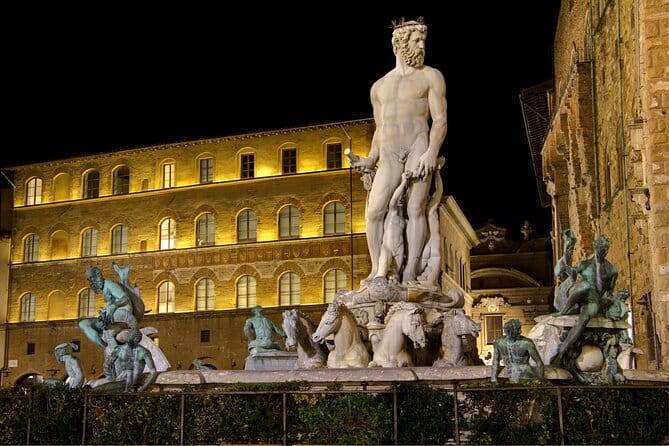
Piazza della Signoria is the tour’s big “stage” moment. You’ll learn how this political heart ties to Palazzo Vecchio and the Uffizi area, and you’ll get the darker side behind their beauty—betrayal, power, and even murder.
This stop matters because it turns the square from a view into a story. Once you understand it as a place where decisions and reputations were made publicly, your photos start to feel more intentional.
Palazzo Vecchio: Conspiracies Tied to the Power Center
Outside Palazzo Vecchio, the tour explains the sinister side of Florence’s political heart: power struggles, assassinations, and conspiracies connected to what happened within its walls.
Even from the outside, the building reads differently after you hear the framing. If you want your city-walk to feel like narrative, this is where it pays off.
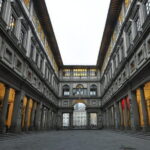
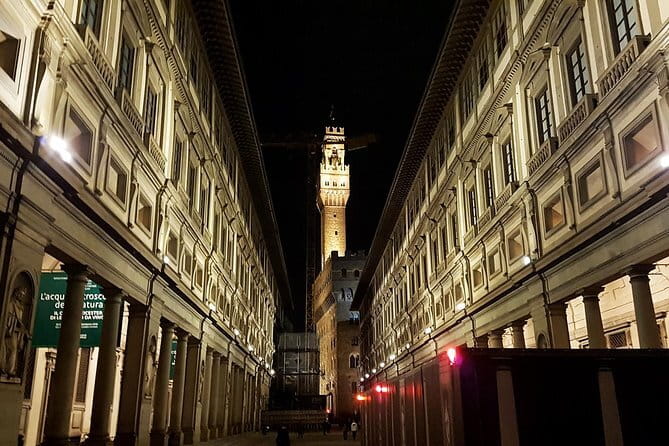
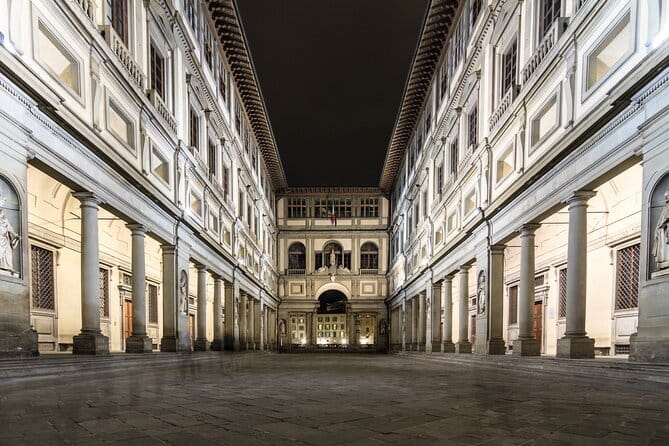
Gallerie degli Uffizi (From the Outside): A Museum With a Political Past
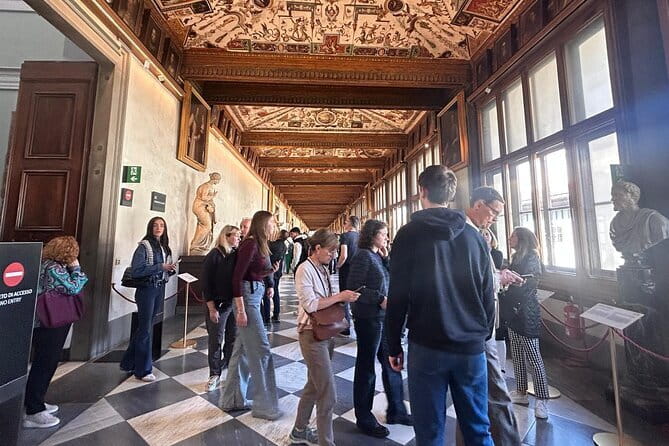
You’ll admire the Uffizi Gallery from the outside while hearing how the Medici family shaped its legacy. The tour also points you toward masterpieces you’ll recognize—mentioning Botticelli and Michelangelo inside the Uffizi.
That’s smart for two reasons:
- You don’t waste your energy trying to squeeze museum time into a night walk.
- You get enough context to make a future Uffizi visit feel purposeful.
Ponte Vecchio: The Bridge Where Whispery Stories Live
Crossing Ponte Vecchio, the tour leans into scandal—secret dealings and forbidden romances. Bridges are perfect for this style of storytelling because they connect neighborhoods and become natural “memory machines.”
This part also gives you a classic night scene for photos, but keep your expectations realistic: the tour is moving, not stopping for long photo sessions.
Palazzo Pitti: Another Seat of Power, Another Layer of Scheming
Near Palazzo Pitti, the tone shifts back to opulence, then back to politics. You’ll hear that it was a seat of power and that the darker side involves political scheming and Medici secrets.
Even if you don’t enter, this stop helps you see the Medici pattern: where power sits, where it moves, and how it shows itself in different buildings.
Palazzo di Bianca Cappello: Love, Scandal, and an Untimely End
At Palazzo Bianca Cappello (originally of the Corbinelli family), the tour pauses for a tragic tale tied to Bianca Cappello and her scandalous relationship with a Medici duke, ending in intrigue and an untimely death.
This is one of the stops that makes the tour title make sense. “Power” isn’t only about politics. It’s also about love stories that become dangerous.
Ponte Santa Trinita: The Walk’s Calm Finish Near Dinner
Finally, you end at Ponte Santa Trinita, described as a Renaissance gem steeped in history. You reflect as the tour wraps up, with themes of love and loss followed by Florence’s resilience.
Because you’re finishing near restaurants and bars, you can keep the evening momentum going instead of heading home right away.
Guides, Group Size, and How the Night Storytelling Feels

Most tours rise or fall on pacing. This one runs about 90 minutes, and the tour is designed for a small group—max 20 people. Many people love that it feels focused, not chaotic.
I also want to flag something important from the variety of guide experiences shared for this tour style. Some guides, like Stefano, Angelo A., Valentina, Francesca, Mel, and Annette, have been called out for making stories come alive and keeping people engaged with humor and clarity. On the flip side, a smaller number of people reported issues like mumbling or a voice that didn’t carry well enough, and that the story sometimes felt too heavy or too much like a long lesson.
So here’s my practical advice: if you’re sensitive to lots of standing and long storytelling, show up rested, keep your water nearby, and don’t expect a chatty, performative style from every guide. The headsets help, but they don’t replace the rhythm of good delivery.
Walking Comfort: Shoes, Stopping Points, and Photo Expectations
This is an evening walking tour, so wear good shoes. The route moves through old streets and you’ll spend plenty of time on your feet. The tour also isn’t suggested for strollers or baby carriages, so it’s best for people who can handle uneven sidewalks and quick pauses.
Photo expectations: you’ll see famous spots at night, but the tour is structured around story points. If you want long photo sessions, you may feel a bit rushed near the most iconic areas.
A smart move if you get easily distracted by hunger: have an early snack or plan dinner soon after. Some people noted that doing this on an empty stomach can feel long when the story runs thick.
Is This the Right Tour for You?
This tour is a good fit if you like:
- Renaissance Florence told through real conflicts (family rivalry, politics, scandals)
- Seeing “famous” sites with added context, not just a photo stop
- A structured walk that helps you orient yourself in the historic center fast
Skip it or consider another option if you want:
- Architecture-first commentary with lots of seating and building access
- A purely light, romance-only story without darker feud material
- A slow stroll designed around unhurried sightseeing
It’s also worth thinking about what you want on your first night. If you’re still figuring out neighborhoods, this route helps you place major sights in your mental map.
Should You Book This Florence Evening Walking Tour?
I think you should book it if you’re excited by the idea of Florence as a power city—where art, family loyalty, and betrayal all shaped what you see today. At $21.72 with audio headsets and a small group, it’s a practical way to turn an evening into a clear story line rather than a random walk.
Don’t book it if you need lots of time to sit, you dislike heavy narrative, or you’re expecting museum entry tickets. Also, plan for walking and frequent standing; the tour is about motion, not lingering.
If you do go, you’ll get the best experience by going in with curiosity. Look at each palazzo like it’s a character in a drama. Florence rewards that mindset, especially at night.
FAQ
What’s the duration of the Florence evening walking tour?
It runs for about 1 hour 30 minutes.
How much does the tour cost?
The price listed is $21.72 per person.
Where do I meet the guide?
You meet at Piazza degli Strozzi, 50123 Firenze FI, Italy.
Where does the tour end?
The tour ends at Ponte Santa Trinita, Firenze FI, Italy.
Is the tour offered in English?
Yes, it’s offered in English.
Do I need to download anything?
You’ll use a mobile ticket.
Are audio headsets provided?
Yes, audio headsets are provided so you can hear your guide clearly.
What group size should I expect?
The tour has a maximum group size of 20 people.
Is it suitable for strollers or baby carriages?
It is not suggested for strollers or baby carriages.
Can I cancel for a full refund?
You can cancel for a full refund if you cancel at least 24 hours in advance.