REVIEW · SYRACUSE
Syracuse: Highlights of Ortigia Guided Walking Tour
Book on GetYourGuide →Operated by Empeeria · Bookable on GetYourGuide
Greek myths meet real marble in Ortigia. In just two hours, you can walk from the Temple of Apollo to the Arethusa spring, with a guide connecting each place to the stories that made Syracuse famous. I love the way this tour gives you both the big sights and the myth behind them, especially at the Fountain of Diana and the Arethusa water that sits a few meters from the sea.
You’ll also get a satisfying sense of place. Piazza Duomo is all about marble workmanship and civic pride, and the Syracuse Cathedral visit adds a tangible “how this city evolved” moment to the walk. If you like history that you can actually see—rather than just read about—this route does a lot with a short time.
One consideration: entry to the Syracuse Cathedral isn’t included, and since it’s a place of worship you’ll need to follow the dress rules. Add that to the fact you should arrive 10 minutes early to keep the schedule on track, and it’s worth planning your timing carefully.
In This Review
- Key highlights you’ll care about
- Ortigia in two hours: the smart way to get oriented
- Meeting under the pomegranate tree: logistics that keep your day calm
- Temple of Apollo: where the tour earns its name
- Piazza Archimede: Fountain of Diana and the Arethusa moment
- Piazza Duomo: marble, power, and the Cathedral visit
- Arethusa spring: freshwater beside the sea and a love story
- Guides and storytelling: why this tour feels worth $29
- Price and value: what you’re really paying for
- Best fit: who should book this Ortigia highlights walk
- Should you book? My practical take
- FAQ
- Where does the Ortigia guided walking tour start?
- How long is the tour?
- How much does it cost?
- What’s included in the price?
- Is the Syracuse Cathedral entry ticket included?
- What language is the guide?
- What if I need help hearing the guide?
- Do I need to follow a dress code?
- Should I arrive early?
- How do monument visits work if hours change?
Key highlights you’ll care about
- Temple of Apollo first: you start at the oldest Greek temple in the Western world and get grounded fast
- Myth you can point to: Diana/Artemis and Arethusa’s transformation story is shown right where you’re standing
- Piazza Duomo’s marble impact: you get time in one of Italy’s most beautiful squares, plus a Cathedral visit
- Arethusa spring by the sea: freshwater tied to the love story between Arethusa and Alphaeus
- Sound support if you need it: you can use your own headset or buy a disposable one on site for €1
- Guides who keep the pace human: guides like Giuseppe, Michael, Letizia, Vincenzo, Eva, and Margaret are known for clear explanations and thoughtful handling of real conditions
Ortigia in two hours: the smart way to get oriented
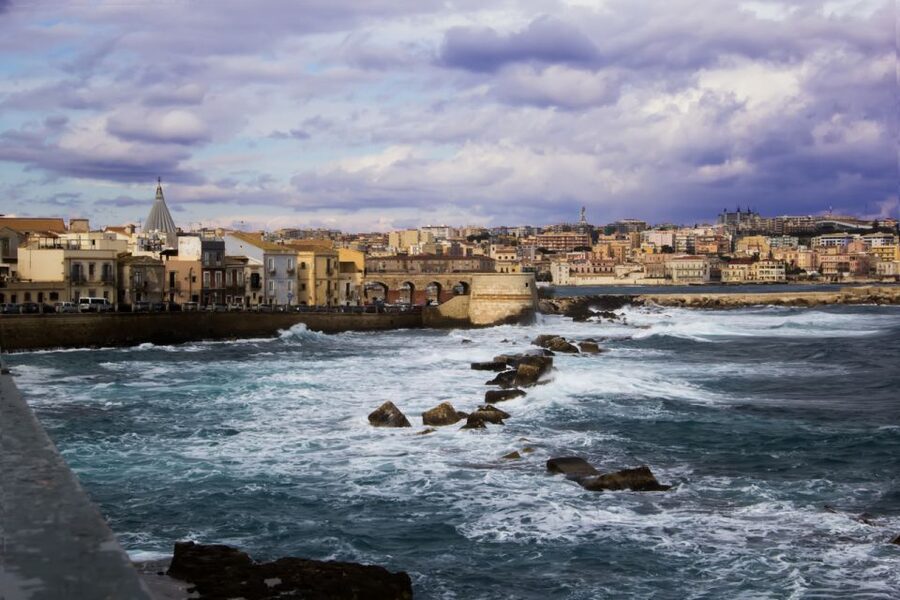
This is the kind of walking tour that works when you want answers fast. You’re in Ortigia, the historic heart of Syracuse, and the route strings together the most recognizable anchor points—Greek, Roman-era influence, and later Christian-era architecture—without turning into a marathon.
At $29 per person for a 2-hour guided walk, you’re paying mainly for two things: local context and the ability to “read” what you’re seeing. That matters in Ortigia because the places feel symbolic—temples, fountains, and squares that look static—but the guide helps connect the dots so they make sense as a single story.
You can also read our reviews of more walking tours in Syracuse


Meeting under the pomegranate tree: logistics that keep your day calm
The tour starts at Largo XXV Luglio, 7. For the actual meetup moment, you’ll look for the guide with a badge under the pomegranate tree in front of the Temple of Apollo, at the roundabout where Corso Matteotti starts.
Two practical notes can save you stress:
- Arrive 10 minutes early so you don’t throw off the timing, especially since visits to monuments can shift with opening hours or holidays.
- If you’ll struggle to hear in busy areas, bring your own headset. If you forget, you can buy a disposable one on site for €1.
Also, the tour can run in English and Italian at the same time. If you’re sensitive to having things repeated (or translated back and forth), it’s good to know that ahead of time.
Temple of Apollo: where the tour earns its name
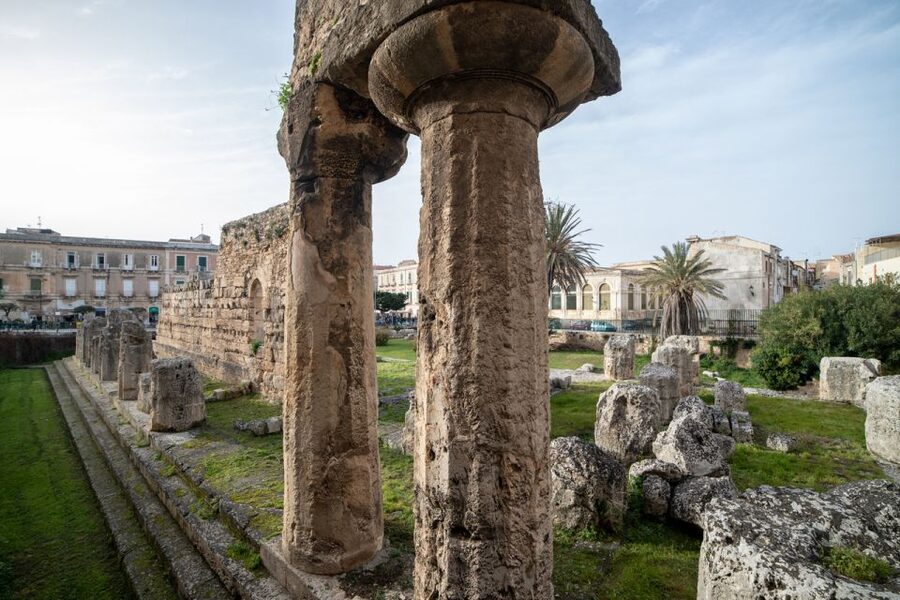
Your walk begins at the Temple of Apollo. This is not a vague “Greek ruins” stop—it’s the oldest Greek temple in the entire Western world, which gives the whole tour instant weight.
What the guide tends to do well here is point out how the architecture becomes a timeline. You’re not just staring at stone; you’re hearing why Syracuse placed Apollo at the start of its cultural story and how Greek influence left a visible mark on the island.
This first stop also sets the tone for the myth portions later. Once you hear the Arethusa connections and the Artemis/Diana transformation story, the route becomes easier to follow because the guide is building meaning step by step.
Piazza Archimede: Fountain of Diana and the Arethusa moment
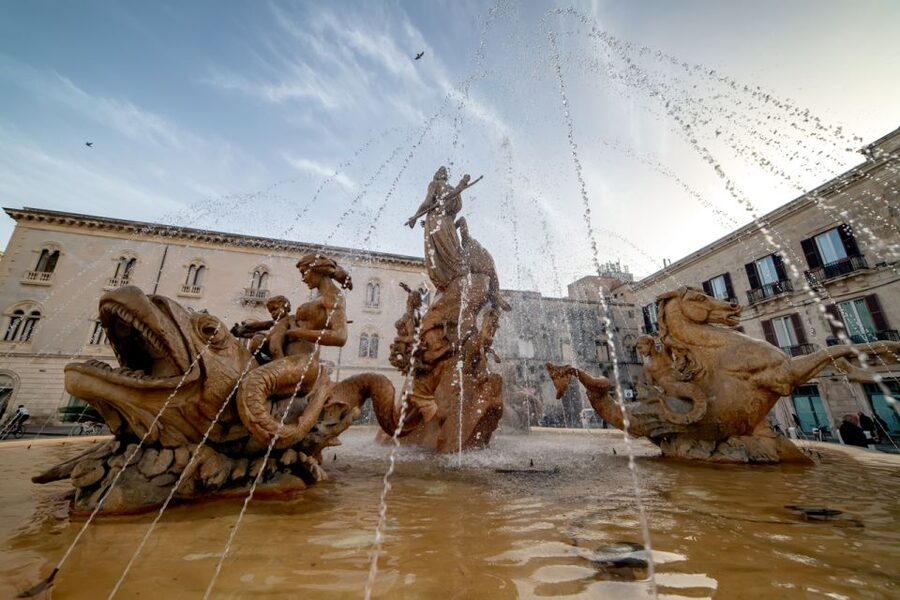
Next you head toward Piazza Archimede, where you’ll see the Fountain of Diana. This isn’t just a pretty photo stop. The guide connects the fountain to a specific moment in Greek myth: the nymph Arethusa is depicted alongside the Greek goddess Artemis at the point where she transforms into a fountain.
That detail matters because it changes how you look at the artwork. Instead of seeing figures at a distance, you start noticing how the scene reflects the story. And if you like learning through direct visual cues, this is a great part of the tour—your brain gets the myth and the location together.
Piazza Duomo: marble, power, and the Cathedral visit
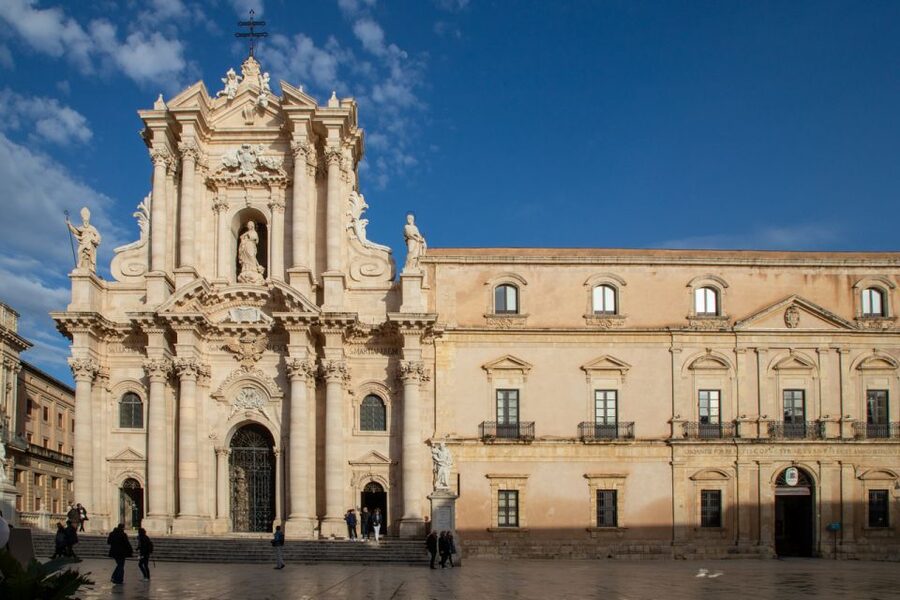
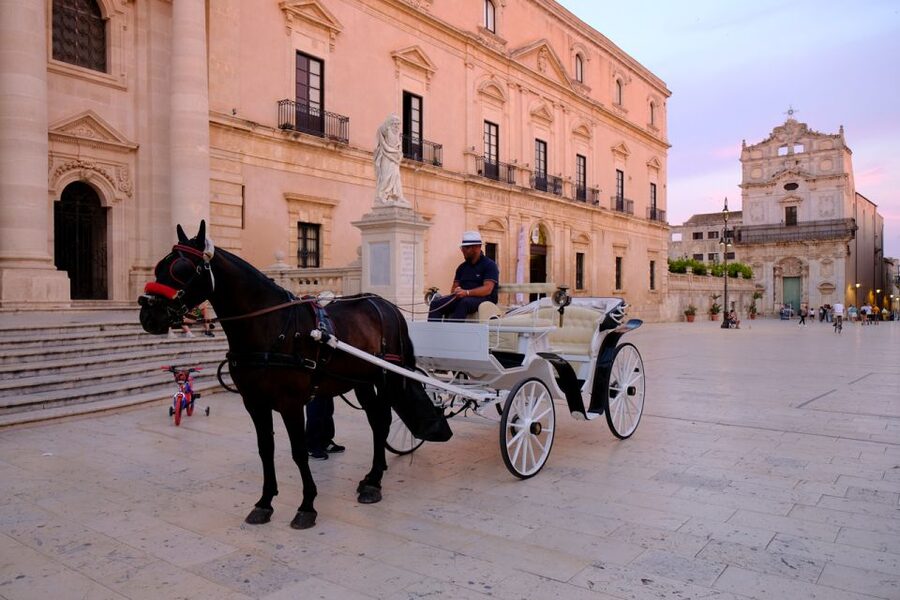
Piazza Duomo is where Ortigia turns from “mythic highlights” into “this is how a city governs itself.” It’s one of the most beautiful squares in Italy, tied to the founders from Corinth who settled here.
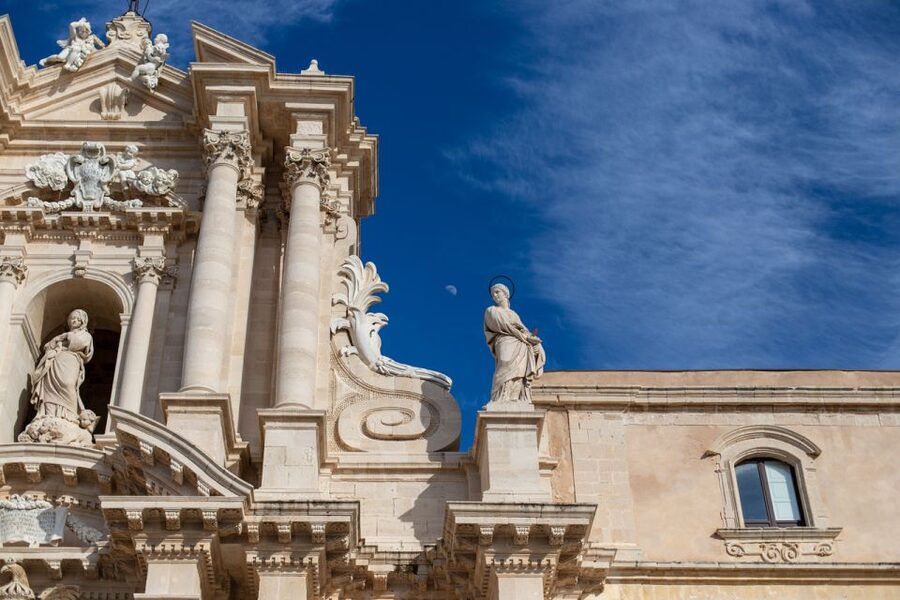
You’ll have time to visit the Syracuse Cathedral. The cathedral itself is a big draw because you’re there for the marble work and the sense that multiple eras layered onto each other over time.
Two things to plan for:
- You must pay the entry ticket on site for the Cathedral.
- Dress code rules for places of worship apply, so bring something that covers appropriately.
If you’re the type who likes to step inside and look slowly, this stop is your best chance to slow down. The rest of the route moves at a steady walking pace, which is what makes it fit into two hours.
You can also read our reviews of more guided tours in Syracuse
Arethusa spring: freshwater beside the sea and a love story
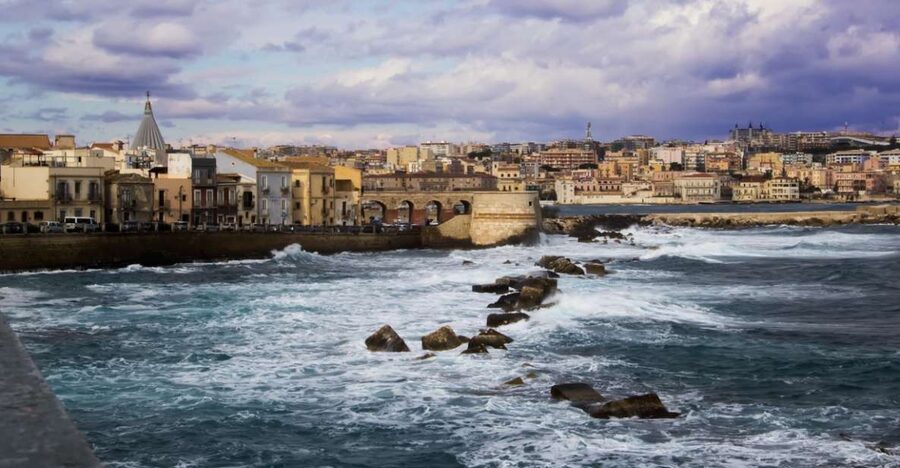
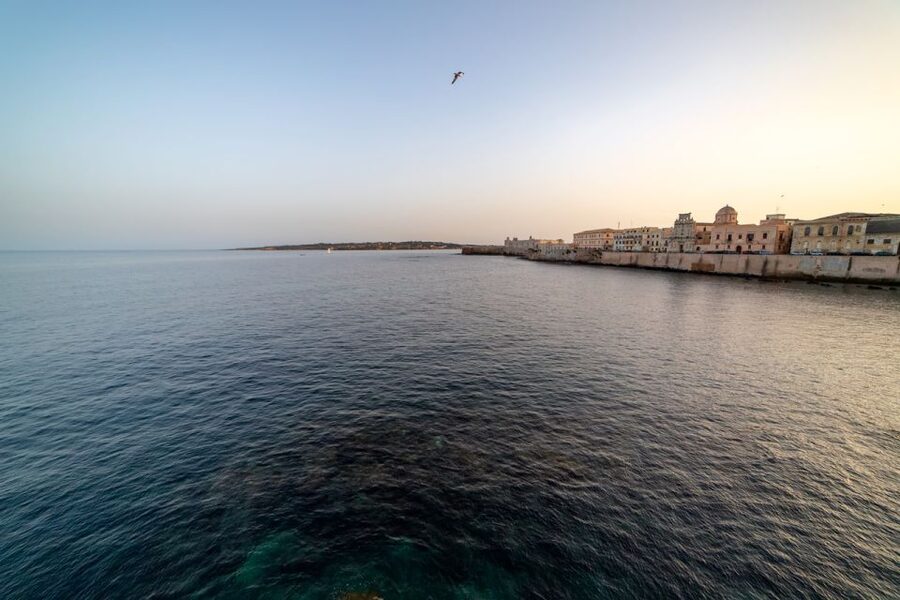
To close the tour, you arrive at the Fountain Arethusa. This is a freshwater spring located only a few meters from the sea, which makes the spot feel almost unreal—like the myth and the geography are shaking hands.
Here, the guide ties the water to the love story behind Arethusa’s name, specifically the tale between Arethusa and Alphaeus. What I like about ending at Arethusa is that you finish with a place you can sense immediately: it’s water, it’s close to the shoreline, and it’s tied to a myth that has lasted far longer than any single building.
It’s the kind of ending that makes the earlier stops feel connected. Temple of Apollo sets the Greek frame. Piazza Archimede brings the Artemis/Arethusa transformation. Piazza Duomo shows the civic and architectural layering. Arethusa spring lands the message: story plus physical reality.
Guides and storytelling: why this tour feels worth $29
A big chunk of your value here is the guide. Some of the strongest examples of guide quality include people like Giuseppe, Michael (praised as a long-time local, living in Siracusa for 22 years), Letizia, Vincenzo, Eva, and Margaret—each noted for being clear, answering questions, and making the history stick.
One standout style that comes through in the feedback is how guides handle real conditions. In hot weather, Michael kept the group in the shade during a 96-degree heatwave. That may not sound “touristy,” but it’s exactly the difference between a pleasant walk and a miserable one.
Even better, the best guides don’t just rattle off dates. They connect the evolution of Ortigia’s spaces—how the place changed and why—to the things you can see in front of you. If you enjoy local lore and you like hearing how the present grew out of the past, this tour format is a strong match.
Price and value: what you’re really paying for
Let’s talk dollars without hand-waving. At $29 for a 2-hour walking tour, you’re not buying museum entry. You’re buying:
- a live guide who explains what you’re seeing
- a curated route that hits major landmarks plus myth-linked stops
- a compact structure that keeps you from wandering around trying to figure out what matters most
Two potential cost-related surprises are worth knowing up front. First, the Syracuse Cathedral ticket is not included—you’ll need to pay on site. Second, if you don’t have a way to hear well, you might choose to buy a disposable headset for €1.
If you’re traveling with limited time in Ortigia, the money makes sense because it buys you fewer wrong turns and more clarity per minute. If you’ve got lots of time and you prefer independent wandering, you could save money—but you’ll likely lose the myth-to-place connections that make this route feel “complete.”
Best fit: who should book this Ortigia highlights walk
This tour is a great match if:
- it’s your first time in Ortigia and you want a fast, well-paced orientation
- you like Greek myths tied to real landmarks, not just generic history lectures
- you want to see the Temple of Apollo, Piazza Duomo, and Arethusa in one compact plan
- you’d rather pay for guidance than spend extra hours figuring out what to prioritize
It may be less ideal if:
- you hate visiting places of worship where dress rules can slow you down
- you want lots of free time inside monuments (your Cathedral visit exists, but it’s part of a timed walk)
- you’re traveling when opening hours or holidays might shift what’s accessible
Should you book? My practical take
Book it if you want Ortigia to make sense quickly. The combination of the Temple of Apollo start, the myth scene at Piazza Archimede, the marble-centered Duomo moment, and a closing visit to Arethusa spring gives you a tight story arc you can remember.
Skip it only if you’re looking for a long, slow, purely architectural tour with lots of unstructured time inside buildings. Otherwise, for $29 and two hours, you’re getting an efficient route plus a guide who can explain why these places matter.
FAQ
Where does the Ortigia guided walking tour start?
You meet at Largo XXV Luglio, 7. Look for the guide with a badge under the pomegranate tree in front of the Temple of Apollo at the roundabout where Corso Matteotti starts.
How long is the tour?
The tour lasts about 2 hours.
How much does it cost?
The price is listed as $29 per person.
What’s included in the price?
The tour includes a walking tour and a live guide.
Is the Syracuse Cathedral entry ticket included?
No. The Cathedral entry ticket is not included, and you must pay on site.
What language is the guide?
The tour is offered in English and Italian, and it may be conducted simultaneously in both languages.
What if I need help hearing the guide?
You can use your own headset. If you don’t have one, you can purchase a disposable headset on site for €1.
Do I need to follow a dress code?
Yes. Since the tour includes places of worship, you must respect the dress code to access them.
Should I arrive early?
Yes. To keep the schedule on track, participants should arrive at the meeting point 10 minutes early.
How do monument visits work if hours change?
Visits to monuments may change based on holidays and opening hours, so what you see can be adjusted by local conditions.