REVIEW · CHESTER
Medieval Walking Tour of Chester
Book on Viator →Operated by Chester medieval tours · Bookable on Viator
A good medieval walk should do more than point at stones. This one makes Chester feel human and political, with a guide in costume and story stops tied to walls, trade streets, and longbow lore. I like how it’s small-group (max 15) and how the route hits multiple layers of Chester’s past in just 90 minutes. The only real drawback to consider is that it leans more toward the medieval conflicts and archers than a stop-by-stop tour of every major building.
You’ll start at a landmark everyone can find, then follow a simple path through the city’s most distinctive spaces. The best part for most people is that the tour ends while you’re still fresh enough to explore the rest of Chester on your own. If you want lots of time to linger at every viewpoint or museum-like detail, you may feel the timing is a bit tight for 1.5 hours.
In This Review
- Key Points You’ll Actually Care About
- Why This Chester Walk Feels Like a Time Machine
- Price and What You Get for $16.67
- Where You Start and How You Finish by River Dee
- The Big Idea Behind the Route
- Stop 0: Chester City Walls and How Defenses Evolved
- Stop 1: Chester Rows and Medieval Trade Under One Roof
- Stop 2: Roman Amphitheatre Area and St John’s Cathedral Connections
- The Longbow and Rebellion Thread That Runs Through the Walk
- How the Guide Keeps the Group Together (Even on Windy Days)
- Timing: 90 Minutes Now, Chester Time Later
- Who Should Book This Tour
- Should You Book the Medieval Walking Tour of Chester?
Key Points You’ll Actually Care About
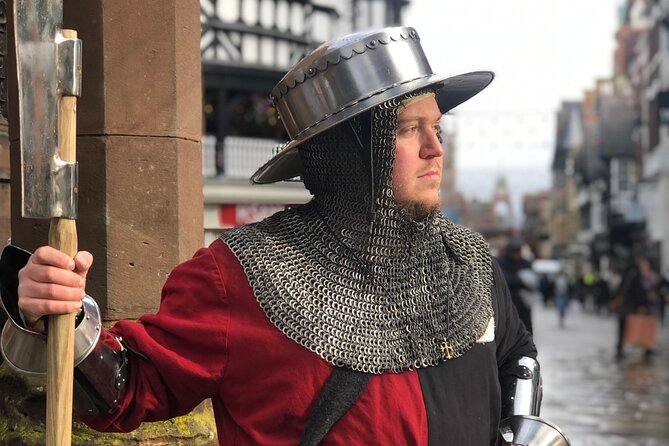
- Costumed storytelling that sticks: longbow and rebellion themes get explained with props and humor.
- Max 15 people: easier listening, easier question time, and you’re less likely to get lost in the crowd.
- City walls + Chester Rows: you don’t just hear history, you walk it.
- Roman amphitheatre area connection: short but focused, tied to St John’s cathedral-era use.
- Ends by River Dee near Handbridge: the story comes with a local historic thread.
- Value-friendly price for 90 minutes: a solid hit of medieval context before you continue sightseeing.
Why This Chester Walk Feels Like a Time Machine

Chester has a way of rewarding slow attention—half Roman bones, half medieval muscle. This tour gives you a guided lens that turns the streets into a map of cause-and-effect: defense, trade, church power, and the kind of conflict where archers mattered.
What makes it work is the format. You’re out for about 1 hour 30 minutes, not a half-day commitment. Then you get the rest of the day free to wander Chester at your own pace—shops, riverside views, and whatever else catches your eye.
You can also read our reviews of more walking tours in Chester

Price and What You Get for $16.67
At around $16.67 per person for roughly 90 minutes, you’re paying for guided interpretation more than for admissions. The route includes clear outdoor highlights—city walls, the Chester Rows, and a Roman amphitheatre area—so you’re not stuck paying your day’s budget at every door.
The value angle is the time-to-information ratio. Many “walks” stop at surfaces. Here, the guide ties each place to a medieval purpose: how Chester grew, how it defended itself, and why the archers had a reputation. For a short trip like this, that context can make the rest of your self-guided exploring much richer.
Where You Start and How You Finish by River Dee

You meet at the Chester Visitor Information Centre on Town Hall, Northgate St (CH1 2HJ). The good news is that this is a straightforward meeting point, and the tour is easy to spot—especially once your guide is in costume.
The walk ends at River Dee (CH4 7JB), finishing near Handbridge. That ending matters. It’s not just a “you’re done” location; the guide uses the riverside setting to close out the tour’s historic thread, including a battle reference connected to Shrewsbury.
Practical note: service animals are allowed, and the tour notes a moderate physical fitness level. You’ll be walking outdoors, so bring sensible shoes.
The Big Idea Behind the Route
This isn’t a “Chester buildings greatest hits” walk. It’s a medieval-focused route where each stop answers a simple question: what was this place used for, and why did it matter?
You’ll cover three main story zones over the 90-minute span:
- a section of Chester city walls
- Chester Rows, the famous covered galleries
- the Roman amphitheatre area, connected to medieval use by St John’s cathedral
Then you wrap it up by the river with more context to tie the whole narrative together.
Stop 0: Chester City Walls and How Defenses Evolved

The tour begins with a walk along a section of the city walls, with explanations of how they started and developed. Even if you’ve seen walls on other trips, this one helps you connect walls to real medieval needs: controlling movement, signaling authority, and protecting the city when trouble came calling.
The useful part here is that you’re not staring at stonework in the abstract. The guide turns the wall into a timeline. You learn to look at the structure as evidence of changing priorities—what Chester needed to defend at different moments in its medieval life.
Why this stop is worth your time:
- You get a big-picture foundation early, so later stops make more sense.
- You learn to read the city’s layout as a defensive system, not just a pretty boundary.
Stop 1: Chester Rows and Medieval Trade Under One Roof
Next comes Chester Rows—the city’s signature two-level covered walkways with shops and entrances. This stop focuses on why these rows existed and how they worked in medieval Chester.
Here’s what I think makes this stop special for you: the Rows aren’t just a design quirk. They’re a practical solution. Covered space means better trading conditions, and the layout suggests how merchants and residents moved through the city while staying protected from weather.
Expect the guide to connect the Rows to everyday life and commerce, not just architecture. This is also one of the points where the small-group size helps. You can hear details without craning your neck through gaps in the crowd.
Possible drawback to keep in mind:
- If you’re hoping for a long, slow stroll through every shop-front detail, 15 minutes can feel brief. This is still a story-driven stop, not a photography tour.
Stop 2: Roman Amphitheatre Area and St John’s Cathedral Connections
Then you move to the Chester Roman Amphitheatre area. The tour’s version of this stop is short, but the payoff is the linkage: you’ll hear how the area was used by St John’s cathedral in medieval times.
That kind of connection is often what turns ruins into something memorable. Instead of treating Roman remains as a separate chapter, you see them being reused, repurposed, and folded into medieval religious and civic life.
At about five minutes, this is the quick-hit stop. If you love deep archaeology, you might wish for longer. But as part of a tight 90-minute story arc, it works—like a chapter title that tells you what to look for later.
The Longbow and Rebellion Thread That Runs Through the Walk
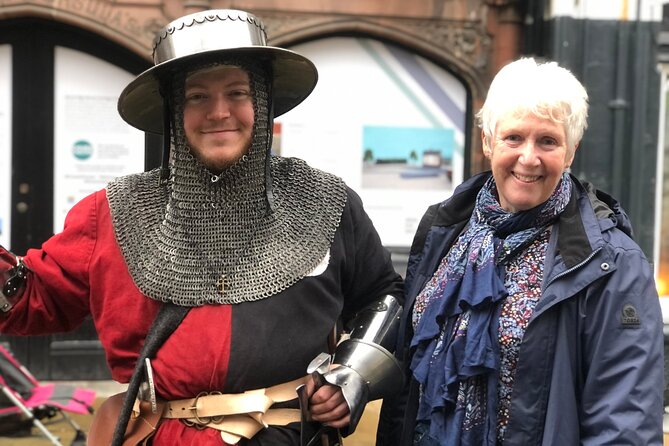
The most consistently praised element across guides is the way the medieval story comes alive through an “in character” presentation. You’ll likely see a guide dressed as a Cheshire longbow man, with story beats connected to the Chester archers and the wars and rebellions that shaped the region.
Names show up in different tour runs, and they’re a useful clue to the style you can expect. Guides such as Thomas, Richard, Carl, Edward, and Chester medieval tours’ presenters have been noted for strong storytelling and a clear passion for the subject. That also explains why you’ll often hear extra context—like the role of Chester archers and why they had a reputation in conflict.
A detail that many people seem to enjoy: hands-on bits. One guide style includes showing items from the period—things like coins and small daily-use objects—plus weapon-related discussion, including how archers carried and used equipment. If you’re traveling with kids, this kind of “look, listen, imagine” format is often easier than a lecture.
One honest consideration: if you prefer a tour that centers on buildings first (façades, dates, and architectural design), this one will sometimes feel more like a history narrative with a few key places used as anchors.
How the Guide Keeps the Group Together (Even on Windy Days)
Short tours can still get messy if the guide loses the pace of the group. This doesn’t seem to be a problem here. People describe guides as careful about counting the group and keeping everyone together, even on days when weather and foot traffic are annoying.
That matters because the route is compact. If you break away, you can miss a key connection between “this is what the wall did” and “this is why the Rows mattered.” The best experience comes when you stay close enough to hear the story beats.
Timing: 90 Minutes Now, Chester Time Later
The tour’s structure is built for flexibility:
- you get the medieval story and a few signature spaces
- then you’re released to explore the rest of Chester
That works well if you like building your day around one good guided block. Start with the tour to get your bearings fast. Then spend the remaining hours wandering without feeling lost in names and dates.
If you’re short on time in Chester, this is also a strong option. Ninety minutes is long enough to feel like you learned something meaningful, but short enough that you can still fit other activities.
Who Should Book This Tour
You’ll probably enjoy this most if:
- you like medieval history but don’t want a full-day lecture
- you enjoy storytelling and characters, with props and period details
- you want to connect Chester’s streets to real medieval themes like defense, trade, and conflict
- you’re okay with “a few key stops explained well” rather than “every famous building covered”
It may be less satisfying if:
- you came mainly for architecture details and building tours
- you want longer time at each landmark for photos or quiet looking
- you strongly prefer a city-mosaic tour over a historical theme tour
Should You Book the Medieval Walking Tour of Chester?
Yes—if your goal is a fast, memorable medieval orientation in Chester. The costumed approach, the small-group size, and the way the guide ties multiple sites together make this feel like more than a stroll.
I’d book it especially if you’re excited by the stories of the Chester archers and the conflicts around them. Even if you aren’t a medieval-history nerd, you’ll leave knowing what Chester’s layout meant and why certain places carried power.
If you’re on the fence, use this rule: book it when you want context. Skip it when you want architecture-by-the-minute.