REVIEW · VILNIUS
Regular walking tour of Jewish Vilnius
Book on Viator →Operated by Vilnius with Locals tours · Bookable on Viator
Vilnius tells its Jewish story in pieces. I love how this 2.5-hour walk gives you street-level context for what’s left behind, and I also love the WWII-centered explanations that connect sites instead of listing them. One thing to plan for: the pace can feel tight, and the Choral Synagogue stop depends on whether it’s open that day.
Guides on this route are often praised for clear English and for answering questions without brushing you off. In the guide roster, names that come up again and again are Kristina, Milda, Michael, and Sarunus—so you’re not just getting a scripted walk.
This is an easy tour to slot into a vacation day: you’re walking between nearby streets, and you’ll finish back where you started. Just keep in mind that the most emotionally heavy parts are part of the story, and the best way to enjoy it is to go at your own mental pace between stops.
In This Review
- Key points that make this tour worth your time
- Getting oriented at Vilnius Town Hall (Rotuse)
- The narrow streets story: M. Antokolskio gatvė
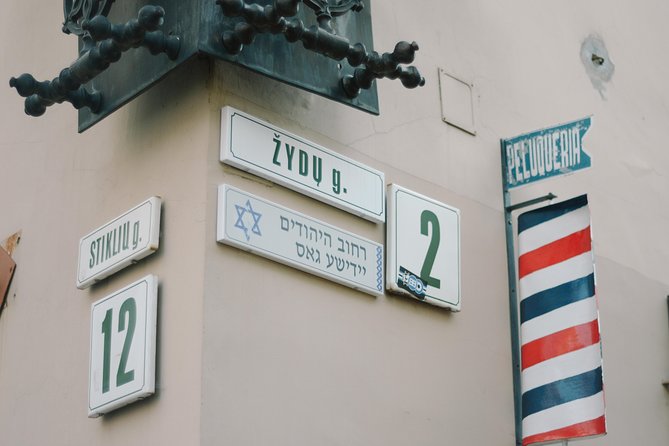
- Stiklių gatvė and Žydų gatvė: art memory and damaged sacred space
- Vilna Gaon Monument: why scholars still shape Vilnius
- From Small Ghetto to Big Ghetto: Vokiečių gatvė and the Map of the Ghetto
- Žemaitijos gatvė: shop names in Yiddish and Polish (a rare kind of evidence)
- Monument to Zemach Shabad: one more human thread
- Vilnius Choral Synagogue: the highlight, but not always guaranteed
- Extra help at the Jewish information office
- How much walking and pacing really means (and how to handle it)
- Value check: $26.62 for a story you can actually follow
- Who should book this tour (and who might want a different day plan)
- Should you book this Jewish Vilnius walking tour?
- FAQ
- How long is the Regular walking tour of Jewish Vilnius?
- What time does the tour start?
- Where do I meet the guide?
- Is the tour offered in English?
- How much does the tour cost?
- Is a mobile ticket included?
- What’s the group size limit?
- Is the Vilnius Choral Synagogue visit included?
- Are there admission fees for the other stops?
- Do I need to be Jewish to join?
- Where does the tour end?
Key points that make this tour worth your time
- A focused 2.5-hour route that turns a confusing old-quarter map into a clear story arc
- Choral Synagogue as a highlight when it’s open (and you may need a small cash fee)
- High-impact sites with minimal signage, so you’ll know what you’re looking at
- Street names that act like clues—including remnants in Yiddish and Polish
- Guides who handle questions well, with some stops designed for interaction
- Small group feel, with a maximum of 30 and frequent split-ups when groups are larger
Getting oriented at Vilnius Town Hall (Rotuse)
The tour meets at Vilnius Town Hall (Rotuse), Didžioji g. 31, with the guide greeting you on the stairs. Starting here matters. You don’t just begin in the middle of Old Town—you start with the big picture, so the neighborhoods you’ll walk through make sense later.
Right away, you’ll get an introduction to Jewish history in Vilnius, with special attention to what changed during the 20th century. It’s a useful approach because the city’s Jewish footprint is scattered now: buildings are gone, walls have shifted, and many sites are quieter than you’d expect. With the early context, you can connect the dots instead of guessing.
A practical plus: the first stop is short, so you won’t feel stuck in a briefing. You’ll be moving on to the lanes that make the Jewish quarter feel like a different city.
You can also read our reviews of more walking tours in Vilnius


The narrow streets story: M. Antokolskio gatvė
Next you head toward M. Antokolskio gatvė, where the guide steers you into the tight, winding street pattern. This is more than a vibe stop. You’re learning how Jews started moving into this area in the 16th century, and the street shape helps you understand why daily life would have felt enclosed and close-knit.
Pay attention as you walk—your guide is likely to point out how the geography supports the narrative. In cities like Vilnius, street layouts can be a kind of evidence. Narrow lanes shorten distances, create hidden corners, and concentrate community spaces. The guide’s job here is to make you notice those details, not just pass by them.
This part is brief (around 10 minutes), but it sets the tone: the tour treats the quarter like a living place, not just a set of ruins.
Stiklių gatvė and Žydų gatvė: art memory and damaged sacred space
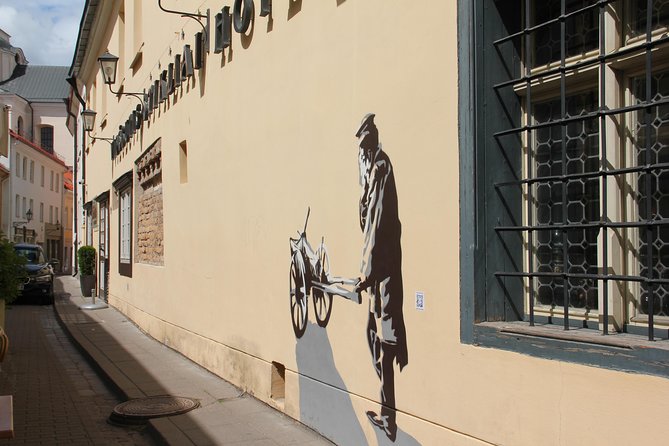
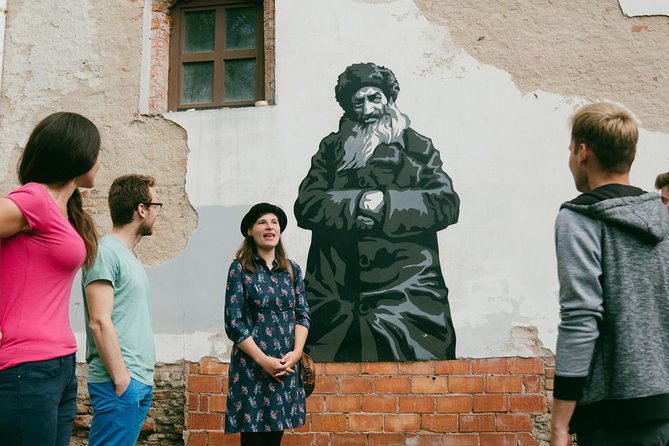
On Stiklių gatvė, one highlight is an art project that commemorates the Jewish past: Walls that remember. Even if you’re not an art person, it helps you grasp a key theme of this walk—memory isn’t only in museums. It’s also in how the city chooses to mark what happened.
From there you’ll pass Glassblowers’ street. That sort of stop is what makes this tour feel practical. You’re not only looking at tragedy; you’re also seeing the everyday craft streets that made Jewish life in Vilnius look like life, not just history.
Then comes Žydų gatvė, where the guide shows you damage connected to the Great Synagogue of Vilna during WWII and the Soviet period. This is where the walk turns heavy. The city can look calm, but the guide’s narration helps you see what destruction replaced.
Tip for enjoying this section: let the guide finish the explanation before you move on. It’s tempting to snap photos quickly on a street corner, but the meaning is in the timing—what happened first, what came next, and why the marks on the ground still matter.
Vilna Gaon Monument: why scholars still shape Vilnius
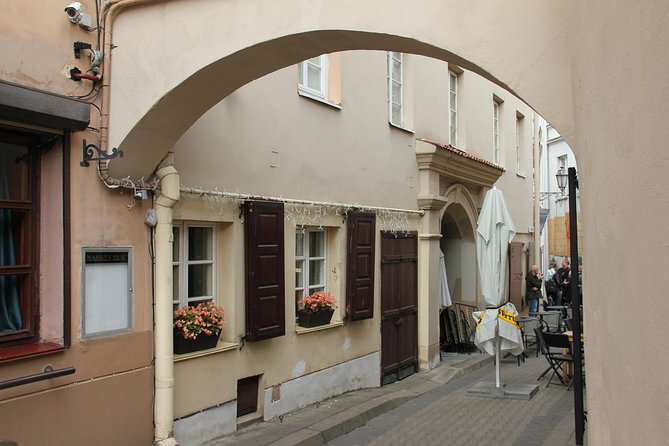
At the Vilna Gaon Monument, you’ll hear the life story of the famous scholar who lived in Vilnius in the 18th century. This stop adds balance. So much of Jewish history in this area is framed by loss, and the tour makes space for intellectual and cultural influence too.
What I like about this is how it expands the idea of what a “site” is. A monument isn’t just a statue. It’s a reminder that communities weren’t only defined by places where they suffered. They were also defined by what they built—learning, study, and ways of thinking that outlast generations.
This segment runs about 15 minutes. If you’re the type who asks questions when something connects to your interests, this is a good moment to do it. Guides here are often praised for handling questions well.
From Small Ghetto to Big Ghetto: Vokiečių gatvė and the Map of the Ghetto
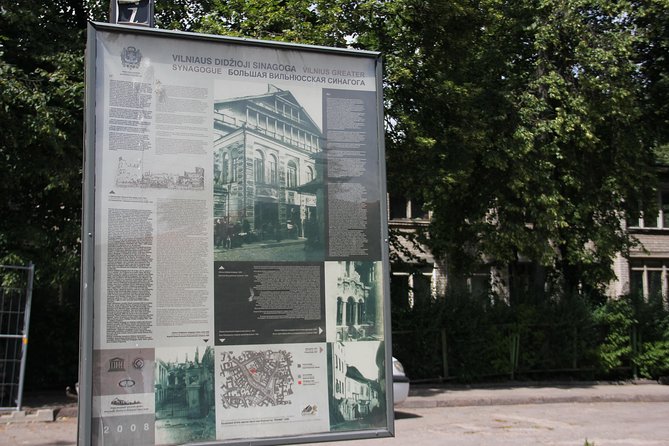
After moving past the earlier area known as the Small Ghetto, you reach Vokiečių gatvė. The guide explains how you’re now moving toward the former territory of the Big Jewish Ghetto. This is an important shift, because it changes the scale and the feel of what people endured.
The tour also gives a small mercy: there’s a possibility of a short break on the German street if needed. In a walking tour, that kind of built-in pause helps. It’s not about comfort for its own sake—it lets you reset your head so the next explanation lands.
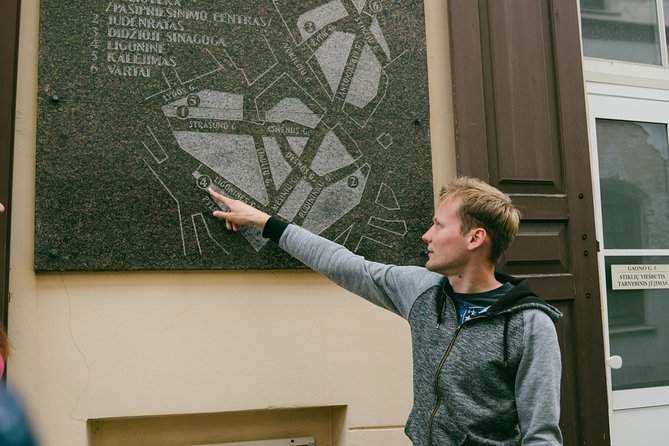
Then you’ll get to the Map of the Ghetto stop. Expect the guide to explain how two ghettos were created during WWII and how the liquidation process unfolded. Even if you know the terms, the guide’s job is to connect map ideas to real streets you’ve just walked.
If you’re traveling with anyone who’s worried the subject will be too intense, this is also where you’ll see how the guide manages tone. The most-liked guides on this route are described as sincere and diplomatic while still being direct.
Žemaitijos gatvė: shop names in Yiddish and Polish (a rare kind of evidence)
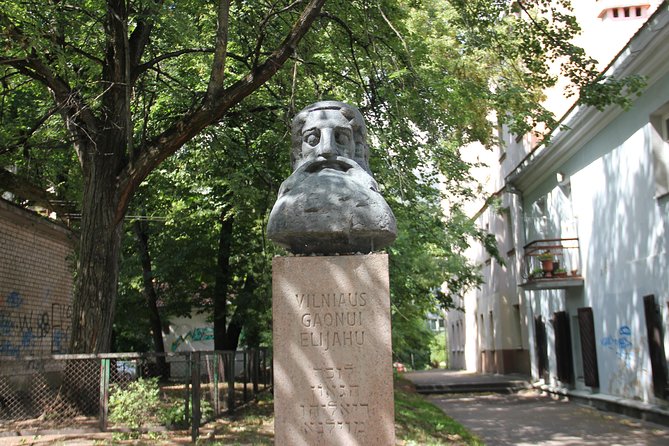
One of the most quietly impressive stops comes on Žemaitijos gatvė. Here, you can find preserved names of Jewish shops in Yiddish and Polish from the interwar period. This is the kind of detail that makes you feel the past in your hands, even though you’re standing on modern pavement.
The stop is about 15 minutes, and it’s worth slowing down as you look. Shop-name remnants are more than nostalgia. They prove that this was a living commercial world—people bought, sold, argued, joked, and worked here.
As you continue toward the end of the street, the guide will point out a building that served as a library during the ghetto years. That’s a powerful contrast: forced confinement alongside the persistence of learning and reading. Whether you’re religious or not, this sort of detail helps you understand daily life beyond the headlines.
Monument to Zemach Shabad: one more human thread
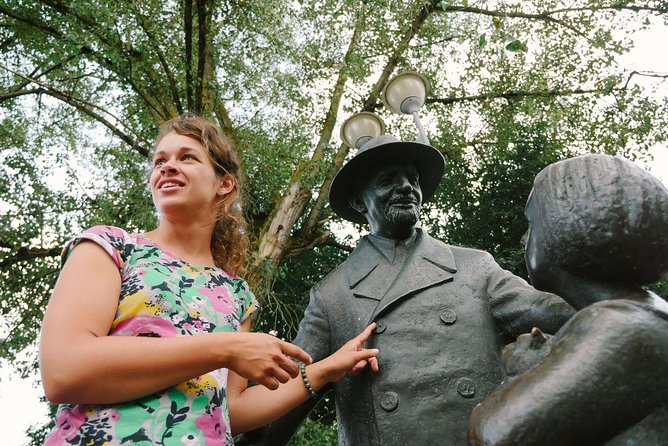
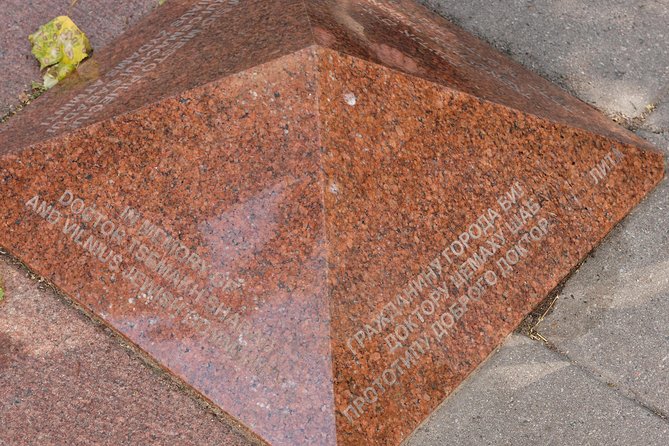
Next is the Monument to Zemach Shabad, described as one of the city’s most lovable statues. The guide shares the story of a famous Jewish doctor who lived in Vilnius. This stop works because it’s neither purely architectural nor purely tragic. It’s biography.
Why biography matters on this tour: it keeps the narrative from becoming only geography. The guide helps you remember that behind each street name and memorial there were people with jobs, roles, families, and reputations.
You’ll spend about 10 minutes here, and it often gives you a small emotional breather before the final major stop.
Vilnius Choral Synagogue: the highlight, but not always guaranteed
The tour ends with Vilnius Choral Synagogue, the only active synagogue in Lithuania’s capital. The plan is to visit it for an additional segment of about 20 minutes—if it’s open.
Important practical reality: synagogue access can depend on opening hours, Jewish holidays, or other reasons. If it’s open, you may need to pay an extra 2 EUR fee in cash. Some operators also describe synagogue entrance as part of the experience, so the best move is simple: treat the cash fee as something to have on hand.
If you do get inside, this stop usually lands well because it’s a living site, not just a memorial. The story you’ve heard on the streets has roots here, and you’ll see how continuity is possible even after almost everything was destroyed.
Even if it’s closed, don’t feel you missed the point. The walk is designed to help you understand what the community lost—and how the city still carries traces.
Extra help at the Jewish information office
Near the end, the guide gives you a pointer to a Jewish information office in case you want more reading or context afterward. I like this option because it respects your curiosity. Some people want a museum. Others want a book list. This gives you a next step without forcing a “shop” finish.
How much walking and pacing really means (and how to handle it)
This walk is about 2 hours 30 minutes total, with many short stops and brief explanations. That structure is good for getting a lot of key locations into one morning or early afternoon block, and it’s why the tour fits so well into a busy itinerary.
That said, one thing to be honest about: the route is packed with stops. A minority of people felt it could feel a bit rushed at times. If you want extra quiet time at memorials or you move slowly, you’ll still be fine—but consider bringing the mindset of “learn the framework now” and then return later on your own for deeper lingering at the places that hit you hardest.
Group size is capped at 30, and the tour can split into smaller groups when needed (a practical detail that helps in a dense old-quarter). Still, on the days with larger groups, you’ll want to stay close so you don’t lose the guide during transitions.
Value check: $26.62 for a story you can actually follow
At $26.62 per person for roughly 2.5 hours, the price feels fair for a guided route through streets that otherwise have little explanation. The real value isn’t the number of stops. It’s the fact that Jewish Vilnius is hard to read on your own—so you’re paying for translation, context, and a route that connects meaningful remnants.
The tour includes a local guide, and the synagogue access piece is framed around visiting the Vilnius Choral Synagogue when open. Even if the synagogue visit doesn’t happen that day, the street sequence still does the heavy lifting by teaching you what you’re seeing.
Also, this is the kind of tour that can reduce the cost of future mistakes. Without guidance, it’s easy to miss why a building, a street name, or a broken-looking wall matters. With guidance, you start planning what to read and where to go next.
A quick booking note: the tour is often booked about 18 days in advance on average, so if your dates are fixed, don’t wait until the last minute.
Who should book this tour (and who might want a different day plan)
You should book if:
- You want an intro to Jewish Vilnius with WWII and ghetto history explained in a clear, walkable way
- You like guides who answer questions and add human stories, not just dates
- You enjoy street-level details like the preserved Yiddish/Polish shop names and memory art
You might think twice if:
- You dislike emotionally intense history; the tour includes WWII-era material by design
- You need long, unhurried stops at every memorial. The route moves, and some people feel the pacing is brisk.
This tour suits pairs, solo travelers, and mixed groups. One of the strongest themes from the experience: it works for people who are Jewish and people who aren’t, as long as you bring curiosity and respect.
Should you book this Jewish Vilnius walking tour?
Yes, if you want your first day in the old Jewish quarter to feel grounded and understandable. This route gives you a strong framework: where the community lived, what survived, what was destroyed, and where the city still shows you clues.
Book it especially if you’re the type who likes to ask questions and wants more than a quick overview. The combination of street-level stops, a focused time frame, and a synagogue highlight when it’s open makes it strong value at $26.62.
If you’re worried about the synagogue being closed, still go. The streets are the point, and the guide’s job is to help you read the evidence even when you can’t step inside the one active synagogue that day.
FAQ
How long is the Regular walking tour of Jewish Vilnius?
It runs for about 2 hours 30 minutes.
What time does the tour start?
The start time is 11:00 am.
Where do I meet the guide?
You meet at Vilnius Town Hall (Rotuse), Didžioji g. 31, 01128 Vilnius, Lithuania.
Is the tour offered in English?
Yes, it’s offered in English.
How much does the tour cost?
The price is $26.62 per person.
Is a mobile ticket included?
Yes, the tour uses a mobile ticket.
What’s the group size limit?
The maximum group size is 30 travelers.
Is the Vilnius Choral Synagogue visit included?
The tour includes an arranged synagogue visit, but it may require an additional 2 EUR fee in cash, and the synagogue may be closed during holidays or other times.
Are there admission fees for the other stops?
Most stops have free admission, and the itinerary notes admission ticket free for the majority of locations.
Do I need to be Jewish to join?
No. The tour states that most travelers can participate, including people who are simply curious about the area.
Where does the tour end?
It ends back at the meeting point (Vilnius Town Hall).