
REVIEW · POMPEII
Pompeii Guided Group Tour with Entry Ticket and Archaeologist
Book on Viator →Operated by Pompei Tour Organizer_Tempio Travel · Bookable on Viator
Volcano-buried Pompeii feels close up—fast. This 2-hour English group walk strings together the main sights from Porta Marina Superiore with an archaeologist-style guide and included express entry.
I love the express entry ticket and the included headsets for larger groups, because it cuts down on time lost and keeps you connected to the story. I also like the balance of stops: you get the Forum and daily-market areas, then you move into big Roman homes and street life.
The main consideration is meeting-point logistics: you’re told to arrive 15 minutes early, and the directions can be confusing if you rely only on maps. Also, on a few departures, audio quality has been reported as less than perfect.
In This Review
- Quick hits
- Entering Pompeii: Porta Marina Superiore and the real meeting point
- Why a guide helps at Pompeii (and what you’ll learn)
- Price and what’s included: express entry, headsets, and the 2-hour hit list
- Porta Marina to the Forum: the civic center comes to life
- Macellum and Forum Baths: food, water, and social life
- House of the Faun and House of the Vettii: luxury and scandal in paint
- Via dell’Abbondanza and the thermopolium: the Roman street-and-snack stop
- Tips for better photos, better listening, and fewer headaches
- Should you book this Pompeii guided group tour?
- FAQ
- Where is the meeting point for the tour?
- What time should I arrive before the tour starts?
- How long is the guided tour?
- Is the Pompeii entry ticket included?
- Are headsets provided?
- What language is the tour?
- Does the tour include the Villa of Mysteries ticket?
- FAQ
- What if the weather is bad?
- Can I cancel for free?
- Is there a limit on group size?
Quick hits
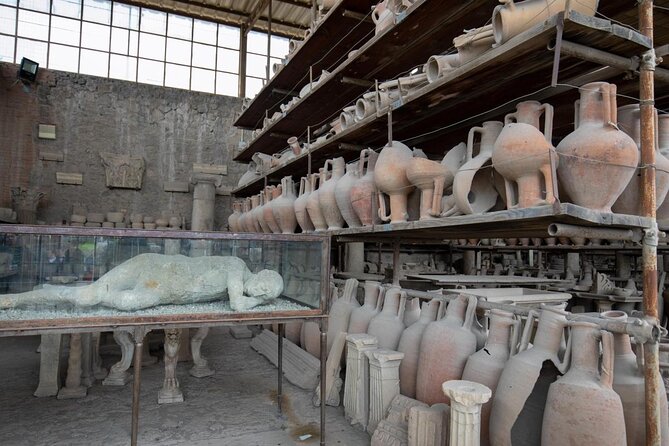
- 15-min early start at Tempio Travel inside the Circumvesuviana station area, not at the street gate
- Express entry included, so you’re not burning your limited time in line
- Headsets when groups run over 15, a big help in crowds and open spaces
- Forum-focused route that explains politics, food, bathing, and social life in one loop
- Two famous houses in a tight time window: the House of the Faun and the House of the Vettii
- Street snack stops with the thermopolium idea of Roman fast food
Entering Pompeii: Porta Marina Superiore and the real meeting point
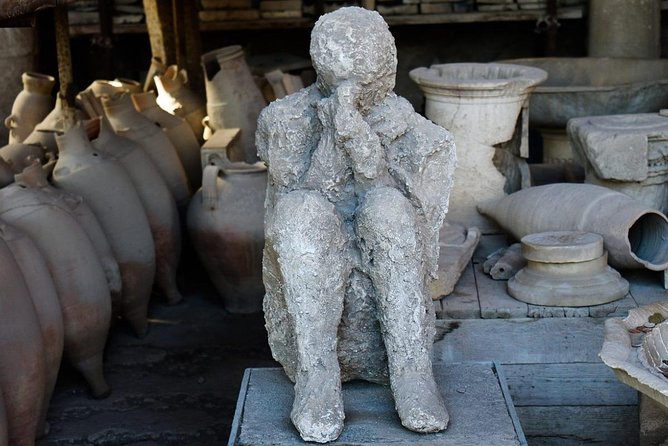
This tour is designed as a “get your bearings fast” visit to Pompeii. You start at Porta Marina Superiore, the main entrance area, which helps you avoid the classic first-timer problem: wandering for 30 minutes before you even see the Forum.
The meeting spot is specific. You’re expected to meet at Via Villa dei Misteri, 1 at the Circumvesuviana stop Pompei Scavi villa dei Misteri. The operator’s office is called Tempio Travel / Pompeii Tickets, and it’s on the first floor of that red station building—about 100 meters from the entrance of Porta Marina Superiore. Plan to arrive 15 minutes before the time on your voucher.
Why this matters: Pompeii mornings can be chaotic, and your time is already tight for a 2-hour overview. If you show up late or at the wrong side of the station, you can end up sprinting—while everyone else is already heading in.
Why a guide helps at Pompeii (and what you’ll learn)

You can wander Pompeii on your own, but a guide changes the whole experience. With this tour, you’re not just looking at ruins. You’re getting explanations that turn stone rooms into daily life: where people gathered, what they ate, how baths worked, and how rich homes expressed status.
The tour is paced to cover major zones without trying to “do everything.” A common complaint about Pompeii is simple: it’s huge. This tour tackles that by picking recognizable anchors—starting with the civic heart (the Forum), then moving to food and bathing spaces, then into elite domestic areas.
Guides associated with this experience have been described as entertaining and patient, with a style that helps you visualize everyday routines. Names that have come up include Laura, Alessandra, and Eraldo—all mentioned in connection with clear explanation and a group-friendly pace. (Since this is a group operation, guide details can vary by date.)
One word of caution: it’s marketed with an archaeologist angle, but the actual leader can differ. If you’re picky about strict academic expertise, I’d confirm the guide type when you book, so your expectations match what you’ll get on the day.
Price and what’s included: express entry, headsets, and the 2-hour hit list
At $59.13 per person for about 2 hours, this tour is basically paying for three things:
- Time saved through express entry
- Direction and interpretation so you’re not guessing what you’re seeing
- Listening support (headsets) so you can hear the guide in busy zones
Admission to the Pompeii Archaeological site is included with express entry. You’ll also get headsets for groups over 15, which is a major comfort factor in open courtyards where voices don’t travel well.
What’s not included is important. The Villa of Mysteries plus ticket is not included. If that’s a must-see for you, you’ll need to add it separately. This tour stays focused on the core city areas and the chosen highlights, not the optional add-ons.
Is it good value? For most first-timers, yes—because Pompeii is difficult to “understand” without context, and 2 hours is exactly the kind of window where you’d otherwise rush and miss the meaning. If you already love archaeology and want to linger, you may prefer a slower self-guided day after the tour.
Porta Marina to the Forum: the civic center comes to life
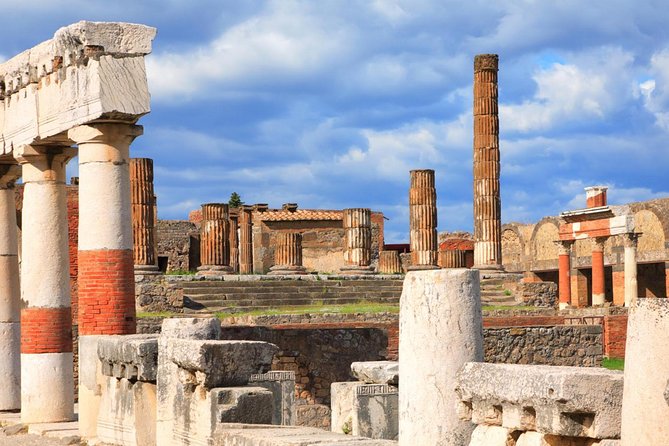
Your first real stop is the Archaeological Park of Pompeii, beginning at Porta Marina Superiore. This is your orientation phase. In a short visit, that matters. If you start in the right place, the rest of the route clicks faster.
Next you head to the Forum of Pompeii, the city’s main square and the hub where political, economic, and religious life intersected. Expect your guide to connect buildings around you to functions. You’re not just looking at columns and paving. You’re learning how public space worked in a Roman city—who used it, why it mattered, and what “everyday importance” looked like in stone.
Then you move to nearby Forum-related highlights. The Forum portion is given a solid chunk of time (around 30 minutes), which is exactly what you want at Pompeii. That’s enough to understand the idea of the place, without turning it into a lecture marathon.
Practical note: Pompeii’s surfaces can be uneven and the crowd flow is real. When your guide stops, step quickly into position. If you’re the kind of person who likes photos every 20 seconds, you’ll still be able to get them—you just need to be mindful of where you stand so you don’t block others.
Macellum and Forum Baths: food, water, and social life
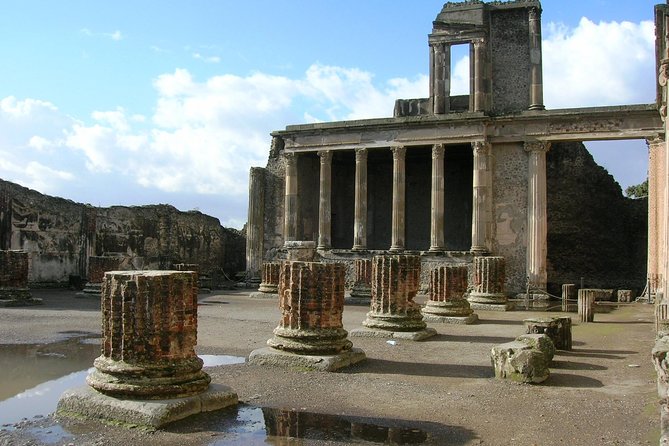
Right in the Forum area, you’ll visit the Macellum, a market connected with meat and fish. Think of it as a structured food hub—Roman-style, with visual storytelling. One of the standout elements here is the presence of affrescos showing foods eaten in the 1st century, which helps you connect what you see with what real people might have ordered and consumed.
A quick stop can still feel meaningful because the guide ties the art and architecture to behavior. The takeaway is that food wasn’t just “food.” It was commerce, community, and status.
Then comes a switch in mood: the Forum Baths. You’ll get a look at bath design that includes both male and female sections and separate entrances, with the bathing complex supported by infrastructure such as the Serino aqueduct. There’s also the detail that they could rely on a well if water was short—small info, big realism. It reminds you that this was a functioning system, not a decorative ruin.
Expect this bath stop to last about 15 minutes. In that time, you can see key layouts and listen to the “how it worked” explanation without needing an engineering degree. If you’re traveling in hot weather, this is a relief stop. If you’re traveling in cooler weather, it still works because it explains daily rhythms, not just temperature.
House of the Faun and House of the Vettii: luxury and scandal in paint
After public life, the tour shifts into private wealth. First up is the House of the Faun, one of the largest and more luxurious aristocratic homes from the Roman Republic period. This is one of the big “wow” moments in the route, partly because the scale reads instantly even when you’re moving quickly.
Inside, you’ll hear about the Mosaic of Alexander—and here’s a useful detail: the mosaic you’ll likely see on-site is described as a copy, while the original is conserved at the MANN. That’s a nice correction that prevents you from thinking Pompeii is keeping everything perfectly in place. It also gives you a clear direction if you want to see the original in a museum later.
Next is the House of the Vettii. This one often hits harder because it connects archaeology to human choices—ownership, art, and private spaces. The house is associated with names Aulo Vettio Restituto and Aulo Vettio Conviva. You’ll also hear about how the home was buried during the AD 79 eruption and found later through archaeological excavations.
A key detail from the tour description is the presence of a room with erotic paintings, linked to a story of someone using that space—described as a prostitute living with the owner. Even if you’re not looking for graphic content, this stop is valuable because it shows Pompeii as lived-in, not sanitized.
These two home stops are short (about 10 minutes each), so don’t expect a slow, room-by-room museum style. Do expect the guide to point out what matters most so you don’t miss the “why anyone would care” aspects.
Via dell’Abbondanza and the thermopolium: the Roman street-and-snack stop
After the houses, you’ll walk along Via dell’Abbondanza, a key street that connected major parts of the city. This is a good palate cleanser after the inside-the-house experience. Street life is where you get a sense of how Pompeii functioned as a network, not a set of isolated ruins.
You’ll also hit one of the most practical “feel like a local” stops: a thermopolium, described literally as a place where something warm was sold. The idea is easy—this is the Roman fast-food concept. Grab-and-go meals. Customers stopping in, ordering quickly, and moving on.
This particular stop is about 10 minutes, but it’s the kind of detail that makes the entire visit stick. Food businesses existed for a reason, and Pompeii’s street structure makes it feel real: you’re walking routes people once walked to get work done, eat, and socialize.
If you’re the sort of traveler who wants to understand how people lived minute-to-minute, this section is one of the best uses of the tour’s limited time.
Tips for better photos, better listening, and fewer headaches
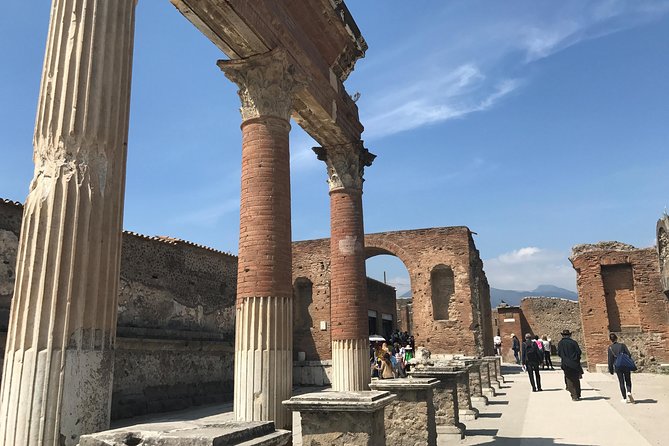
A 2-hour Pompeii visit is not about covering everything. It’s about grabbing the main threads and then using them to explore on your own afterward.
Here’s how to get the most out of the day:
- Wear comfortable, sturdy shoes. Pompeii ground can be uneven, and you’ll be standing and walking through multiple zones in a short window.
- If your group receives headsets, test yours early. A couple reports have described audio issues (echo or quality problems), so start with a quick check so you’re not fighting the device mid-route.
- Don’t treat the guide like a substitute for your eyes. Use the guide to understand what you’re seeing, then take photos and look around during the pauses without drifting too far from the group.
Group size can matter. This tour has a maximum of 35 travelers. That’s big enough that listening and crowd flow can be tricky, which is exactly why headsets help when the group runs over 15.
Finally: plan your time buffer. Pompeii can be slow-moving even on a “quick” tour day. If you want to add more sites later, build in extra time so you’re not racing the closing hours.
Should you book this Pompeii guided group tour?
Book it if you’re a first-timer who wants a smart overview without losing half a day to guesswork. At $59.13 with express entry and (often) headsets, it’s a strong value for understanding the core of Pompeii: Forum life, baths, elite houses, and street food culture.
Skip it or adjust expectations if you:
- Want a full-day Pompeii deep dive (this is about highlights, not everything)
- Are very strict about getting an actual archaeologist vs. a general guide (the advertised role can vary)
- Know you’re sensitive to audio quality and noise (some departures have reported headset problems)
If you’re flexible and you come prepared—arrive early, wear good shoes, and use the tour as a launchpad—this is one of the most efficient ways to make Pompeii meaningful fast.
FAQ
Where is the meeting point for the tour?
You meet at Via Villa dei Misteri, 1, Pompei at the Circumvesuviana station Pompei Scavi villa dei Misteri. The operator office is called Tempio Travel / Pompeii Tickets, on the first floor of the red station building, about 100 m from Porta Marina Superiore.
What time should I arrive before the tour starts?
The instructions say to be there 15 minutes before the time shown on your voucher.
How long is the guided tour?
The duration is about 2 hours.
Is the Pompeii entry ticket included?
Yes. You get an express entry ticket to the Pompeii Archaeological site included in the tour.
Are headsets provided?
Headsets are provided for listening when the group is more than 15 people.
What language is the tour?
The tour is offered in English.
Does the tour include the Villa of Mysteries ticket?
No. The Villa of Mysteries entrance plus ticket is not included.
FAQ
What if the weather is bad?
This experience requires good weather. If it’s canceled due to poor weather, you’ll be offered a different date or a full refund.
Can I cancel for free?
Yes. You can cancel for a full refund if you cancel at least 24 hours in advance of the experience start time.
Is there a limit on group size?
Yes. The tour has a maximum of 35 travelers.