REVIEW · DRESDEN
Dresden Old Town – Guided Walking Tour in English
Book on GetYourGuide →Operated by Walkative Tours · Bookable on GetYourGuide
Dresden reads like a rebuilt epic. In this 2.5-hour English walking tour, you’ll trace how Slavic roots and Saxon power shaped the city, then watch how 20th-century destruction changed what you see today. Starting at Neumarkt, the story moves site by site, with the Elbe as a quiet theme tying it all together.
I love the way the guide connects the big timeline—from a small Slavic settlement to Holy Roman Empire prince-electors, and then to early-1700s Wettin grandeur—without making it feel like a textbook. I also love the mix of headline sights and crowd-friendly orientation, so you come away knowing what matters and why, not just what’s where.
One consideration: it’s a steady walk, and a few people wished there were a toilet stop built in. If you need frequent pauses, plan to carry water and be ready to keep moving for the full time.
In This Review
- Key things that make this tour worth it
- Why Dresden’s Old Town feels like one long story
- Neumarkt and Frauenkirche: start where the city’s identity is loud
- Fürstenzug: when baroque turns into a rulebook
- Dresden Castle and the Altmarkt–Kreuzkirche axis
- Brühlsche Terrasse: a riverside viewpoint with a historical job
- Hofkirche and Semperoper: court culture in plain sight
- Zwinger Palace near the Elbe bridge: baroque as the grand finale
- Price and value: $35 for a 2.5-hour guide-led orientation
- Who should book this tour in Dresden
- Should you book this Dresden Old Town walking tour?
- FAQ
- How long is the Dresden Old Town guided walking tour?
- Where is the meeting point?
- Is the tour offered in English?
- Is transportation included?
- Is the tour wheelchair accessible?
- Can I cancel for a full refund?
- What does the price include, especially with pay-what-you-wish?
Key things that make this tour worth it
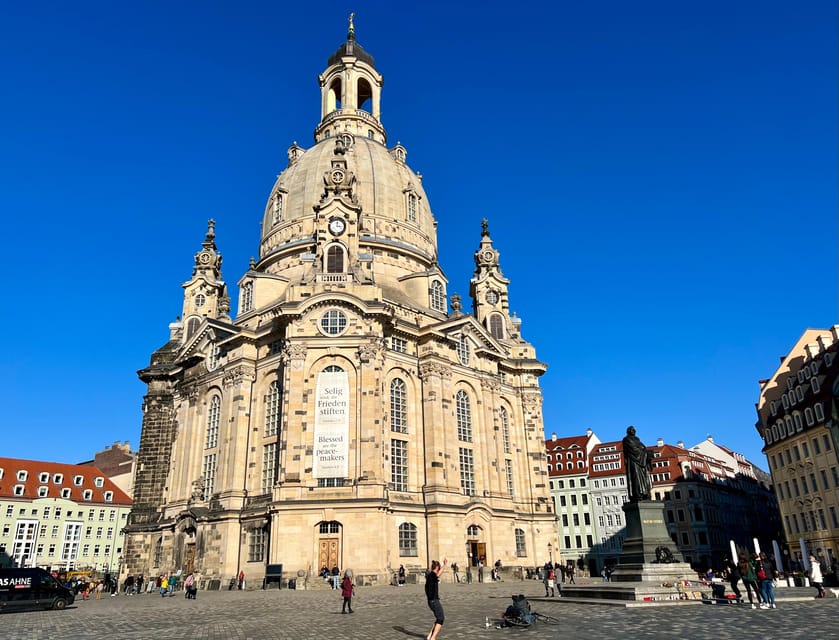
- Neumarkt meets you first, at the Martin Luther statue next to Frauenkirche
- Fürstenzug turns a building detail into a political timeline of Saxon prince-electors
- Dresden’s post-WWII reconstruction is part of the walk, not a side note
- Baroque sights line up in one smart circuit: Zwinger, Semperoper, Brühlsche Terrasse, and more
- Guides like Nicolo/Nicolas and Dominica show up in feedback for lively storytelling and humor
Why Dresden’s Old Town feels like one long story
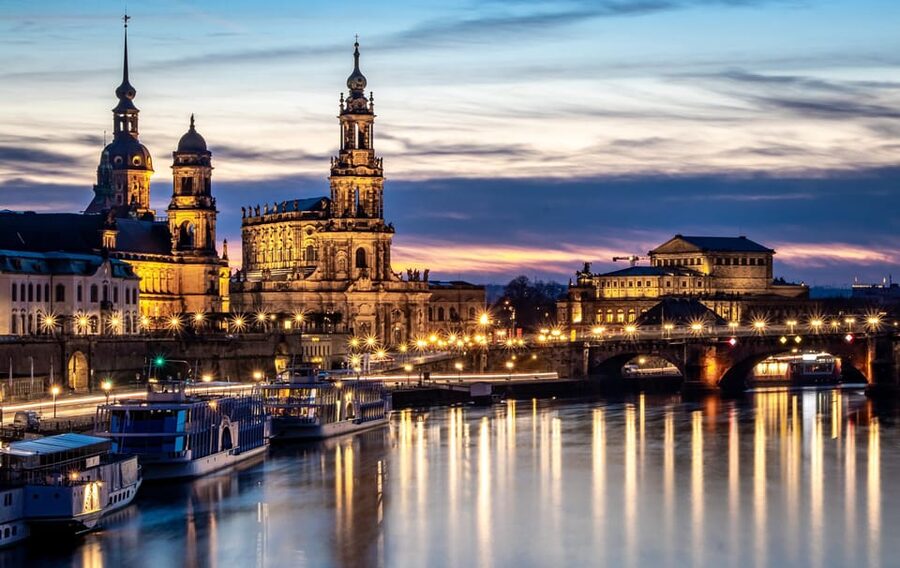
Dresden has a way of making you look twice at familiar architecture. You start with the Elbe, which is often talked about as a historical boundary between Germanic and Slavic worlds. But the tour’s big idea is that the Elbe also brought contact and overlap. Standing in Dresden, it’s easy to see why: the city began as a small Slavic settlement, and even its name can feel familiar to people from Czech, Slovak, Polish, and Sorbian language areas.
Then the city accelerates. By the 1200s, Dresden grew around a castle. By the late Middle Ages it became a major trading center, fueled by silver and lead mined in the nearby Rudavy mountains. And when the Saxon rulers gained high status—first as seats of Holy Roman Empire prince-electors, then later when the Wettin dynasty’s Saxon princes were elected kings of Poland and grand dukes of Lithuania in the early 1700s—Dresden’s architecture began to feel almost imperial.
The twist is the 20th century. Dresden was bombed during World War II to the point of near erasure. And yet, unlike many places in West Germany, the city center was carefully restored using older building techniques and design principles. Walking the cobbled streets, you might not even notice how much was rebuilt. That matters because it changes how you read the city: you’re not just seeing styles. You’re seeing decisions about memory.
This is the kind of tour that helps your brain connect dots fast: names, rulers, and reasons, stitched to the places themselves.
You can also read our reviews of more walking tours in Dresden

Neumarkt and Frauenkirche: start where the city’s identity is loud
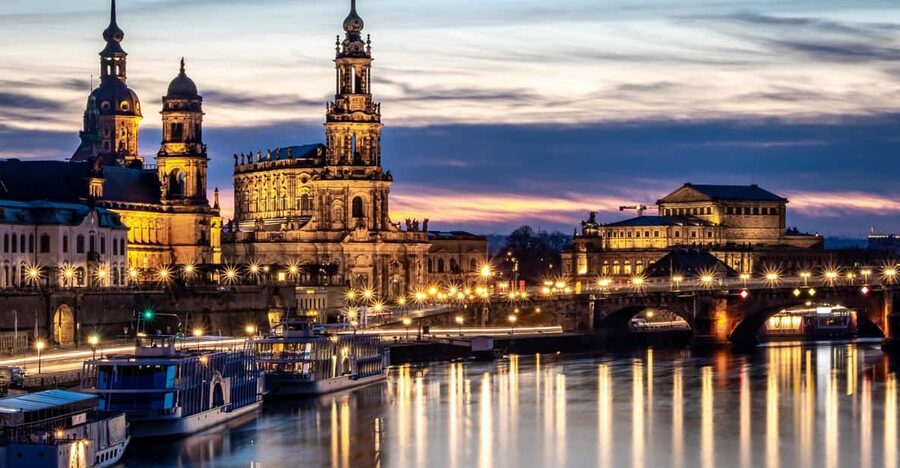
Your meeting point is practical and easy to spot: the guide meets you at Neumarkt next to the Frauenkirche, by the statue of Martin Luther. You’re told to look for the guide with a yellow umbrella, and to arrive about 10 minutes early so you can start on time.
Neumarkt is where Dresden’s public life and symbolism overlap. Frauenkirche sits here for a reason. The church is tied to the city’s identity, and in Dresden that identity includes recovery. On this walk, you don’t just treat the building like a photo stop. You hear the larger story of why Dresden looks the way it does now—after destruction and careful reconstruction.
Even if you’ve seen Frauenkirche in pictures, standing in the square with the guide’s context makes it click. You start to notice how quickly Dresden shifts between eras: a Slavic-name origin becomes a Holy Roman power center, then baroque ambition, then 20th-century loss, then restoration that brought the old look back.
If you like getting your bearings early, this opening works. It gives you a reference point for everything that comes after: palace power, court culture, and the way the Elbe-area promenades fit into the city plan.
Fürstenzug: when baroque turns into a rulebook
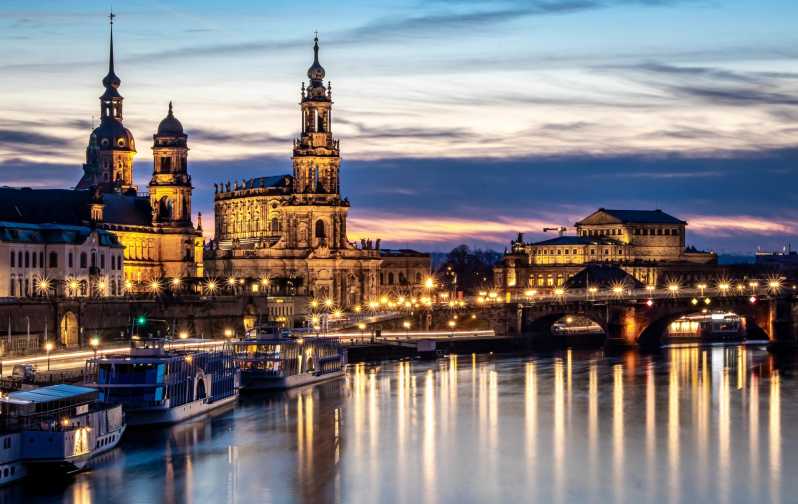
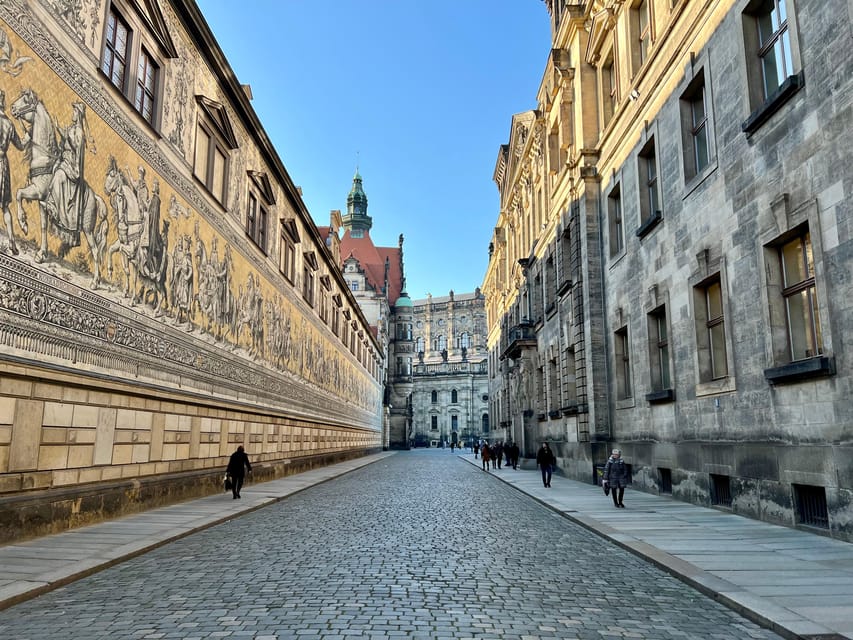
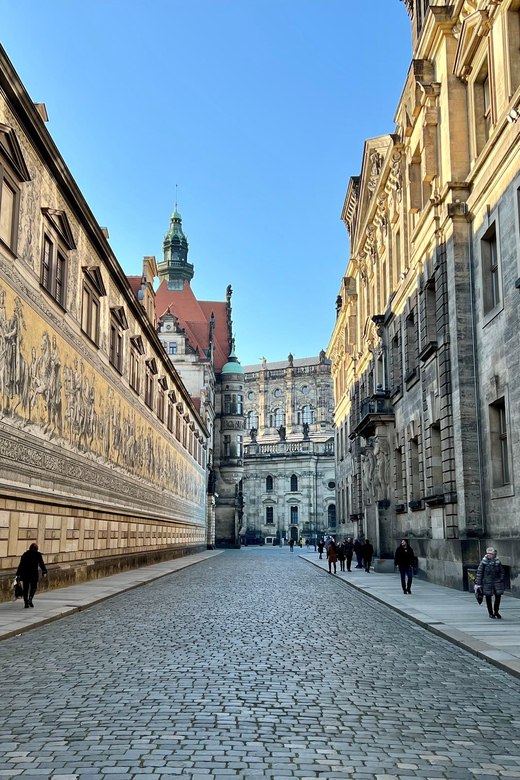
Next up is Fürstenzug, the long, showy procession you’ll see associated with Saxon rulers. It’s described as the gallery of the prince-electors of Saxony—basically a visual list of authority made stone-and-ceramics.
This stop is valuable because it turns a name you might hear in passing into something you can actually see. The tour’s framing helps you understand why these prince-electors mattered: Dresden’s growth wasn’t accidental. It was tied to who ruled, who got elected, and how power expressed itself through major buildings and public status.
You’ll get more than a quick “this is nice” moment. The guide is there to help you read what you’re looking at: the reason the procession exists, what it signals politically, and how it fits into the wider Saxon rise that made Dresden shine in the early 1700s.
One small downside: Fürstenzug is a detail-heavy attraction. If your group is prone to moving fast, you might want to slow yourself down and take a beat. The value of this stop is in the explanation.
Dresden Castle and the Altmarkt–Kreuzkirche axis
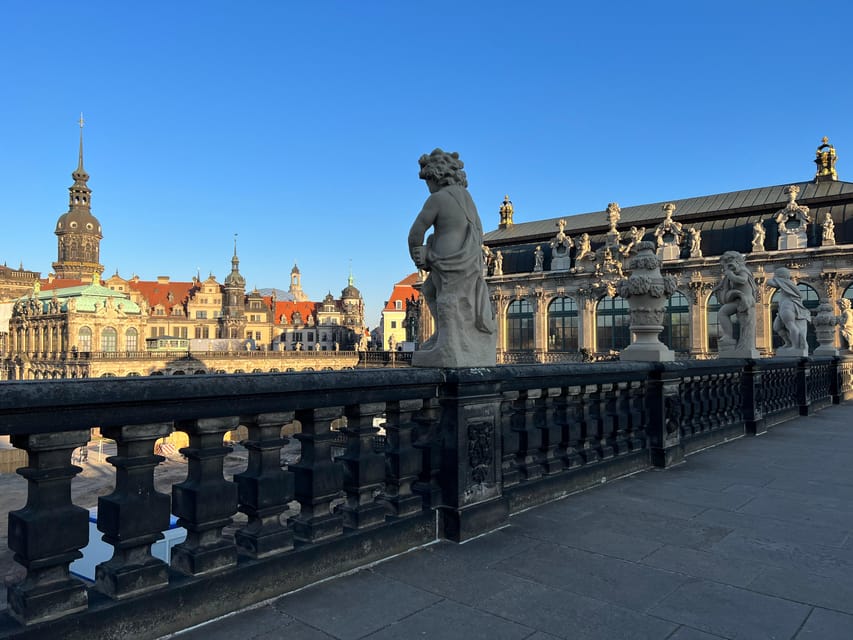
As the tour moves deeper into the center, you’ll hit Dresden Castle, then continue through Altmarkt and Kreuzkirche, with the palace of culture also on the route.
This part of the walk is about understanding how Dresden organizes public space around power and culture. A castle tells you about rule. A major square like Altmarkt tells you where civic life happens. A church such as Kreuzkirche adds another layer—religion and community shaping how people gathered and how the city presented itself.
What I like about this section is the way it helps you stop treating architecture as separate attractions. The guide’s job is to connect the places into a single picture: from medieval origins to baroque staging, then to modern-era interpretation after reconstruction. You start to understand why these buildings are not just pretty. They’re part of how Dresden communicates status and belonging.
If you prefer tours that focus only on the most famous icons, this might feel like the middle becomes a little more “read and understand.” But if you want Dresden to make sense while you’re walking, it’s time well spent.
Brühlsche Terrasse: a riverside viewpoint with a historical job
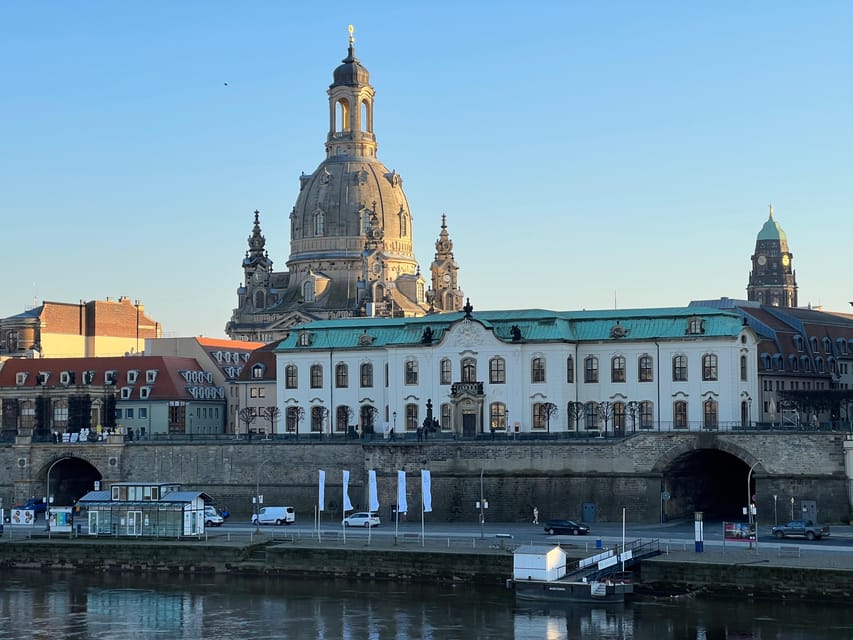
Then you get to Brühlsche Terrasse, a terrace associated with views along the Elbe. This is one of those stops where context improves your experience. The Elbe isn’t just a river on a map. In Dresden, it’s a theme running through the story of exchange: Germanic and Slavic worlds meeting, trading, influencing, and overlapping.
A terrace walk tends to do two things for you. First, it gives your legs a chance to reset. Second, it helps your eyes understand the city’s shape. Standing above or by the river, you can start imagining routes and sightlines that helped define trade and power.
If you’re the type who likes a photo, take it here. If you’re the type who hates photo stops, you can still benefit: the terrace is a natural place to absorb how the city sits next to water and how that location fed its growth.
You can also read our reviews of more guided tours in Dresden


Hofkirche and Semperoper: court culture in plain sight
After the terrace, the tour continues through more baroque-heavy anchors, including Hofkirche and Semperoper.
Hofkirche fits the “court” side of the story—closer to the rulers’ world, tied to the idea of Dresden’s baroque ambition. Semperoper brings you to the cultural side, with an opera house presence that signals Dresden’s self-image as more than a trading town.
Here’s the practical value: these stops help you understand that Dresden’s baroque greatness wasn’t only about grandeur for grandeur’s sake. It was tied to identity-building by the Wettin dynasty and the court world around them. When you see the church and then the opera house in sequence, the city starts to read like a system: power, belief, and culture all reinforce each other.
One note from the tone of feedback: the tour is designed to keep things lively, and many guides are praised for humor when appropriate. That’s useful here, because architectural stops can get dry fast if you’re stuck with dates only. The guide’s job is to keep the meaning moving.
Zwinger Palace near the Elbe bridge: baroque as the grand finale
The walk ends with Zwinger Palace near the Elbe bridge. Zwinger is one of those names you’ve probably heard even if you’re not a baroque superfan. In Dresden, it’s an easy place to understand why the city’s early-1700s growth is often described as near-imperial in feel.
This final stretch matters because it lets you connect what you heard earlier—silver-and-lead prosperity, Wettin power, the prince-electors—back to what you see. Zwinger doesn’t exist in a vacuum. It’s the kind of project that happens when a city has money, status, and a reason to show it.
If you take nothing else from the tour, the ending can give you a clean mental summary: Dresden became important through trade and ruling power, then got flattened in the 20th century, and then got carefully rebuilt so you can still read the baroque “language” today.
Price and value: $35 for a 2.5-hour guide-led orientation
At $35 per person for a 2.5-hour English walking tour, you’re paying mainly for three things: time with an English-speaking guide, a route through key Old Town landmarks, and the storytelling that makes those landmarks make sense.
Transportation is not included, which is normal for a central walking tour. That’s also good for budgeting: you’re not paying for a bus ride you don’t need.
One detail worth understanding: booking is described as joining a general pay-what-you-wish setup, where the amount you pay covers the reservation fee and the guide’s payment. In plain terms, you’re not just buying a product. You’re funding the guide who’s doing the explanation. If you’ve ever been disappointed by tours where you feel like you’re being herded, this structure is designed to keep the focus on the guide’s work.
Is it worth $35? For me, it is when you want more than snapshots. The tour’s big strength is that it treats reconstruction and political history as part of the same narrative. If that’s your kind of travel, you’ll feel the value quickly.
Who should book this tour in Dresden
This tour is a great fit if you:
- want an English guide to connect the city’s layers: Slavic roots, Saxon rise, and reconstruction
- like architecture and want a route that links landmarks instead of listing them
- prefer a walk where humor and small “what to notice” tips keep the pace from feeling like a lecture
- want to feel oriented fast in the Old Town area
It may be less ideal if you:
- need frequent breaks, because the route is built as a continuous walk (and one review specifically wished there had been a toilet stop)
- prefer very structured museum-style pacing with lots of time inside, since this is mainly outdoors on a walking circuit
Should you book this Dresden Old Town walking tour?
If you’re visiting Dresden for the first time, or you’ve been before but want to understand what you’re actually looking at, I’d book it. The tour’s strongest advantage is that it makes the city’s big shifts readable while you’re standing in front of the buildings—especially the contrast between 20th-century devastation and painstaking restoration.
But if you’re traveling with mobility needs beyond wheelchair accessibility, or you really need built-in stops, consider whether a full 2.5 hours of steady walking matches your day.
If you want Dresden to feel like a story you can follow, not just a list of sights, this is the kind of guide-led walk that helps your memory stick.
FAQ
How long is the Dresden Old Town guided walking tour?
The tour lasts 2.5 hours.
Where is the meeting point?
Meet your Walkative guide next to the Martin Luther statue at Neumarkt (next to Frauenkirche). Look for the guide with the yellow umbrella.
Is the tour offered in English?
Yes, the guide leads the walking tour in English.
Is transportation included?
No. Transportation is not included.
Is the tour wheelchair accessible?
Yes, the tour is listed as wheelchair accessible.
Can I cancel for a full refund?
Yes. You can cancel up to 24 hours in advance for a full refund.
What does the price include, especially with pay-what-you-wish?
The tour includes an English-speaking guide and a walking tour. The booking is described as joining a general pay-what-you-wish tour, where the amount you pay covers the reservation fee and the guide’s payment.