REVIEW · ASSISI
Assisi Private Walking Tour including St. Francis Basilica
Book on Viator →Operated by Umbria con Me · Bookable on Viator
Assisi is a pilgrimage town full of corners. This private walking tour keeps it human, with your guide tailoring the pace while you learn how Francis and Clare shaped Assisi’s most important sacred sites. I also like that you skip the map grind and follow the meaning behind each stop, not just the sights. One heads-up: you’ll pay extra for St. Francis basilica entry/headsets, plus a strict dress code applies.
You start in the heart of Assisi near Piazza Santa Chiara and finish by the lower entrance of S. Francesco. It’s offered in English with a mobile ticket, and even though the tour price is per group, it stays private—your guide is fully focused on your people, not a big herd.
One more practical note: Assisi is hilly, and you’ll be walking and stopping in churches where knees and shoulders must be covered. On Sundays and major Catholic/national holidays, guided access inside the Basilica of St. Francis isn’t allowed, so your guide will explain from outside and you’ll go in alone in silence.
In This Review
- Key things worth knowing before you go
- A Private Assisi Walk Focused on Francis and Clare
- Meeting in Piazza Santa Chiara and Ending by Lower S. Francesco
- St. Clare’s Basilica: The Story Starts Here
- Chiesa Nuova: Renaissance Details Built on a Sacred Tradition
- Piazza del Comune: Roman Forum Ground and a Lion Fountain
- Santa Maria sopra Minerva: When a Roman Temple Becomes a Church
- Basilica of St. Francis: What to Expect Inside (and What Costs Extra)
- Access rules you need to plan around
- Private Guide Value: Slower Pace, Better Questions, Real Personal Attention
- Terrain, Dress Code, and Hearing in Quiet Churches
- Price and Timing: Does $278.16 Per Group Make Sense?
- Should You Book This Tour?
- FAQ
- Is this tour private or shared?
- What’s the duration of the experience?
- What language is the tour offered in?
- Do I need tickets for the Basilica of St. Francis?
- Are headsets included?
- What’s the meeting point?
- Are there any restrictions on entering the Basilica of St. Francis?
- What dress code should I follow?
Key things worth knowing before you go
- A private guide, not a group scramble: you can ask questions and change the pace on the spot.
- Francis and Clare, in the right order: the route starts with St. Clare’s world and leads into St. Francis.
- You’ll get architectural context: façades, Roman foundations, and basilica vaults make more sense with a guide.
- Headphones may be worth it: headsets cost extra for St. Francis, and that can matter for hearing details.
- Access can change with the calendar: Sundays/holidays shift how the Basilica of St. Francis is handled.
- Plan for additional entry costs: St. Francis basilica admission is not included.
A Private Assisi Walk Focused on Francis and Clare
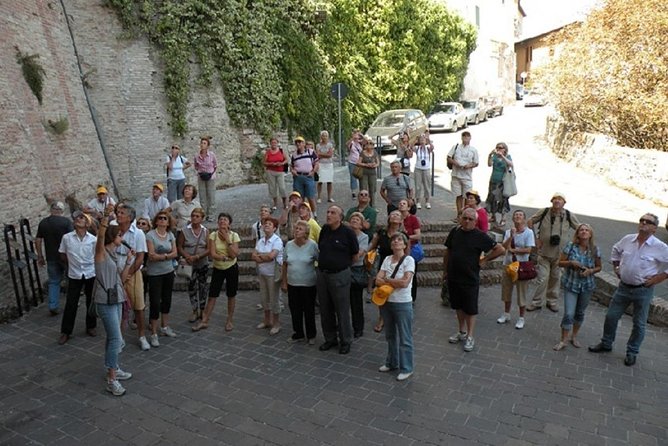
This tour works because it’s not trying to do everything. It focuses on the spiritual and artistic spine of Assisi: St. Clare, then key church-and-square stops, and finally the Basilica of St. Francis and Sacred Convent.
A private setup changes how you experience a place like this. You aren’t racing to beat a line or scanning a screen for the next landmark. You can linger where the details hit—like an unusual façade, a Roman footprint under a later church, or the way the basilica interior is arranged to guide your eyes.
You can also read our reviews of more walking tours in Assisi

Meeting in Piazza Santa Chiara and Ending by Lower S. Francesco
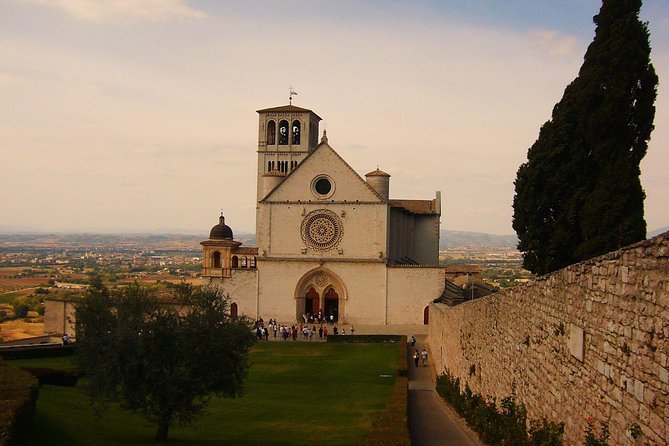
You meet at Piazza Santa Chiara (06081 Assisi) and wrap up near Piazza Inferiore di S. Francesco (2, 06081 Assisi). The start point is central and connected to public transportation, which helps if you’re arriving from another town in Umbria or bouncing between sites.
Because it ends near S. Francesco, this route naturally sets you up to keep exploring on foot after the tour. If you want a final quiet moment in the area, you’re close.
St. Clare’s Basilica: The Story Starts Here
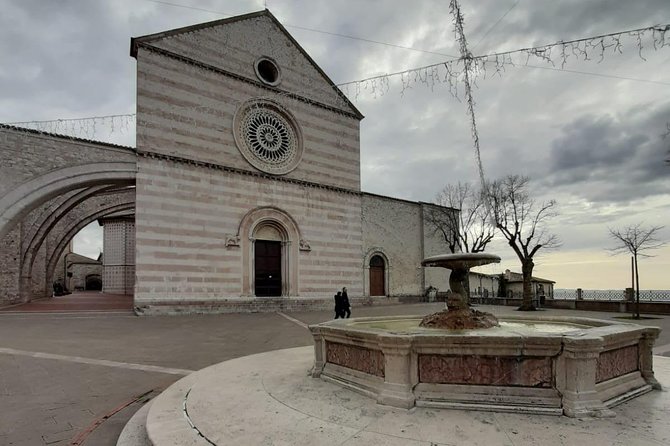
The tour begins at the Basilica of Saint Clare, a church dedicated to and containing the remains of Saint Clare of Assisi. She was a follower of St. Francis and the founder of the Order of Poor Ladies, known today as the Order of Saint Clare.
I like starting here because it anchors the tour in the people who carried Francis’s ideas forward. If you just jump straight to the Basilica of St. Francis, you can miss the larger movement—how devotion spread, how women’s religious life took shape, and how sacred space was built to remember these figures.
Even if you keep your expectations modest, this stop tends to land emotionally. The setting is designed for reverence, and your guide’s job is to point out what you might otherwise overlook—symbols, connections to Francis, and why the church matters beyond being famous.
Chiesa Nuova: Renaissance Details Built on a Sacred Tradition
Next up is Chiesa Nuova, erected in 1615 on the remains of a building believed to be the home of St. Francis. The exterior architecture reflects Renaissance design choices, and it’s worth paying attention even if you only have about 20 minutes.
The façade is brick, divided by four pillars with a Doric entablature and an attic gable. Above it rises a hemispherical dome.
Here’s the practical value: a guide helps you “read” what you’re seeing. Without context, the church can feel like another stop. With context, those classical lines and Renaissance features start telling you how later generations honored an older sacred memory.
Piazza del Comune: Roman Forum Ground and a Lion Fountain
You’ll step into Piazza del Comune, in a place where the ancient Roman Forum once stood. The square is anchored by the imposing Rocca Maggiore, and you’ll notice how the layout links back to the main pedestrian flow of Assisi.
One standout detail is the 16th-century fountain of the three lions, revisited in 1762 by Giovanni Martinucci. In a small town, that kind of specific “who changed what and when” info helps you see the place as layered, not frozen.
This stop is brief—about 10 minutes—so I treat it like a palate cleanser between churches. It’s the spot where you get your bearings and start noticing how Assisi’s religious life and civic history overlap.
Santa Maria sopra Minerva: When a Roman Temple Becomes a Church
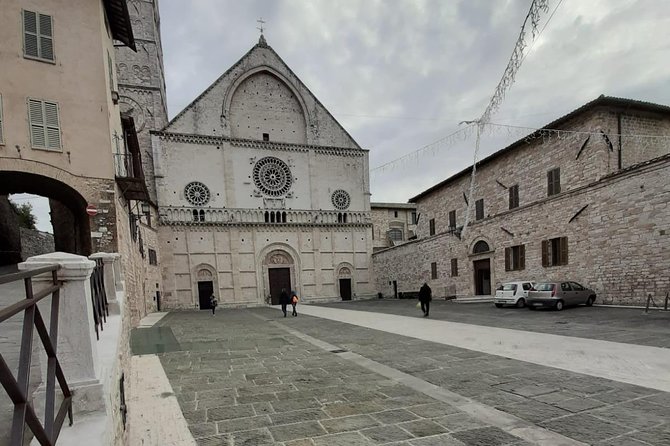
Santa Maria sopra Minerva is special because it’s built on Roman bones. The Temple of Minerva is an ancient Roman structure that now houses the church of Santa Maria sopra Minerva, built in 1539 and renovated in Baroque style in the 17th century.
The original temple dates to the 1st century, built by will of Gnaeus Caesius and Titus Caesius Priscus—two of the city’s quattuorviri who financed the construction.
You’ll have about 30 minutes here, which is enough time to slow down. I’d spend that time noticing the transition: how Roman proportions and location become a foundation for later Christian worship and later artistic changes. This is also a great stop for questions—your guide can explain why Assisi keeps reusing sacred space instead of wiping the slate clean.
Basilica of St. Francis: What to Expect Inside (and What Costs Extra)
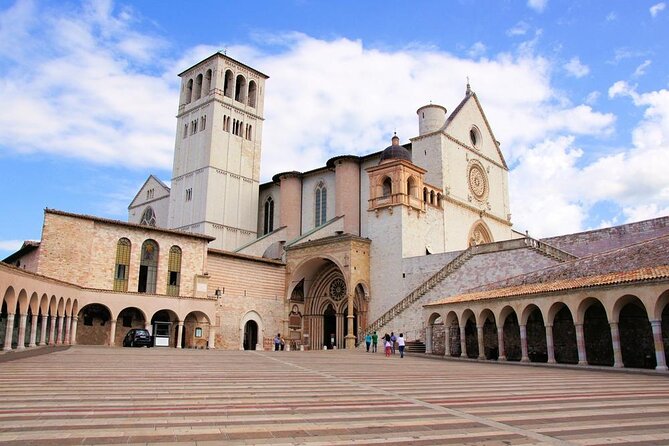
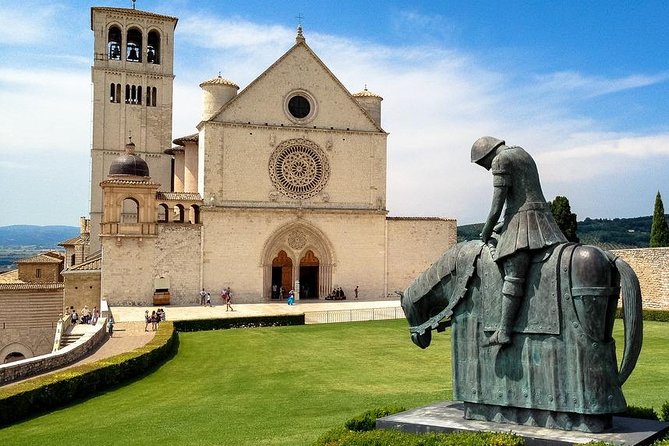
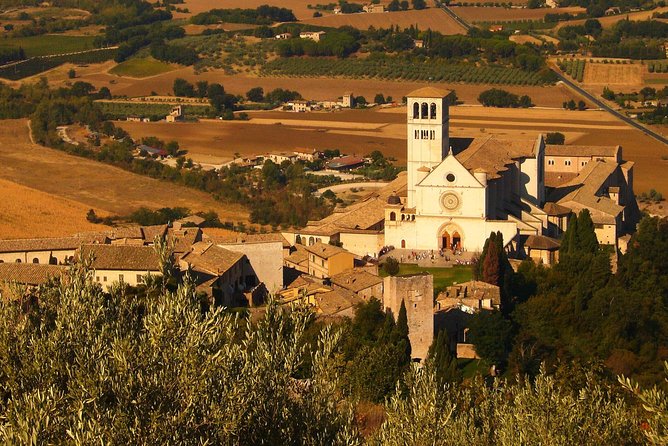
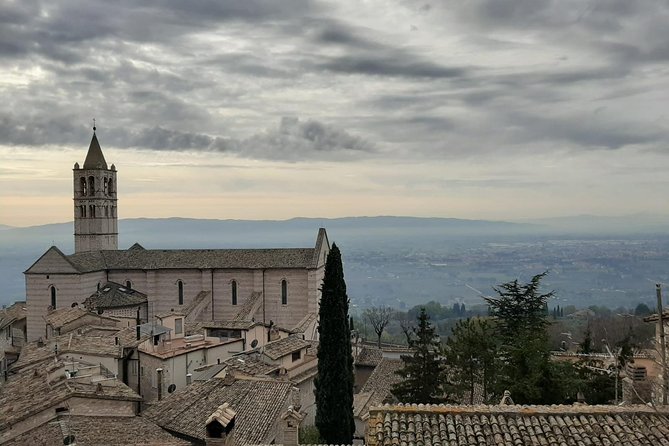
This is the big finale: the Basilica Papale e Sacro Convento di San Francesco d’Assisi, the mother church of the Roman Catholic Order of Friars Minor Conventual in Assisi. Assisi is also where St. Francis was born and died, which is why the site carries such weight for pilgrims.
You’ll spend significant time here—two segments of about 45 minutes each in the plan. The basilica interior is bright and spacious, with a single nave in four bays and a cross-vaulted ceiling. You’ll see patterns of crosses and leaves, a transept, and a polygonal apse. The four ribbed vaults are decorated alternately with golden stars on a blue background and paintings.
Now for the practical part. Admission for the Basilica of St. Francis isn’t included. On top of that, headsets for visiting the basilica are optional but commonly helpful, costing €3.00 per person. If you’re near the back or you know hearing can be tough in large churches, those headsets can be money well spent.
Access rules you need to plan around
Two schedule-based changes are important:
- On Sundays, big Catholic holidays, and national holidays, guided tours inside the Basilica of St. Francis are forbidden. Your guide explains from outside, and you enter alone in silence.
- Due to the public display of the relics, access to the basilica of St. Francis will be suspended from February 15 to April 6, 2026. During that period, your guide provides the explanation from outside.
That might sound like a deal-breaker, but it’s not always bad. If you can’t get inside, you still get the structure of the story, and you’ll likely enjoy the walk even more because you’re not trying to force a visit when the building is operating under restrictions.
Private Guide Value: Slower Pace, Better Questions, Real Personal Attention
This tour’s best selling point is simple: it’s private. That means you can ask things like:
- Why certain artworks and architectural choices matter
- What connections exist between St. Clare and St. Francis
- How Assisi’s civic spaces shape religious life
I’ve found that guides make a huge difference when a place is famous. Assisi can be either inspiring or confusing, depending on whether you understand what you’re looking at. Here, your guide’s job is to turn famous names into specific, grounded details.
The tone varies by guide, but the pattern stays consistent. You might be with someone like Francesca or Michele, who are described as friendly, flexible with preferences, and willing to answer follow-up questions. Another guide, Simone, is noted for patience even when timing goes off. And if your group includes teens, guides such as Werner and Andrea have a knack for pacing the story so it sticks.
You’re also in a better position to add small personal choices. Some guides have gone beyond the main sacred highlights to point out extra meaningful moments and practical places to eat afterward. That matters because Assisi’s best day often comes from smart choices made after you understand what you just saw.
Terrain, Dress Code, and Hearing in Quiet Churches
Let’s be real: Assisi is hilly. Even the best walking tour can feel like a workout if you’re expecting flat strolls. The good news is that the walking is manageable; the hard part is the up-and-down terrain, not the tour itself.
Then there’s the dress code. For places of worship (and selected museums), you need knees and shoulders covered for both men and women. No shorts or sleeveless tops. If you ignore this, entry refusal is possible, which can turn a sacred moment into a logistical hassle.
Finally, plan for hearing. The tour uses a headset option only for the Basilica of St. Francis area. If you prefer to catch every line of explanation, budgeting for the €3.00 per person headset can save frustration.
Price and Timing: Does $278.16 Per Group Make Sense?
The price is $278.16 per group (up to 15 people) for about 2 hours 30 minutes. That pricing structure can be great value if you’re traveling as a family or a small group—because the “private guide” cost spreads across your people rather than per person.
What you do need to factor in:
- St. Francis basilica admission is not included
- Headsets cost €3.00 per person (optional)
- You’ll likely want to leave time for the walking between stops, since Assisi’s pace is slower once you’re in the sites
Timing also matters. This experience is often booked about 60 days in advance. If you’re traveling in peak season, on religious holiday weekends, or you want a specific time of day, earlier planning is smart.
If your plans are flexible, free cancellation up to 24 hours in advance (with full refund) gives you room to adjust without feeling trapped.
Should You Book This Tour?
Book it if you want Assisi to feel meaningful, not just photographed. This private format is ideal when:
- You care about the story of Francis and Clare and want context for the art and architecture
- You’d rather ask questions than wander and guess
- You want a guided pace that works for your group, even if someone needs slower moments
Consider skipping (or doing a self-guided day) if:
- You’re comfortable navigating historic churches on your own and don’t want to pay for interpretation
- You’re cost-sensitive once you add St. Francis entry and optional headsets
- You’re visiting during a window when access to the basilica is restricted and you mainly want interior time
If your goal is a calm, structured walk through Assisi’s most important sacred spaces—where the meaning is explained as you go—this tour is a strong bet.
FAQ
Is this tour private or shared?
It’s private. Only your group participates, and your guide’s attention stays focused on you.
What’s the duration of the experience?
It’s approximately 2 hours 30 minutes.
What language is the tour offered in?
The tour is offered in English.
Do I need tickets for the Basilica of St. Francis?
Yes. Admission for the Basilica Papale e Sacro Convento di San Francesco d’Assisi is not included.
Are headsets included?
No. Headsets for visiting the Basilica of St. Francis cost €3.00 per person.
What’s the meeting point?
You start at Piazza Santa Chiara, 06081 Assisi PG, Italy.
Are there any restrictions on entering the Basilica of St. Francis?
Yes. On Sundays, big Catholic holidays, and national holidays, guided tours inside are forbidden. The guide explains from outside and you enter alone in silence. Also, access is suspended from February 15 to April 6, 2026.
What dress code should I follow?
You need knees and shoulders covered. No shorts or sleeveless tops, and refusing entry is possible if you don’t comply.