REVIEW · TROGIR
Trogir walking tour with a local guide
Book on Viator →Operated by Discovery tours · Bookable on Viator
Trogir moves fast when you have a local guide. In about 1 hour 30 minutes, you connect the city’s biggest landmarks with small, easy-to-miss details, so the town feels less like a checklist and more like a story. I like the way the walk centers on St. Lawrence Cathedral’s sculptural entrances and views, then shifts to everyday civic life in the squares and arcades.
My second favorite part is the small group size (up to 15), which makes it easier to ask questions and actually hear the guide’s explanations. One thing to keep in mind: the time can run a bit short on some days, so don’t build a tight schedule right after.
In This Review
- Key Highlights You’ll Notice Right Away
- Trogir in 90 Minutes: A Smart Shape for First Timers
- Entering Old Town at the North Gate
- Cathedral of St. Lawrence and Radovan’s Portal
- John Paul II Square to Town Hall: Venice in Limestone Form
- Clock Tower, Town Loggia, and Palace Cipiko
- Fishermen’s Church, Kairos, and the Garagnin-Fonfogna Connection
- Riva Promenade to Kamerlengo Castle Sea Finish
- Price, Timing, and Group Size: Is It Good Value?
- Should You Book This Trogir Walking Tour?
- FAQ
- How long is the Trogir walking tour?
- Is the tour offered in English?
- What is the price per person?
- Where does the tour start and end?
- How many people are in the group?
- Do I get a mobile ticket?
- What happens if the weather is poor?
- Is the booking refundable if I cancel?
Key Highlights You’ll Notice Right Away
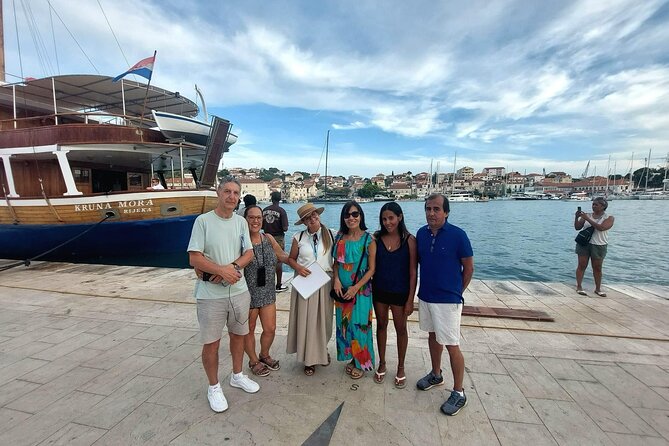
- St. Lawrence Cathedral focus on Romanesque + Gothic features and the bell tower views over Trogir and the Adriatic
- Radovan’s Portal (Master Radovan, 13th century) a standout sculptural entrance detail that many people miss on their own
- John Paul II Square as an open-air lounge with surrounding historic buildings and café life setting the pace
- Civic architecture route including the Town Hall staircase, Town Loggia meeting space, and Venetian-era palace facades
- Sea finish along the Riva promenade plus Kamerlengo Castle for that end-of-walk photo moment
Trogir in 90 Minutes: A Smart Shape for First Timers
If you only have a small slice of time in Trogir, this is the kind of walk that makes your next hour on your own way easier. You start inside the historic core and keep moving through the places that tell you how the city worked: church power up top, then courts, councils, and daily life around the squares and covered loggia.
This also helps with navigation. Trogir Old Town is small, but the lanes can feel like a maze, especially on your first day. A guide gives you quick mental landmarks so you don’t waste time doubling back.
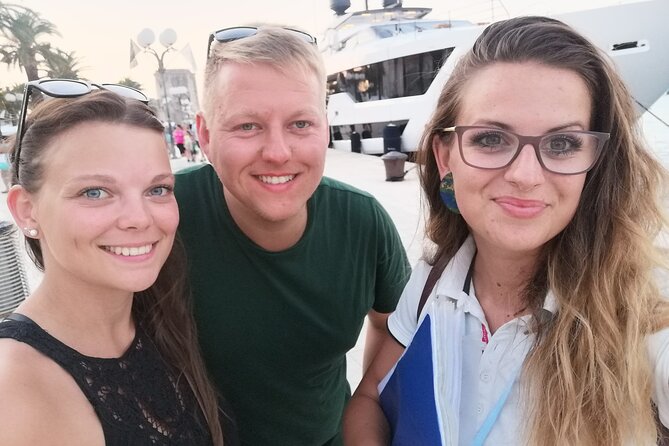
The vibe is calm and focused, not rushed. Guides named in past tours like Daniela and Kristina are praised for blending clear facts with storytelling, including family connections to Trogir.
You can also read our reviews of more walking tours in Trogir

Entering Old Town at the North Gate
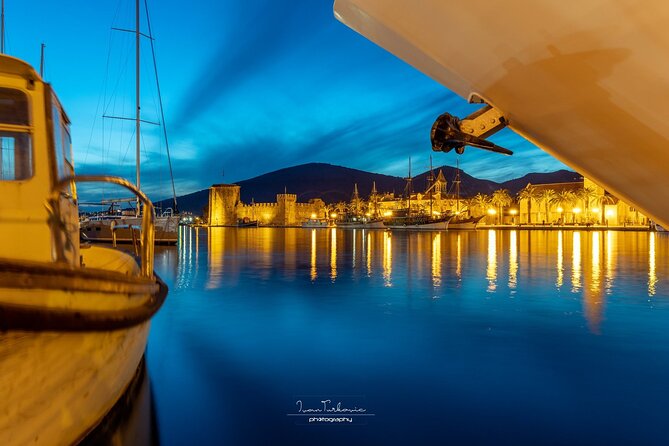
The walk starts at Ul. Gradska vrata 5 and finishes near the waterfront at Obala bana Berislavića. That matters because you end with the sea views instead of stopping abruptly mid-town.
As you step into Old Town through the North Gate, you immediately pass the area tied to the Garagnin-Fonfogna heritage. The route points out a museum housed in palaces that were once owned by the Venetian family of Garagnin-Fonfogna. Even if you don’t go inside, it’s useful context: this town wasn’t only built by locals and emperors, it was also shaped by Venetian power and wealthy families.
Practical tip: since this is a walking tour in a historic core, wear shoes that work on uneven stone. And bring water if you’re visiting during hot weather, because some groups have mentioned it can get intense.
Cathedral of St. Lawrence and Radovan’s Portal
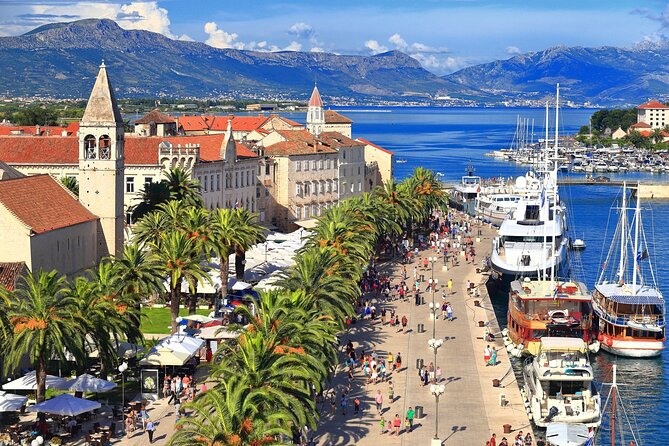
The heart of the tour is the Cathedral of St. Lawrence. Construction began in 1213 and stretched for five centuries, which is why the building reads like a time-lapse in stone. You’ll notice the mix of Romanesque and Gothic traits, plus the cathedral’s three-nave plan.
Then you get to a detail that’s easy to overlook when you’re just passing by: Radovan’s Portal, the main entrance sculpted by Master Radovan, a medieval craftsman from Trogir. This is described as a unique work from the first half of the 13th century. The point for you isn’t academic bragging rights. It’s that the portal is the kind of carving you can stare at for five minutes and suddenly see how the city’s identity was made by hands, not just timelines.
The cathedral complex also includes a bell tower viewpoint. Even if you don’t linger too long, it sets the stage for what you’ll see again later: Trogir, the island of Čiovo, the mainland, and the Adriatic Sea.
John Paul II Square to Town Hall: Venice in Limestone Form

Once you step away from the cathedral area, the walk becomes more about how Trogir lives day-to-day. John Paul II Square (Trg Ivana Pavla II) is often described as one of the most beautiful historic piazzas in the region. The key for your experience is how natural it feels: it’s surrounded by important buildings, and the café tables and umbrellas take over the square like an open-air lounge.
This is where you can slow down. Your guide’s job here is to connect what you’re seeing (architecture and urban layout) to why it’s still used. If you’re someone who likes people-watching with context, this stop hits.
Next comes the Town Hall built in the 15th century. Look for the stone building’s elegant courtyard decorated with coats of arms. Then turn your attention to the outside staircase, one of the most striking examples of Venetian architecture in Trogir. For many visitors, the staircase is the detail that makes the whole building click.
A solid guide will point out how Venetian influence shows up not only in big monuments, but also in civic design—where city leaders looked, walked, and met.
Clock Tower, Town Loggia, and Palace Cipiko
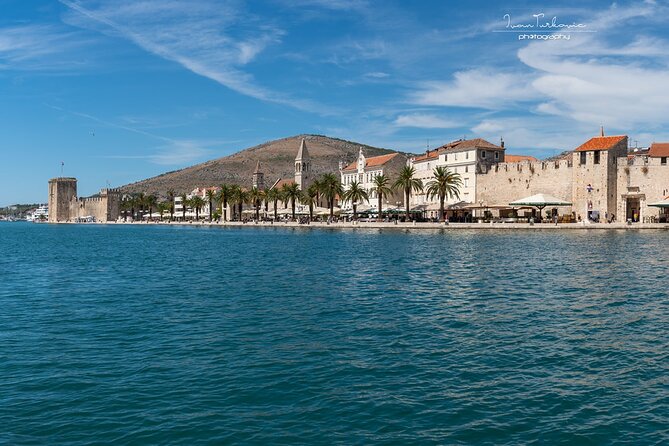
Trogir’s political and social life shows up in a very walkable cluster of landmarks.
St. Sebastian’s Church and Clock Tower enters the story in a meaningful way. The church was built in 1476 by citizens of Trogir grateful to have been delivered from the plague. The architect named here is Niccolò di Giovanni Fiorentino (Nicolas of Florence). Even if you’re not a church architecture person, this stop gives you the emotional reason behind the building: it was gratitude made visible.
Next is the Town Loggia, a covered space dating back to the 13th century. It’s not just a pretty corridor. It’s where citizens used to congregate to discuss the issues of the day. The local court also met there on certain days to proclaim laws and handle court cases. This is a rare chance to connect a physical space to civic routine—how justice and decision-making actually played out in everyday life.
Then you move to Palace Cipiko, also spelled as Great Cipiko Palace in descriptions. It’s composed of Romanesque buildings that later took on a Venetian Renaissance look between the 15th and 17th centuries after extensive remodeling. Niccolò di Giovanni Fiorentino is mentioned again as part of the project, including carving the south portal of the palace.
For you, the takeaway is simple: these stops aren’t random photos. They’re a chain. Church gratitude leads to civic governance, and civic power leads to the architectural statement of elite families.
Fishermen’s Church, Kairos, and the Garagnin-Fonfogna Connection
Not every stop is about government or grand entrances. The tour also threads in the lives of people who worked.
Off the waterfront promenade in the western part of Old Town, you’ll find the Church of Our Lady of Mount Carmel. This church is historically tied to Trogir’s fishermen, craftsmen, and laborers. If you happen to be there on 16th July, there’s a traditional procession in the evening featuring a statue of Our Lady. Even if you’re not traveling during that date, the stop matters because it shifts your perspective from leadership to labor.
The route also includes a bas-relief connected to the figure of Kairos. You’ll see the young man standing on tiptoe, ready to fly away instantly, with arms outstretched and a pair of scales in his hands. The long tuft of hair and the bald crown are part of the symbolism. The message is a practical one: seize the moment before it flies away.
It’s one of those details that makes Old Town feel personal. You don’t just see stone; you hear a thought. For people who like meaningful art instead of just architecture, this is a strong moment.
Riva Promenade to Kamerlengo Castle Sea Finish

As the walk turns toward the end, it shifts from stone and institutions to sea air and open sightlines.
You’ll stroll along the Riva, what locals call Trogir’s palm-fringed promenade. It’s wide, flat, and straight, running right along the water edge. The payoff is the view across the sea channel to Čiovo, which gives you a natural sense of the geography that shapes this town.
The final major stop is Kamerlengo Castle, an early 15th-century fortress at the end of Trogir’s promenade. It sits on the corner of the tiny island that hosts the Old Town. Right nearby you’ll spot a local football pitch, a small playground for kids, and the stalls where tour operators set up.
This end point is smart. It gives you a breather after the denser parts of the Old Town and makes it easy to keep exploring on your own with a clear idea of where the waterline is. It’s also a good place to take photos without trying to wedge into a crowd at every turn.
Price, Timing, and Group Size: Is It Good Value?

At $18.14 per person for about 1 hour 30 minutes, the value here is less about ticking off sites and more about how your time gets translated into understanding.
You’re getting:
- Multiple landmark stops packed into a short route
- English commentary
- A local guide presence that’s repeatedly praised in past outings for calm, easy pacing and for bringing personal context to the history of Trogir and Croatia
That last point is big. Guides named across strong feedback—like Daniela, Kristina, Blanka/Blanca, Christina, Michael, and Michaela—are credited with making the town feel real through stories. One recurring theme is guides sharing family connections and even memories shaped by modern events in the region. That turns a cathedral tour into something that connects past and present.
Now the tradeoff. Some groups have found the walk ended around 60 minutes rather than closer to 1 hour 40. So plan like a local: treat this as a quick tour to get your bearings, not a guarantee to finish at an exact minute. If you’re catching another event right after, leave some buffer.
Also, the tour needs good weather. If conditions are poor, you’ll be offered a different date or a full refund. That’s worth taking seriously in coastal Croatia, where the sky can change fast.
Should You Book This Trogir Walking Tour?
Yes, if your goal is to understand Trogir fast, not just collect photos. This is especially worth it if it’s your first time in the Old Town, or if you want the city’s architecture explained in a way that connects to how people actually lived—cathedral craft, civic meeting spaces, and worker-focused places like the Church of Our Lady of Mount Carmel.
Book it early in your visit. A guide helps you decide what to revisit later, whether that’s the cathedral details, the Venetian staircase angles at the Town Hall, or the sea views that make Kamerlengo Castle feel like an exclamation point.
Skip it only if you hate walking on uneven old streets or if you’re trying to schedule something immediately right after with no time cushion. Otherwise, this is a solid, good-value way to get oriented and leave with Trogir feeling like a place, not a puzzle.
FAQ
How long is the Trogir walking tour?
The tour lasts about 1 hour 30 minutes.
Is the tour offered in English?
Yes, it is offered in English.
What is the price per person?
The price is listed as $18.14 per person.
Where does the tour start and end?
It starts at Ul. Gradska vrata 5, 21220, Trogir, Croatia and ends at Obala bana Berislavića, 21218, Trogir, Croatia.
How many people are in the group?
The tour has a maximum of 15 travelers.
Do I get a mobile ticket?
Yes, you receive a mobile ticket.
What happens if the weather is poor?
This experience requires good weather. If it is canceled due to poor weather, you will be offered a different date or a full refund.
Is the booking refundable if I cancel?
This experience is non-refundable and cannot be changed for any reason.