REVIEW · STRATFORD UPON AVON
Stratford Town Walking Tour 365 Days a Year
Book on Viator →Bookable on Viator
Shakespeare appears in surprising places. This Stratford Town Walk stitches together the big names and the smaller streets you’d miss on your own. It’s a 2-hour on-foot tour with a local guide you can spot in a flash of yellow by the Swan Water Fountain.
I especially love how much ground you cover without feeling rushed. You get a tight route that hits Shakespeare’s Birthplace, New Place, Holy Trinity Church, and the theatre district—plus extra stops like the Gower Memorial, the canal basin, and Rother Market. The guide focus on real connections, from family life to how the Royal Shakespeare Company grew around the theatres.
One thing to consider: most major sites are not included in the price. You’ll want to plan for separate admission at places like Shakespeare’s Birthplace, Hall’s Croft-related interiors, Holy Trinity Church, and other ticketed stops.
In This Review
- Key Points You’ll Actually Care About
- Stratford Town Walking Tour: Why This Route Beats a Quick Self-Guided Stroll
- Starting at the Swan Fountain in Bancroft Gardens (Find Your Yellow Marker)
- Shakespeare’s Birthplace and New Place: The Town’s Two Most Important Bookends
- Hall’s Croft and the Holy Trinity Church: Medicine, Worship, and River Avon Time
- Guild Chapel and Shakespeare’s Schoolroom: Medieval Art and Tudor Education
- Royal Shakespeare Theatre, Swan Theatre, and The Other Place: The Theatre District Story in 15 Minutes
- Town Hall, High Street, Almshouses, and Harvard House: The Town’s Power Moves
- Marie Corelli, the Gower Memorial, the Canal Basin, and Rother Market: Extra Stops That Feel Like Local Life
- What You Pay for: Tour Price vs. Shakespeare House Entry (and the Discount Angle)
- Timing Tips: Morning or Afternoon, Plus How to Fit a Theatre Night
- Group Size and Comfort: What It Feels Like to Walk for Nearly Two Hours
- Names to Watch For: Guides Like John, Georgina, Grace, Josh, and Jane
- Should You Book Stratford Town Walking Tour? My Decision Guide
- FAQ
- How long is the Stratford Town Walking Tour?
- Is the cost the same for adults and kids?
- Are admission tickets to Shakespeare’s houses and churches included?
- Is the tour offered in English?
- Where do I meet the tour guide?
- Can I cancel for a refund?
Key Points You’ll Actually Care About
- Swan Fountain meet-up: Find the guide by the lamppost in Bancroft Gardens on Waterside.
- 2-hour plan, big payoffs: A full loop through key Shakespeare spots plus theatre-area history.
- Ticketed sites cost extra: You get stories and exterior time at many stops, with discounts for Shakespeare’s houses.
- Morning or afternoon options: Helps you build your day around museum hours and showtimes.
- Small-ish group: Maximum 25 travelers, so it doesn’t turn into a moving crowd.
Stratford Town Walking Tour: Why This Route Beats a Quick Self-Guided Stroll
Stratford-upon-Avon can be a lot in one day: theatres, tombs, half-timbered facades, and those “wait, what was here?” side streets. This walking tour is built to solve that problem. You’re not just seeing Shakespeare landmarks—you’re learning how the town’s layout, buildings, and institutions connect to the man and the era people associate with his name.
I like that it keeps the pace practical. At each stop, you get enough time to look closely, then move on before you start repeating yourself. The whole tour runs about 1 hour 45 minutes to 2 hours, which fits nicely if you’re doing a day trip, or if you’re pairing Stratford with a show at the Royal Shakespeare Theatre or the Swan Theatre.
It also helps that the guide isn’t limited to the famous headlines. You’ll be pointed toward features like medieval wall paintings and civic history tied to local buildings, not just photo ops. If you’ve got Shakespeare on your mind, this tour keeps the town itself in focus—where people lived, worked, studied, worshipped, and performed.
You can also read our reviews of more walking tours in Stratford upon Avon


Starting at the Swan Fountain in Bancroft Gardens (Find Your Yellow Marker)
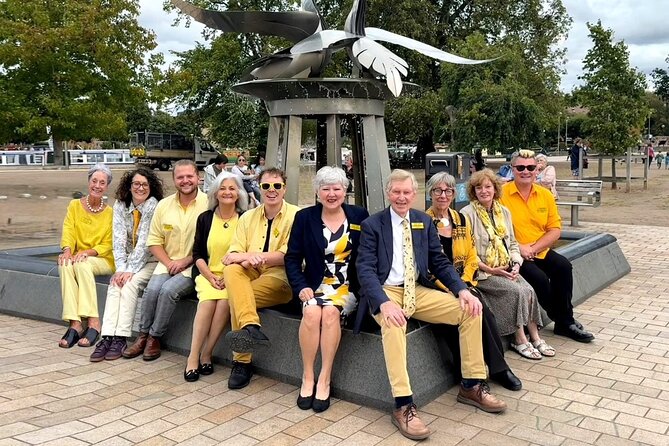
The tour meets at the Swan Water Fountain in Bancroft Gardens on Waterside, at 20 Waterside, Stratford-upon-Avon CV37 6BA. You’ll be looking for the guide by a lamppost with a yellow sign showing the company name, and wearing a flash of yellow.
This sounds small, but it matters. Stratford is easy to wander in, and being off by even ten minutes can waste the best part of your day. The clear meet-up point means you can arrive, orient fast, and get moving.
Also, the area has public conveniences and plenty of cafes nearby. That’s useful because you’ll likely want a coffee or a quick bathroom stop before you start the walk.
Shakespeare’s Birthplace and New Place: The Town’s Two Most Important Bookends
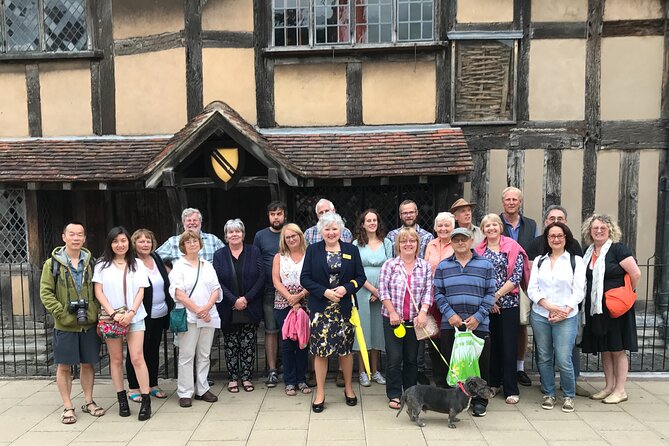
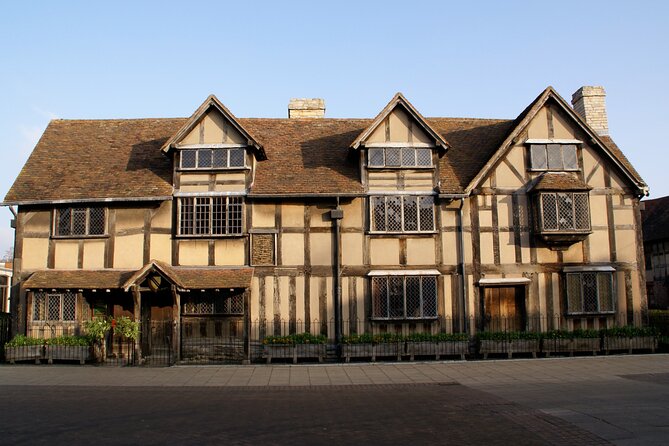
Your first major “big Shakespeare” stop is Shakespeare’s Birthplace, a beautiful 16th-century half-timbered building on Henley Street. This is where John and Mary Shakespeare raised William, and where he was born in 1564. The guide’s job here is to turn the building from a famous object into a real home—talking about family life in Tudor times and John Shakespeare’s glove-making business.
The practical angle: plan to look at the structure closely from the outside during the tour. Entry isn’t included, so you’ll be deciding whether to add admission before or after you walk. Good news: there’s a discount offered to Stratford Town Walk customers if you want to visit Shakespeare’s Birthplace outside the tour time.
From there, you head to Shakespeare’s New Place. Shakespeare bought it in his early thirties, lived there with his family, and stayed until he died at age 52. Today you stand outside the gates and imagine what would have felt enormous in a town like Stratford. A key story point is why it was demolished in 1759—a detail that makes you think about how the town changed after Shakespeare’s lifetime, and how memory survives even when buildings don’t.
If you like history that explains not just what existed, but why it vanished, these two stops are a great pair.
Hall’s Croft and the Holy Trinity Church: Medicine, Worship, and River Avon Time
Next up is Hall’s Croft, the home of John Hall, who married William Shakespeare’s eldest daughter Susanna. The building is Jacobean, so it feels like a different architectural chapter than the half-timbered look of the Birthplace. During the tour you’ll hear stories tied to medieval medical cures—an unusual angle that helps you see Shakespeare’s family network as something practical, not just literary.
Then comes Holy Trinity Church, on the banks of the River Avon. It’s among England’s most visited parish churches, and it’s where Shakespeare was baptized, worshipped, and later buried in the chancel. Approaching along an avenue of lime trees gives you an old-English processional moment—walking toward something that feels ceremonial even before you reach the door.
This stop is another exterior-focused moment, since entry isn’t included. But the payoff is the church’s role in a full life cycle: birth, faith, and burial in one place. That structure of a story—beginning to end—tends to stick in your mind more than a list of dates.
Guild Chapel and Shakespeare’s Schoolroom: Medieval Art and Tudor Education
If you want one of the tour’s most “wait, that’s still there?” experiences, it’s the Guild Chapel. Dating back to 1269, it was home to the Guild of the Holy Cross, a major social and religious organization. The key detail: the chapel holds one of the rarest series of medieval wall paintings in Europe.
You’ll see the building as a physical artifact of a time when guilds shaped daily life. The story doesn’t feel stuck in the past either, because the guide ties these institutions back to community rhythms—who had power, where art survived, and what people gathered to celebrate.
A short walk later, you reach Shakespeare’s Schoolroom & Guildhall. The schoolroom is a half-timbered building dating to the 1400s. It’s linked to Shakespeare’s education and inspiration, known at the time as the King’s New School (now King Edward VI Grammar School, or K.E.S). Underneath is the Guildhall, which served as Stratford’s civic center for over 400 years.
There’s a lot packed into that one area: education above, town governance below. Even if you’re not a “school history” person, it helps you understand Stratford as a place where learning and civic life overlapped.
Royal Shakespeare Theatre, Swan Theatre, and The Other Place: The Theatre District Story in 15 Minutes

This is the part of the walk that makes it feel like more than a museum tour. You’re guided through the layers of Stratford’s modern theatre world: how buildings were replaced, repurposed, and funded.
You’ll start with the Royal Shakespeare Theatre. It dates to 1932 and was designed by British architect Elisabeth Scott, after a competition. It replaced the 1879 Shakespeare Memorial Theatre, which burned in 1926. Today it’s home to the Royal Shakespeare Company, performing Shakespeare’s plays for visitors from around the world.
Next, you move to the Swan Theatre. The Swan stands on the site of the 1879 theatre again. Fire destroyed most of it in 1926, but the library and art gallery survived. In 1986, the Swan opened within the original red-brick gothic facade, thanks to fundraising and benefactors. If you like architecture that tells a story through scars and survival, this stop is a winner.
Then there’s The Other Place. In the 1970s it was a rehearsal and studio space in a corrugated tin shed for new and experimental theatre. It reopened in 2006 as the Courtyard Theatre, seating 1000 during the temporary period of transforming the RST and Swan. Now it’s a flexible 200-seat space with rehearsal rooms and costume storage.
This cluster of stops gives you a “theatres have biographies” feeling. It also helps if you plan to attend a performance: you’ll understand what you’re looking at, not just where to buy a ticket.
Town Hall, High Street, Almshouses, and Harvard House: The Town’s Power Moves
Not every Stratford landmark is about Shakespeare directly. Some places are about how Stratford ran itself before it became a tourist magnet.
The tour takes you by Town Hall Stratford upon Avon, a Grade II listed building from the mid 1700s. It stands on the site of a Market House that, during the English Civil War, was used as a munitions store. A gunpowder explosion damaged the building badly, and the current structure was completed in 1767, officially opened in 1769 by actor David Garrick. There’s also a Shakespeare statue in a niche on the front of the building, presented by Garrick during the Shakespeare Jubilee.
Then you walk through High Street. In the 1400s, a High Cross stood at the junction of High Street and Bridge Street to mark the market location. Near the corner of High Street and Bridge Street is a small building sometimes called The Cage, with the town jail beneath. The guide also points out the personal side of history here: it was connected to Shakespeare’s youngest daughter, Judith, and her husband Thomas Quiney, a vintner.
You’ll also see the Almshouses, also called the Guild Cottages, built by the Guild of the Holy Cross in the 1500s for aged and infirm members. The Municipal Charities of Stratford-upon-Avon manage these properties now. It’s a reminder that “history” isn’t only kings, churches, and playwrights—it’s care for everyday people.
Finally, there’s Harvard House, built in 1596 by Thomas Rogers. The facade is elaborately carved and among the richest in town, reflecting Rogers’s wealth and standing. The guide ties the name to family connections: Rogers’s daughter Katherine married into the Harvard family, and their son, John Harvard, emigrated to America and established the library around which Harvard University was built.
If you like when a local story turns into an international one, this is your moment.
Marie Corelli, the Gower Memorial, the Canal Basin, and Rother Market: Extra Stops That Feel Like Local Life
After the Shakespeare core, the tour adds a few short stops that make Stratford feel less like a themed park and more like a real town.
You’ll hear about the home of Marie Corelli, the Victorian novelist known as Shakespeare’s Champion, who lived in Stratford and was involved with conservation. It’s a reminder that literature didn’t stop with Shakespeare, and that Stratford’s literary draw kept growing.
You’ll also see the Gower Memorial, created in 1888 by Lord Ronald Gower. It sits alongside the main road into town near Clopton Bridge, with the Royal Shakespeare Theatre visible behind. From Bancroft Gardens, you can see it too. The memorial features Shakespeare plus characters like Hamlet, Prince Hal, Lady Macbeth, and Falstaff.
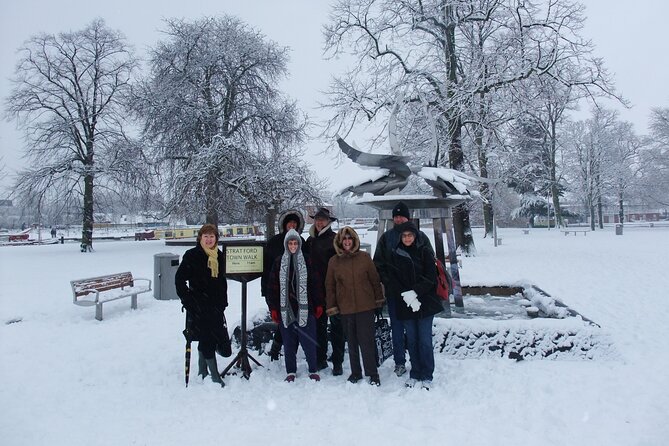
Another distinctive look is the Birmingham to Stratford Canal, opened in 1816. Back then it moved goods like coal and wood. Today it’s mostly used for leisure boating. The canal terminates in a basin where a lock can be operated to access the River Avon, which gives the area a working-water feel even if it’s now recreational.
And if you want a sense of Stratford’s everyday rhythm, you’ll pass by Rother Market, where the weekly market is held on Fridays and Saturdays.
These stops are short, but they add texture. They answer the question: what’s around Shakespeare, day to day?
What You Pay for: Tour Price vs. Shakespeare House Entry (and the Discount Angle)
The tour costs $16.67 per person, and it’s about 1 hour 45 minutes to 2 hours. That’s not a “museum pass” price—it’s a guided storytelling price. You’re paying for a local tour guide and a route that makes sense on foot through key sites.
Most entries are separate. The tour lists Shakespeare’s Birthplace as not included, plus Shakespeare’s New Place, Hall’s Croft, Holy Trinity Church, and several other stops as admission not included.
Still, it’s not a bad deal if you plan ahead. If you want to visit Shakespeare’s Birthplace as part of your day, you’ll get a discount offered to Stratford Town Walk customers when you visit outside the tour. So you may not need to buy tickets at full price.
My advice: decide early what you truly want to go inside. If your priority is walking and viewing exteriors with expert context, you can keep additional costs light. If you want the full house experience at several sites, pencil in extra admission time for after the tour.
Timing Tips: Morning or Afternoon, Plus How to Fit a Theatre Night
You get a choice of morning or afternoon tours. That matters in Stratford, because opening hours and showtimes can drive your schedule.
If you’re planning to see something at the Royal Shakespeare Theatre or the Swan Theatre, consider taking the walking tour earlier in the day. You’ll end up with a better sense of where things are, and you’ll understand the theatre buildings’ backstories while you’re still fresh from hearing the guided explanations.
If you’re doing this as a day trip, the 2-hour duration is a friendly anchor. I’d plan around it instead of trying to cram it between meals and shopping. A guided walk works best when you can linger a little at the stops you care about, then move on.
Group Size and Comfort: What It Feels Like to Walk for Nearly Two Hours
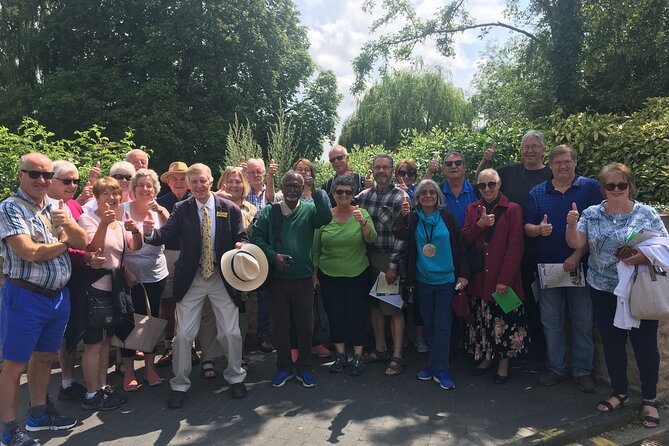
This is a small-group format with a maximum of 25 travelers. That’s enough people to feel lively, but small enough that the guide can keep the group together and explain at each stop without turning it into a lecture broadcast.
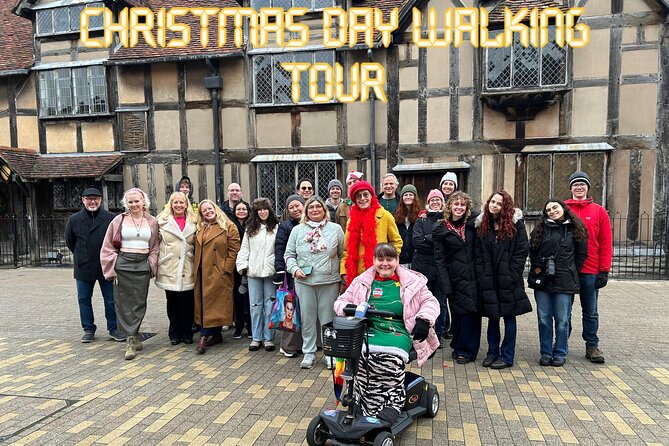
That said, it’s still a walking tour. The tour notes it’s not recommended if you have difficulty standing or walking. Service animals are allowed, and disabled parking bays are nearby, but the core experience is built around walking through town.
Wear shoes you trust. Stratford streets can be uneven, and you’ll want a comfortable stance for multiple exterior stops.
Names to Watch For: Guides Like John, Georgina, Grace, Josh, and Jane
One of the best signs here is the consistency of storytelling you get from different guides. I’ve seen guides such as John, Georgina, Grace, Josh, and Jane leading the tour, and the common theme is entertainment plus history tied to what you’re seeing.
If you care about how facts become a story, you’ll probably appreciate that style. And if it rains, you’ll likely still want to go—just bring a jacket you can move in.
Should You Book Stratford Town Walking Tour? My Decision Guide
Book it if you want a tight, walkable way to connect Shakespeare sites to real Stratford places—especially if you also care about the theatre story. At $16.67, the value is strong when you compare it to paying for multiple standalone audio guides or trying to map the town yourself.
Skip it or keep expectations flexible if your goal is mostly indoor visits. Since admission to key attractions like Shakespeare’s Birthplace and Holy Trinity Church isn’t included, you’ll still need to plan entry tickets separately.
Best fit:
- Shakespeare fans who want more than just photos
- Theatre lovers who are visiting the Royal Shakespeare Theatre area
- First-timers who want a smart route that hits both the famous landmarks and extra local stops
If that sounds like you, this is an easy yes.
FAQ
How long is the Stratford Town Walking Tour?
It runs about 1 hour 45 minutes to 2 hours.
Is the cost the same for adults and kids?
The provided price is listed per person at $16.67. No separate pricing info is included in the details you gave.
Are admission tickets to Shakespeare’s houses and churches included?
No. Entry to places such as Shakespeare’s Birthplace, Shakespeare’s New Place, Hall’s Croft, Holy Trinity Church, and other attractions is not included.
Is the tour offered in English?
Yes, the tour is offered in English.
Where do I meet the tour guide?
Meet at the Swan Water Fountain, 20 Waterside, Stratford-upon-Avon CV37 6BA, UK. Look for the guide by the lamppost with a yellow sign.
Can I cancel for a refund?
Yes. You can cancel up to 24 hours in advance for a full refund, and you’ll receive confirmation at booking time.