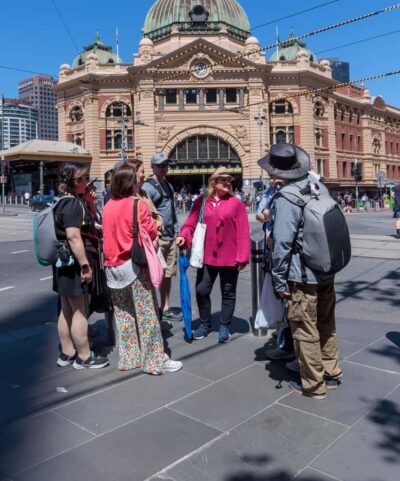
Mother Glasgow has a loud fan. This 3-hour Glasgow walking tour turns central streets into stories, with Johnny guiding you through landmarks and local quirks, all under the big personality of Mother Glasgow.
I especially love the small-group feel (max 15), which keeps the pace human and the questions flowing.
You also get real character, not just dates. Johnny’s style is full of props, photos to pass around, and even little extras like a chance to try Irn Bru, which makes the walk stick in your memory.
The one drawback is simple: you’ll be outdoors for much of the tour, so comfy shoes and weather prep matter, especially on cold or rainy days.
In This Review
- Key highlights to look for
- A 3-hour central Glasgow walk with Johnny’s Mother Glasgow thread
- Where you start at Royal Exchange Square (and why that matters)
- The small-group limit (max 15) makes the stories easier to follow
- Duke of Wellington Statue: cones, comedy, and a tradition you’ll remember
- George Square and Glasgow City Chambers, plus that rooftop ship
- Georgian Glasgow and a club with pig-like gluttony
- Mother Glasgow at work: decline, renaissance, and long impact
- Trongate: Tron Kirk steeple area and an entertainment venue with character
- Tolbooth Steeple and Glasgow Cross: where the city’s epicentre lives
- St Mungo street art and the Provand’s Lordship area
- Glasgow Cathedral and the Necropolis backdrop
- The after-walk payoff: local advice that saves you time
- Should you book the Glasgow Gander walking tour?
- FAQ
- How long is the Glasgow Gander walking tour?
- What is the price per person?
- What time does the tour start?
- Where do I meet the tour?
- Where does the tour end?
- Is the tour offered in English?
- How big is the group?
- Do I need a printed ticket?
- Are service animals allowed?
- Is there free cancellation?
Key highlights to look for
- Small-group cap of 15 keeps the experience personal and easy to hear
- Johnny’s storytelling connects buildings to everyday Glasgow life
- The Mother Glasgow focus gives you a single thread tying the city together
- Quirky details at key stops like the cone-wearing Duke of Wellington tradition
- A practical finish with recommendations to guide your next days
A 3-hour central Glasgow walk with Johnny’s Mother Glasgow thread
If you want Glasgow to make sense fast, this is a good way to do it. The whole tour is built around a guiding idea: the city has a personality, and the guide calls it Mother Glasgow. You’ll see civic buildings, steeples, and street art, but the point is how all of it links to Glasgow’s rise, industry, and ongoing impact.
I like that you’re not stuck in a single lane of history. You get architecture moments, quirky local customs, and industrial-era stories, all stitched together by Johnny’s calm control of the route and the tempo. Reviews call his energy infectious, but what matters to you as a visitor is that the walk doesn’t feel like a lecture.
This is also a very do-able length. About 3 hours is long enough to learn the city, but short enough to still have energy for dinner, a pub crawl, or a second explore session.
You can also read our reviews of more walking tours in Glasgow


Where you start at Royal Exchange Square (and why that matters)
The meeting point is 8-10 Royal Exchange Square, Glasgow G1 3AB. The tour starts at 10:30 am, and it ends around Glasgow Cathedral on Castle St (you’ll be inside the cathedral on the north-west side of the city centre area as listed, with the final portion adjusted if conditions restrict group size or mask-wearing).
Starting in this part of the city helps you get your bearings. You’re not starting out on the far edges and then sprinting toward the highlights. It’s a classic city-centre loop style, which works well if you only have one or two days in town.
Another practical plus: the tour offers a mobile ticket, and service animals are allowed. If you’re using public transport, the meeting area is also listed as near public transportation.
The small-group limit (max 15) makes the stories easier to follow
This is a real difference-maker. A maximum of 15 travelers keeps the group tight enough for you to actually hear the guide at each stop. It also means Johnny can slow down when someone is interested in a detail, instead of rushing everyone through like an assembly line.
One review mentioned a small group of 9, which is exactly the kind of size that feels personal. When you’re in that size range, you can ask follow-ups and get answers that fit what you care about.
It also helps with the practical “don’t block the locals” aspect. Johnny is said to scout the areas before going inside so you’re not piling into businesses or causing trouble at stops. That’s the kind of courtesy that makes your walking tour feel like it belongs to the neighborhood, not a disruption.
Duke of Wellington Statue: cones, comedy, and a tradition you’ll remember
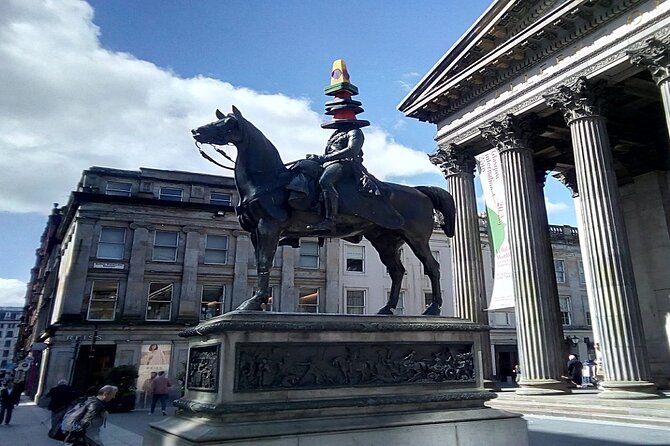
Early on, you’ll reach the Duke of Wellington Statue. The highlight here isn’t the stone itself—it’s the story behind a tradition linked to the modern city, told at the expense of Wellington.
You’ll hear about the original cone-wearing commander and why that look became part of Glasgow’s humor. This is the kind of stop that works even if you’re not obsessed with statues. It gives you a quick Glasgow lesson: the city likes a twist, and it often turns old power figures into jokes.
If you’re the type who takes a “tour for bearings” approach, this is a great opener. It tells you how the guide thinks—humor, place, and meaning all together.
George Square and Glasgow City Chambers, plus that rooftop ship
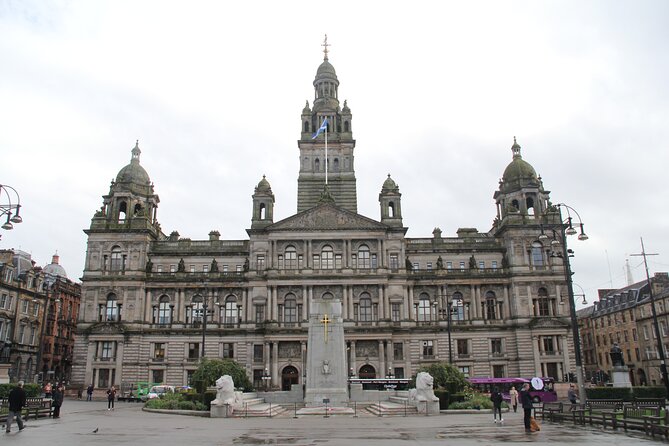
Next comes George Square, the symbolic heart of Glasgow. You’ll be guided around this area while keeping an eye out for an odd feature: an unpredictable rooftop ship.
George Square is also where you’ll see Glasgow City Chambers, described as one of northern Europe’s finest civic buildings. That wording matters because it hints at what you’ll notice: this isn’t just a pretty facade. It’s a major civic statement, and the tour frames it as part of Glasgow’s identity—what the city wanted to show the world about itself.
A tip for you: at stops like this, take a minute to look up and scan details before the guide moves on. The ship moment works best when you’re not rushing your eyes.


Georgian Glasgow and a club with pig-like gluttony
There’s a mid-route stop focused on an often-overlooked side of town: a slice of Georgian Glasgow. You’ll also hear about a club where pig-like gluttony was encouraged.
I like this kind of storytelling because it’s not trying to be polite or purely academic. It gives you a glimpse of how social life worked, including the strange extremes people embraced. It’s memorable because it’s weird, and it’s useful because it reminds you that history includes manners, habits, and social rules—not just wars and buildings.
If you prefer tours that only do the famous monuments, this stop may feel like a palate cleanser. If you like the human side of history, it’s exactly the sort of detail that makes Glasgow feel alive.
Mother Glasgow at work: decline, renaissance, and long impact
After the Georgian moments, the tour shifts into one of its core themes: Mother Glasgow as a powerhouse. You’ll stand in the shadow of a striking city-centre building and hear an unflinching story of Glasgow’s growth as a commercial and then industrial city—followed by decline, then a renaissance.
What I appreciate here is that it doesn’t treat the story as one straight line upward. You get the idea of industrial power, then consequences, then renewal. That matters because it helps you read Glasgow with your eyes open even after the tour ends.
You also get the sense of why the name Mother Glasgow is more than a nickname. The guide uses it as the thread connecting earlier civic pride, later industrial change, and how the city continues to shape the world today.
If you want Glasgow to feel understandable rather than just impressive, this is the section that does the heavy lifting.
Trongate: Tron Kirk steeple area and an entertainment venue with character

You’ll continue to Trongate, an ancient thoroughfare near the 16th-century Tron Kirk steeple. Here the story turns to entertainment—specifically, an incredible hidden venue described in glorious grottiness.
You’ll hear about what was hidden, how it worked, and why it mattered in the life of the street. This kind of stop is valuable because it changes how you look at the city. A random-looking street starts to feel like a stage, with layers of activity stacked over time.
Practical advice: if you’re photographing, don’t focus only on the steeple. The tour’s point is often the street-level story, the little gaps and entrances you would normally walk right past.
Tolbooth Steeple and Glasgow Cross: where the city’s epicentre lives
Next is Tolbooth Steeple, where the guide brings you to Glasgow Cross and the epicentre of Old Glasgow. You’ll be standing at a major junction area described as where the Trongate, the Saltmarket, London Road, the Gallowgate, and the High Street meet.
From here, the city’s geometry matters. This is the kind of location where stories about trade, movement, and power make immediate sense because you can see the street plan. If you like tours that explain why a city grew where it did, this is one of the stronger stops.
Also, steeples and civic spires are a perfect height cue. As the tour moves, you get constant orientation, which makes the whole walk feel easier to follow.
St Mungo street art and the Provand’s Lordship area
At St. Mungo at High Street, you’ll see one of Glasgow’s most famous sons hiding in plain sight: a standout piece of street art. This isn’t just “look at art.” It’s tied to identity, and it’s timed to keep the tour from turning into only stone-and-steeple facts.
Then you’ll move across from Provand’s Lordship, the city’s oldest house listed here. From that area, you’ll take in four special buildings, including a small blue one sometimes used for inter-dimensional travel.
That last detail is pure Glasgow humor, and I love it for one reason: it stops the tour from feeling too serious. It also makes the city’s quirks feel intentional, like you’re being taught how to see Glasgow, not just what to see.
Glasgow Cathedral and the Necropolis backdrop
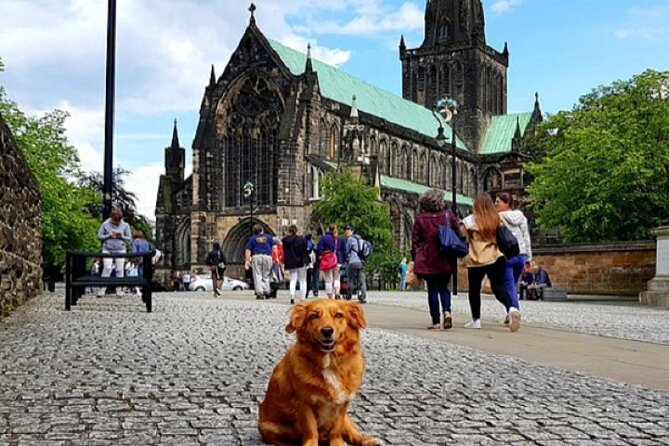
The tour ends at Glasgow Cathedral, described as the architectural pinnacle, a medieval Scottish Gothic cathedral. Behind it is the Necropolis, framed here as Victorian Glasgow’s city of the dead.
If you only know Glasgow through photos, this is the kind of finish that can change your mental image. You get the cathedral as the focal point, and then you get the cemetery backdrop that gives the whole area a dramatic sense of time.
One practical note: depending on conditions around group size and mask-wearing, the tour may finish outside the cathedral rather than inside. Either way, you’re ending with one of the city-centre’s most visually strong moments.
The after-walk payoff: local advice that saves you time
A walking tour is only half the job. The other half is what it gives you for day two, day three, and beyond.
Johnny sends recommendations at the end, including things to do and places to eat and drink. Multiple reviews emphasize that the list is extensive and practical, which is exactly what you want when you’re trying to decide between museums, neighborhoods, and pubs.
I also like that the tour includes little tangible extras: props and photos, plus a chance to try Irn Bru for some groups. It gives your brain a few hooks to hang onto while you’re walking, and that makes it easier to remember the city later.
Should you book the Glasgow Gander walking tour?
Book it if you want a fast, fun way to understand central Glasgow. The best reasons are the small-group size, Johnny’s storytelling style, and the Mother Glasgow thread that connects civic buildings, industrial change, and street-level character.
Skip it only if you dislike walking in all kinds of weather or you already feel fully oriented and just want one very specific museum or attraction. This tour is about breadth and bearings, not about sitting down for long indoor time.
If you can spare about 3 hours at 10:30 am, bring comfy walking shoes, and come ready to notice details (look up, look for odd corners, keep an eye on steeples), you’ll leave with a Glasgow you can actually navigate.
FAQ
How long is the Glasgow Gander walking tour?
The tour is about 3 hours.
What is the price per person?
The price is listed as $16.64 per person.
What time does the tour start?
The start time is 10:30 am.
Where do I meet the tour?
You meet at 8-10 Royal Exchange Square, Glasgow G1 3AB, UK.
Where does the tour end?
The end point is Glasgow Cathedral, Castle St, Glasgow G4 0QZ, UK.
Is the tour offered in English?
Yes, it is offered in English.
How big is the group?
The maximum group size is 15 travelers.
Do I need a printed ticket?
No. A mobile ticket is offered.
Are service animals allowed?
Yes, service animals are allowed.
Is there free cancellation?
Free cancellation is available. You can cancel up to 24 hours in advance for a full refund.